
Introduction
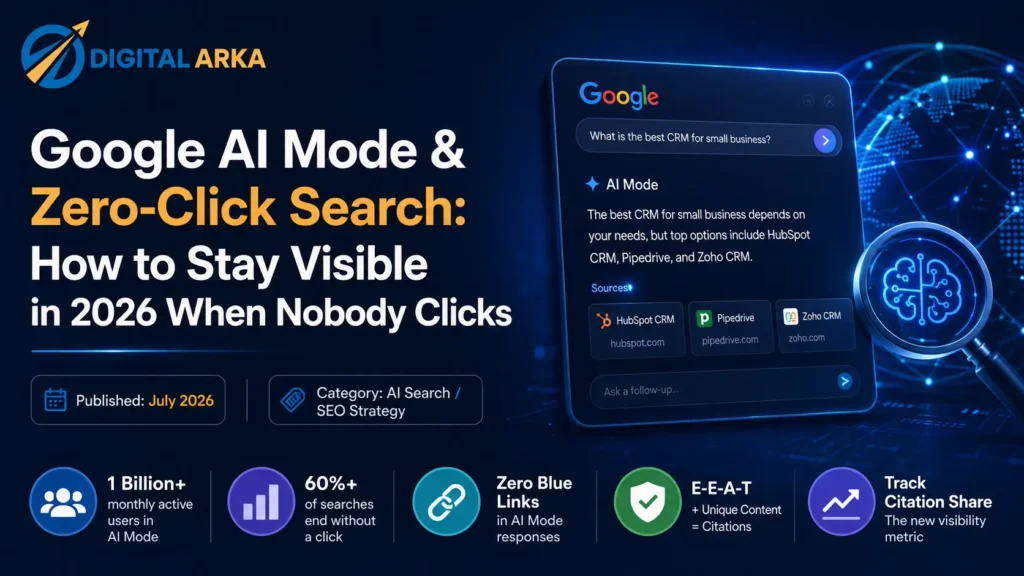
On 19 May 2026, at Google I/O, Liz Reid confirmed what SEOs had been quietly dreading: AI Mode had crossed one billion monthly active users, and queries inside it were doubling every quarter. For the first time in the history of search, the dominant search experience returns zero blue links. Users ask, Google synthesises, and the answer appears — complete, sourced, and utterly final.
If your strategy still depends entirely on click-through rates from organic rankings, you are optimising for a surface that is shrinking. This guide explains what Google AI Mode actually is, how it selects sources to cite, and exactly what you need to do to earn visibility inside it — even when nobody ever clicks through to your website.
What Is Google AI Mode?
Google AI Mode is a dedicated conversational search experience powered by Gemini 3.5 Flash (as of May 2026). Unlike AI Overviews, which appear above traditional search results, AI Mode replaces the SERP entirely with a conversational interface. Users can ask follow-up questions, upload images, and receive synthesised multi-source answers without ever seeing blue links.
Key facts as of July 2026:
- Over 1 billion monthly active users worldwide (Google I/O 2026, confirmed by Liz Reid, VP Search)
- Queries inside AI Mode are doubling every quarter since launch
- Powered by Gemini 3.5 Flash — 4x faster than previous frontier models on output tokens per second
- Available in 180+ countries with Personal Intelligence integration across Gmail and Calendar
- Zero organic blue links shown inside AI Mode responses — citation is the only visibility mechanism
Why Zero-Click Search Changes Everything
Traditional SEO was built around one assumption: users click links. Keyword ranking was the metric because clicks were the currency. That model is breaking. According to research from mid-2025, over 60% of all Google searches were already ending without a click. With AI Mode now handling billions of queries monthly, that number is accelerating rapidly.
Ahrefs benchmark data shows that when AI Overviews appear on a SERP, position-1 organic CTR drops by approximately 34.5%. A Pew Research study of 68,000 queries found users clicked results only 8% of the time with AI summaries displayed, versus 15% without — a 47% relative decline in click behaviour.
This shift means two critical things for SEO professionals. First, rankings alone are no longer a reliable proxy for business impact. Second, citation share inside AI responses is now the primary visibility metric — and it is fully measurable through Google Search Console, GA4 AI referral channel groups (added natively in the May 2026 update), and third-party AI visibility tracking tools.
How Google AI Mode Selects Sources to Cite
Google’s official May 2026 optimisation guide, published by John Mueller via Google Search Central Blog, confirms that AI Mode source selection is grounded in the same quality signals as classic Search. The guide names five areas that support visibility in AI responses:
- Unique, non-commodity content that AI cannot generate itself — original research, first-hand expertise, proprietary data
- Strong E-E-A-T signals: author credentials, visible bylines, transparent sourcing, and factual accuracy
- Schema.org structured data for rich-result eligibility (Article, FAQPage, LocalBusiness)
- Clean technical SEO foundations: crawlability, indexability, canonical hygiene, and page speed
- Local and shopping data via Google Business Profile and Google Merchant Center feeds
Critically, 92% of AI Overview citations come from top-10 ranking pages — but 47% of those citations come from pages ranked below position 5. This proves that structural clarity and passage extractability matter as much as ranking position when it comes to citation eligibility.
5 Proven Tactics to Win Visibility in Google AI Mode
Below are some SEO practices for zero-click searches–
1. Front-Load Direct Answers in Every Section
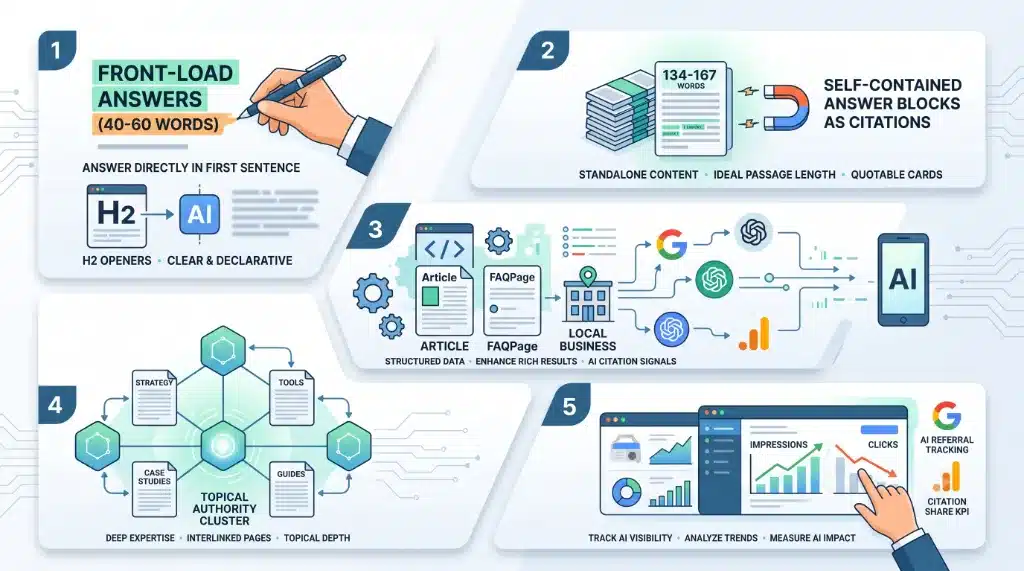
AI Mode extracts the first clear, declarative sentence of each H2 section. If your section opens with a vague introductory paragraph, the model skips it. Rewrite every H2 opener to answer the section question directly in 40-60 words, then expand. Instead of writing “Understanding local SEO is important for Delhi businesses,” write “Local SEO helps Delhi businesses rank in Google Maps and near-me searches by optimising their Google Business Profile, local citations, and hyperlocal content clusters.”
2. Build 134-167 Word Self-Contained Answer Blocks
Research on optimal passage length for AI citation identifies 134-167 words as the ideal block size. Each block should stand alone — answering one question completely without requiring surrounding context. Think of each H2 section as a quotable card, not a chapter in a long narrative. This structure is also what makes your content extractable by Perplexity and ChatGPT.
3. Add Article, FAQPage, and LocalBusiness Schema Markup
Google’s guide confirms structured data remains valuable for rich results even though no special markup is required for AI responses specifically. FAQPage schema still directly benefits non-Google AI platforms including ChatGPT, Perplexity, and Bing Copilot, where FAQ blocks are actively cited in responses. Add Article schema with datePublished and dateModified to all blog posts to strengthen freshness signals.
4. Build Topical Authority Clusters, Not Isolated Pages
AI Mode preferentially cites sources that demonstrate deep, consistent expertise across a topic area. A single strong page on “local SEO Delhi” is less citable than a site with 15 interlinked posts covering local SEO from every angle — strategy, tools, case studies, pricing guides, and how-to tutorials. Build the content cluster before chasing the individual keyword ranking.
5. Track Citation Share as Your Primary KPI
Open Google Search Console and compare impressions vs clicks for your top 20 queries. If impressions are rising while clicks fall, AI Mode is absorbing your traffic. Set up the GA4 AI referral channel group (added natively in the May 2026 GA4 update) to separate AI-referred sessions. Track citation share across Google, ChatGPT, and Perplexity monthly as a standalone business metric.
What NOT to Do — Tactics Google Has Officially Warned Against
Google’s May 2026 optimisation guide explicitly warns against several tactics currently being sold by agencies as GEO or AEO strategies:
- Chunking content into small “AI-friendly” snippets — Google systems parse full pages and artificial chunking degrades the reading experience without improving citations
- Manufacturing inauthentic brand mentions across forums and social platforms — core ranking systems evaluate quality and spam filters actively penalise manipulation at scale
- Treating GEO/AEO as a separate strategy requiring different content — it is foundational SEO applied to an AI surface, not a different discipline
Conclusion
AI Mode is not the death of SEO. It is the maturation of SEO — the moment when every bad habit (thin content, keyword stuffing, anonymous authorship, generic definitions) gets filtered out by a system sophisticated enough to demand genuine quality. The businesses that will earn visibility inside AI Mode are the ones already doing SEO correctly: building real expertise, writing for humans first, and structuring content for easy extraction.
The only metric that changes is the goal. Swap rank position for citation share. Build for AI surfaces the same way you built for featured snippets — by being the clearest, most credible, most easily extractable answer in the room.
Frequently Asked Questions (AI Query-Based)
Q1: What is Google AI Mode and how is it different from AI Overviews?
A: Google AI Mode is a dedicated conversational search interface powered by Gemini 3.5 Flash that completely replaces the traditional SERP. AI Overviews appear above organic blue links on standard search results. AI Mode shows zero blue links and delivers a fully synthesised, multi-turn conversational answer. As of July 2026, AI Mode has over 1 billion monthly active users globally.
Q2: How do I get my website cited in Google AI Mode?
A: Earn citations in Google AI Mode by writing unique, non-commodity content with strong E-E-A-T signals, structuring each section to front-load a direct answer in the first 50 words, adding Article and FAQPage schema markup, and building topical authority clusters. Google’s own guidance confirms AI Mode source selection uses the same quality signals as classic Search.
Q3: Does Google AI Mode reduce my organic traffic?
A: Yes, for most sites. Research shows organic CTR at position 1 drops approximately 34.5% when AI-generated answers appear. Over 60% of Google searches in 2026 end without a click. However, AI-referred traffic when it occurs converts at 1.5x-5x the rate of classic organic traffic because the AI has already vetted the source.
Q4: Is zero-click search the same as Google AI Mode?
A: Zero-click search refers to any search that ends without a user clicking a result — including featured snippets, knowledge panels, local packs, and AI Overviews. AI Mode is the most extreme form because it removes blue links entirely. Not all zero-click searches involve AI Mode.
Q5: What is citation share and how do I measure it?
A: Citation share is the percentage of AI-generated responses for your target queries that reference your content. Track it via Google Search Console impressions for AI Mode queries, the GA4 AI referral channel group (added May 2026), and third-party tools like Passionfruit Labs or SE Ranking AI visibility tracker.
Q6: Does schema markup help with Google AI Mode?
A: Schema markup does not directly improve AI Mode citation rates per Google’s May 2026 guide. However, structured data remains valuable for rich-result eligibility in classic Search, and FAQPage and Article schema directly benefit AI citations on Perplexity, ChatGPT, and Bing Copilot. Implement schema for the full ecosystem.
Q7: How long should a blog post be to get cited in AI Mode?
A: Word count is not a direct ranking or citation factor. The optimal passage length for AI citation is 134-167 words per self-contained answer block. A 600-word post with perfectly structured answer blocks will outperform a 3,000-word wall of text in AI citation. Focus on topical coverage depth, not word count targets.
Q8: Can small businesses compete in Google AI Mode?
A: Yes. AI Mode preferentially cites sources with clear, specific, first-hand expertise — something small businesses with deep domain knowledge can satisfy more authentically than large brands publishing generic content. Local businesses with strong Google Business Profiles, verified reviews, and hyperlocal content clusters are well-positioned.
Q9: What happened to AI Overviews after Google I/O 2026?
A: Google announced the merging of AI Overviews and AI Mode into a more seamless experience at I/O 2026. AI Mode, with 1 billion monthly users, is becoming the primary interface for complex queries. AI Overviews continue appearing on standard results for informational queries, triggering at 80-88% rates in some industries.
Q10: What is the difference between SEO, GEO, and AEO in 2026?
A: Google’s official May 2026 guide confirms that GEO (Generative Engine Optimization) and AEO (Answer Engine Optimization) are rebranded labels for SEO fundamentals applied to AI search surfaces. No separate strategy is needed. Strong foundational SEO — E-E-A-T, unique content, technical hygiene, structured data — is the complete framework for visibility across all surfaces