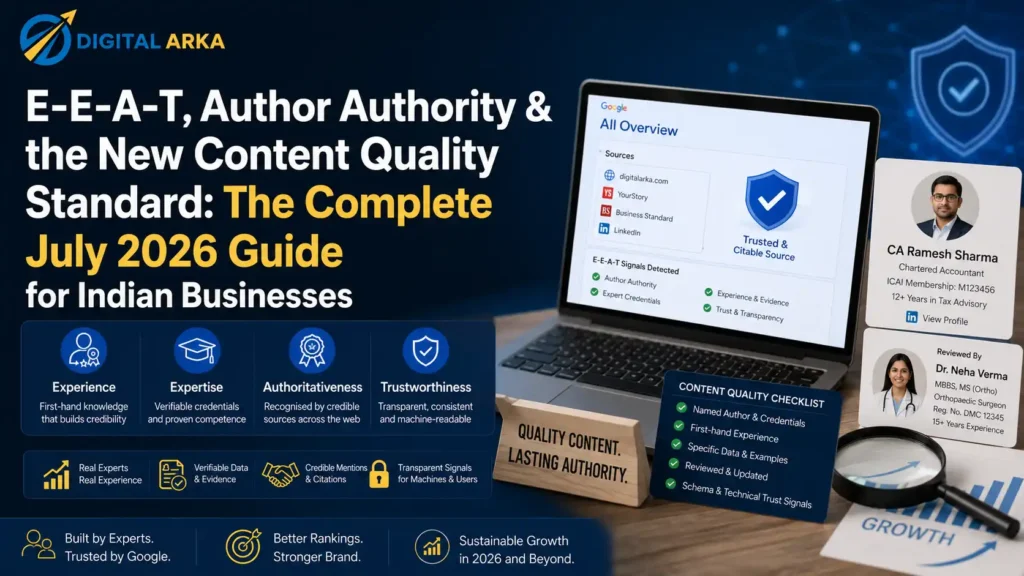

In June 2026, SEO experts analysing the sites that recovered from — or grew through — the year’s four major Google updates found a pattern that was cleaner than almost any previous algorithm cycle: 73% of sites that dropped in rankings had no visible trust signals. 71% of ranking drops were correlated with anonymous authorship and weak affiliate content. Verified experts with genuine credentials earned citation lifts of up to 35% in AI Overviews.
The signal from 2026’s entire algorithm update sequence is unusually consistent. Every update — February Discover, March core, March spam, May core, June spam, and now the unconfirmed July volatility — has moved in the same direction: content written by real experts, about real topics, with real evidence, attributed to real people, wins. Everything else loses ground.
This is what Google means by E-E-A-T (Experience, Expertise, Authoritativeness, Trustworthiness) in practice in July 2026. Not a content checklist. Not a set of meta tags. A fundamental change in how content credibility is assessed — simultaneously by human quality raters applying Google’s 176-page Search Quality Rater Guidelines, and by AI systems parsing your content for the specific signals that make it citable and trustworthy.
This blog covers exactly what E-E-A-T requires in July 2026, what the common failures look like in Indian business content, and the precise implementation steps that move your content from invisible to authoritative.
The most important shift in 2026’s E-E-A-T enforcement: it is now technical as well as editorial. Author pages, Organisation schema, consistent entity data, and review/update date signals are machine-readable trust signals — not just content quality best practices. Your website must communicate trust to machines, not just to human readers.
Understanding the Four E-E-A-T Dimensions in July 2026
Google’s Quality Rater Guidelines define E-E-A-T with specific criteria that have evolved significantly through 2026’s update cycle. Here is what each dimension means in practice for Indian businesses:
Experience: First-Hand Knowledge That Cannot Be Faked
Experience was added to Google’s quality framework in December 2022, and its weight has increased with every subsequent update. Experience signals indicate that the content creator has directly done what they are describing — not just researched it, not just synthesised existing articles, but personally experienced the topic.
For Indian businesses, experience signals are embedded in specific content patterns:
- Case study content with actual client names, timelines, and outcome numbers: “We helped a Noida JEE coaching institute increase online admission enquiries from 15 to 62 per month over 7 months using this approach” — this is experience. “We help coaching institutes grow their online presence” — this is not.
- Process documentation from actual delivery: A Delhi law firm that writes about “what actually happens in the company registration process — based on 300+ registrations we have handled” demonstrates experience that a freelance content writer summarising the Companies Act cannot replicate.
- Specific, verifiable observations about real market conditions: A Gurgaon real estate company that publishes “what we observed in Q2 2026 NCR property transactions across 12 projects” is demonstrating experience. A company publishing “NCR property market trends 2026” aggregated from other sources is not.
Expertise: Demonstrated Professional Competence
Expertise is the dimension most commonly conflated with “good content” — but Google’s definition is specific. Expertise requires that the content creator has verifiable qualifications or demonstrated competence in the topic. The key word is verifiable.
Google’s AI systems and quality raters evaluate expertise through author credentials that can be independently verified. A blog post on tax planning written by “our team” fails the expertise test. The same post written by “CA Ramesh Sharma (ICAI membership number M123456, 12 years tax practice, specialising in SME tax planning)” passes it — because the expertise claim is specific, checkable, and LinkedIn-verifiable.
For Indian YMYL categories — healthcare, legal, financial, educational guidance — expertise verification requirements are the strictest in Google’s framework. A medical blog post that does not identify the specific doctor who reviewed it, their hospital affiliation, and their specialisation area is evaluated significantly more critically than one that does.
Authoritativeness: What the Web Says About You
Authoritativeness is primarily an off-site signal. It reflects how other credible sources on the web characterise your brand and its expertise. This is the dimension that digital PR and editorial mention acquisition directly builds.
In July 2026, the citation source data from AI Overviews reveals what authoritativeness looks like to Google’s systems: LinkedIn mentions for professional queries, YouTube presence for educational and how-to queries, editorial links from industry publications, and Reddit discussion thread participation for community-based topics.
For Indian businesses building authoritativeness: the highest-value activities are genuine contributions to credible Indian industry publications (Economic Times SME, YourStory, Business Standard, sector-specific trade media), HARO responses that earn expert citation in national journalism, and LinkedIn thought leadership that earns engagement from named industry professionals.
Trustworthiness: The Machine-Readable Layer
Trust is the fourth dimension and the one that has the most significant technical component in 2026. Trust signals that are now evaluated machine-readably include:
- Consistent entity data: Your business name, address, phone, and operating information identical across your website, Google Business Profile, LinkedIn, and all directory listings
- Transparent contact and about information: A physical address, named contact person, and functional contact form — businesses that hide their location and team signal lower trustworthiness
- Review dates and content update signals: dateModified in Article schema, clearly visible “last updated” dates on service pages, and content that references current-year information
- HTTPS and security standards: Still a baseline trust signal — a site without HTTPS is evaluated as untrustworthy regardless of content quality
- Privacy policy, terms of service, and refund policy: Present, current, and genuine — not boilerplate. Google’s quality raters specifically check these pages during YMYL evaluation.
The Seven Most Common E-E-A-T Failures in Indian Business Content
Based on the pattern from the 2026 algorithm updates, here are the seven most commonly penalised E-E-A-T failures in Indian business content — with the specific fix for each:
Failure 1: Anonymous Authorship
“Written by Staff,” “By Our Team,” or no author attribution at all. This is the single most common E-E-A-T failure across Indian business websites, and it is directly correlated with ranking losses in every 2026 update. 73% of sites that dropped in the 2026 update cycle had no visible trust signals, and anonymous authorship is the leading missing signal.
The fix: Every content page needs a named author. Service pages: named by the professional responsible for that service area. Blog posts: named by the expert who wrote or reviewed the content. About pages: named individuals with job titles, credentials, and LinkedIn links. This is non-negotiable in July 2026.
Topical Authority is must in order to rank the content.
Failure 2: Generic Claims Without Specific Evidence
“We are a leading digital marketing agency with years of experience” tells Google’s systems nothing. It cannot be verified. It is the same claim made by every competitor. It contributes nothing to E-E-A-T scores.
The fix: Every claim needs a specific, verifiable figure or example. “We have completed 575+ website development projects since 2019” is verifiable. “Our average client sees 149% organic traffic growth in 12 months — here are three specific case studies” is verifiable. Specificity is E-E-A-T. Generality is not.
Failure 3: Outdated Content Without Refresh Signals
Content published in 2022 and never updated carries a significant trust penalty in 2026 — especially in fast-moving categories like digital marketing, tax and legal compliance, healthcare, and technology. Google’s systems evaluate freshness through dateModified schema and visible content date signals.
The fix: Identify every page on your website that hasn’t been updated in 18+ months and is in a category where information changes. Update the actual content — not just the date. Add a clearly visible “Last updated: [month, year]” label to every content page. Update the dateModified field in Article schema. Schedule quarterly content reviews for your top 20 pages.
Failure 4: YMYL Content Without Appropriate Professional Review
Healthcare, legal, financial, and educational guidance content — Google’s Your Money or Your Life (YMYL) categories — requires demonstrably higher levels of expertise and review. A healthcare blog post written by a marketing professional and not reviewed by a medical professional fails YMYL standards regardless of how well-written it is.
The fix: Every YMYL content page needs a named professional reviewer with verifiable credentials. Healthcare content: reviewed by a named doctor with specialty, hospital affiliation, and medical registration number. Legal content: reviewed by a named advocate with Bar Council registration. Financial content: reviewed by a SEBI-registered advisor or CA with ICAI membership number.
Failure 5: Weak or Absent About and Team Pages
An About page with three sentences and a stock photo, or no team page, signals to Google’s trust evaluation systems that the business is either not real, not credible, or deliberately obscuring who is behind it. All three interpretations suppress E-E-A-T scores.
The fix: Rebuild your About page as a genuine company story: founding context, specific expertise development, verifiable client results, named team members with photos and credentials, and professional affiliations. Your team page should have LinkedIn links, professional photographs (not stock photos), and brief credential statements for each named team member.
Failure 6: Missing or Incorrect Schema Markup
E-E-A-T is now partially technical — Organisation schema, Person schema, Article schema with proper author attribution, and LocalBusiness schema are the machine-readable layer of the trust signals that human-readable content provides. A page that demonstrates genuine expertise in its text but has no schema markup is communicating that expertise only to human readers, not to AI systems that parse schema before body content.
The fix: Implement the minimum viable schema stack: Organisation on homepage, LocalBusiness for local businesses, Article (with @author linked to Person schema) on all content pages, FAQPage on FAQ sections. Use Google’s Rich Results Test to verify schema is correctly implemented and error-free.
Failure 7: Content That Synthesises Without Contributing
Content that aggregates information from other sources, rephrases existing articles, or summarises third-party data without adding original analysis, first-hand observation, or unique perspective is exactly what the 2026 algorithm updates are designed to deprioritise. Publishing AI-written filler at scale without a trust layer — volume without credibility — is easy to ignore. Google’s own statement confirmed 45% less low-quality, unoriginal content after 2024 updates.
The fix: Every piece of content must contribute something original. A blog post about “SEO trends 2026” that only summarises industry reports contributes nothing. The same post that adds your own client data, your specific Indian market observations, and analysis of how these trends manifest differently in the Indian context — that is original contribution.
Building E-E-A-T Into Your Content System: The Operational Framework
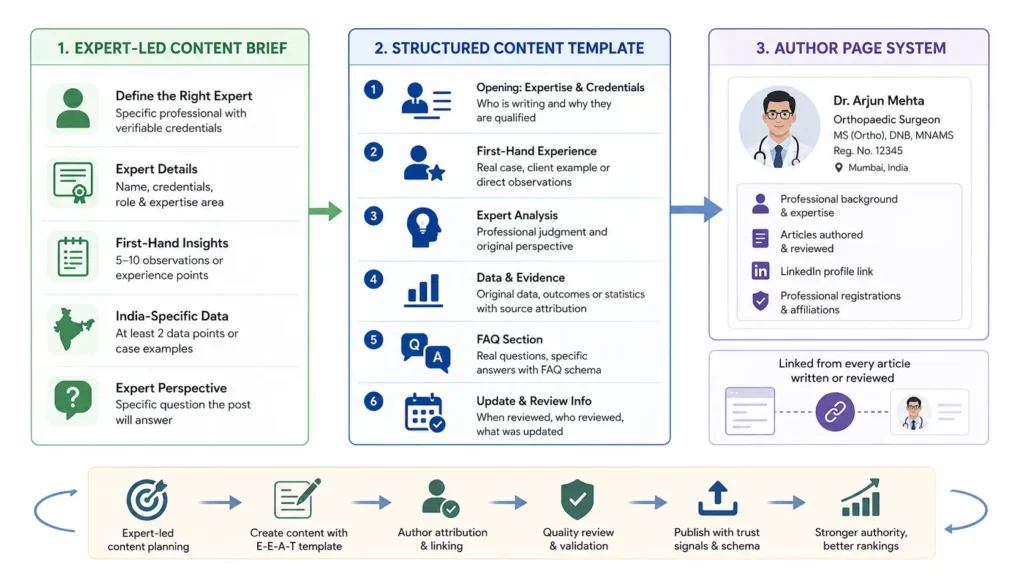
Individual page fixes improve E-E-A-T reactively. The businesses that will compound their authority advantage through the second half of 2026 are building E-E-A-T into their content production system — so that every piece of content produced meets the standard automatically.
The Expert-Led Content Brief
Before any content is written, define the expert source for this specific piece. Not “our marketing team” — the specific professional with verifiable credentials in this topic. A CA firm’s post about advance tax should be briefed from and attributed to the CA who handles advance tax for the firm’s clients. A clinic’s post about knee replacement recovery should be briefed from and attributed to the orthopaedic surgeon who performs the procedure.
The brief should include: the expert’s name and credentials, 5–10 first-hand observations or experience points they can contribute, at least 2 India-specific data points or case examples they have direct knowledge of, and the specific question the post is answering from the expert’s perspective — not from keyword research alone.
The Structured Content Template
Every content page should follow a structure that embeds E-E-A-T signals automatically:
- Opening paragraph: Who is writing this and why are they qualified? Not a boastful claim — a factual statement. “I have been a practicing oncologist at X hospital for 14 years, specialising in Y. This post covers Z based on my direct clinical experience.”
- First-hand experience section: A specific case, client example, or direct observation from the expert’s practice. Named where possible, anonymised appropriately where client confidentiality requires.
- Expert analysis section: What does the expert actually think about this topic? Not what other sources say — the expert’s own professional judgment, supported by reasoning.
- Specific data or evidence section: Original data, specific case outcomes, or verifiable statistics with source attribution.
- FAQ section with FAQPage schema: The actual questions patients, clients, or customers ask in practice — answered specifically, not generically.
- Update and review information: When was this reviewed, who reviewed it, and what was changed — visible at the bottom of the page.
The Author Page System
Every expert contributing to your content needs a dedicated author page with: professional photograph (not stock), full name and credentials, professional background in the specific topic area, a list of articles they have authored or reviewed on your site, LinkedIn profile link, and — for YMYL categories — professional registration numbers or affiliations.
These author pages should link from every article that expert has authored, creating a verifiable connection between the author’s credentials and the specific content they are accountable for. This is how Google’s systems evaluate expertise at scale — not by reading every article, but by parsing the author attribution signals and evaluating the author page they link to.
E-E-A-T Measurement: How to Track Trust Signal Improvement
E-E-A-T is not directly measurable by any single metric — but its commercial impact is measurable through the combination of signals it influences. Here is how to track E-E-A-T improvement over time:
- Branded search volume month-over-month: As E-E-A-T improves, brand recognition and trust build, which drives more people to search your brand name directly. Track this in GSC by filtering for branded queries.
- AI Overview impressions for your target queries: As content quality improves and author attribution strengthens, AI Overview citation eligibility increases. Monitor this in the AI performance report in GSC.
- Organic CTR improvement on high-value pages: Better E-E-A-T signals lead to richer search snippet displays (star ratings, author images, FAQ dropdowns) that improve CTR even without ranking changes.
- Inbound link velocity from credible sources: As your content demonstrates genuine expertise, other credible sites link to it naturally. Track new referring domains in Ahrefs or SEMrush, specifically filtering for links from publications with editorial standards.
The Bottom Line: E-E-A-T Is the Strategy That Survives Every Update
Every Google algorithm update since 2022 has moved in the same direction. The businesses that saw consistent growth through all of 2026’s updates — February Discover, March core, March spam, May core, June spam — share a common characteristic: genuine, verifiable, expert-attributed content with strong technical trust signals.
This is not a coincidence. It is the direct result of Google’s stated mission: to surface the most helpful and reliable content for searchers. The businesses that are genuinely helpful and genuinely reliable — and that communicate this through verifiable signals — are the businesses that every Google update rewards.
The businesses that are struggling are those that built their SEO on signals that mimic quality rather than genuine quality. AI-generated content that sounds authoritative but contains no original expertise. Author names attached to content that the named person never reviewed. Case study claims without verifiable specifics. Entity data that differs across platforms.
Building genuine E-E-A-T is slow. It requires real expertise, real attribution, real evidence, and real systems. It cannot be faked at scale. It does not respond to quick fixes. And it is, for exactly these reasons, the most durable competitive advantage available in July 2026’s SEO landscape — because it is the one advantage that no competitor can copy with a content brief and an AI tool.
The practical test for every piece of content your business publishes: “Could a well-qualified professional in this field read this content and say it reflects genuine expertise and first-hand experience?” If the honest answer is no, the content is not E-E-A-T compliant — regardless of how well it is keyword-optimised or how cleanly it is structured.
DigitalArka builds E-E-A-T compliant content strategies for Indian businesses. Get a free content quality audit at digitalarka.com