
Introduction
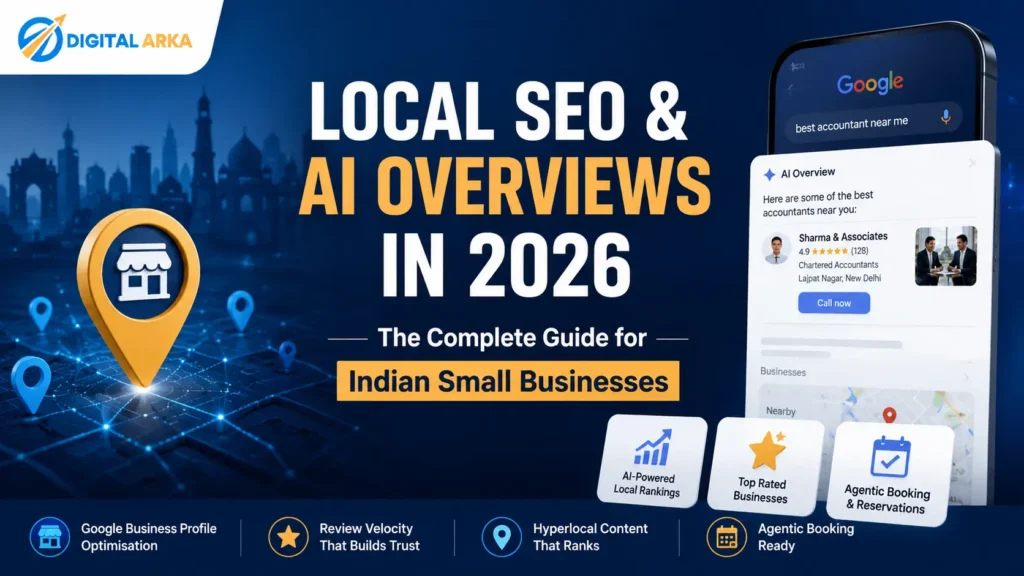
A customer in Lajpat Nagar opens Google and types “best accountant near me.” Five years ago, they would have seen ten blue links and clicked two or three. Today, they see an AI Overview at the top that names three local firms, summarises their specialisations, shows their ratings, and provides a “Call now” button — all before a single organic result appears.
Local SEO in 2026 is no longer about ranking in the ten blue links. It is about appearing in the AI-generated local recommendation that replaces them. This guide covers exactly what Indian small businesses need to do to earn visibility in local AI Overviews, Google Maps AI-enhanced results, and the emerging agentic booking layer that Google is rolling out through the rest of 2026.
Whether you run a dental clinic in Dwarka, a restaurant in Connaught Place, or an SEO agency in South Delhi, the principles are identical — and the window for early-mover advantage is open right now.
How Local Search Has Changed in 2026
Local search has always been competitive. What changed in 2026 is the surface that matters. Google AI Overviews appear on 80-88% of informational searches in some industries, and for local service queries (“SEO agency in Delhi,” “best restaurant in South Delhi”), they now regularly include a local recommendation block synthesised from Google Business Profile data, customer reviews, and local content.
The Google I/O 2026 keynote also introduced Agentic Booking for local services — expanding Google’s AI agents to make reservations and initiate phone calls on behalf of users for categories including home repair, pet care, and select professional services. Early categories are limited to the US, but expansion to India is expected through 2026-2027. Businesses in eligible categories that are not properly structured for agentic booking will be invisible to this new discovery layer entirely.
Additionally, Google’s Personal Intelligence feature — now rolling out in 98 languages including Hindi, Tamil, Telugu, and Marathi — means local search results will increasingly reflect a user’s personal context, history, and preferences. A restaurant that has been searched before, reviewed positively, or saved to Google Maps will appear preferentially for returning users.
Google Business Profile — The Foundation of Local AI Visibility
Your Google Business Profile (GBP) is the single most important local SEO asset in 2026. It is the primary data source for local AI Overviews, the Google Maps local pack, and the emerging agentic booking system. An incomplete or inconsistent GBP means you are invisible in every one of these surfaces.
Complete GBP optimisation checklist for Indian businesses:
- Business name: exactly matches your website and all directory listings (no keyword stuffing in the name field)
- Primary and secondary categories: choose the most specific primary category available (e.g., “SEO Agency” not “Marketing Agency”)
- Business description: 750 characters, naturally including primary service keywords and location modifiers
- Address: complete, PIN code included, geocoordinates verified on the map
- Phone number: primary Indian mobile or landline, consistent with all directory listings
- Website URL: pointing to your homepage or a relevant service landing page
- Hours: accurate including special hours for Indian holidays (Diwali, Holi, Republic Day)
- Photos: minimum 10 high-quality photos including exterior, interior, team, and products/services
- Products/Services: every service listed with name, description, and price range
- Q&A section: proactively add and answer 10+ common customer questions
- GBP Posts: publish at minimum one post per week (offers, updates, events)
Read Also: Predictive SEO: How to Win the Rankings Game Before the Algorithm Even Changes
5 Local SEO Strategies That Work in India in 2026
1. Build a Review Velocity Strategy
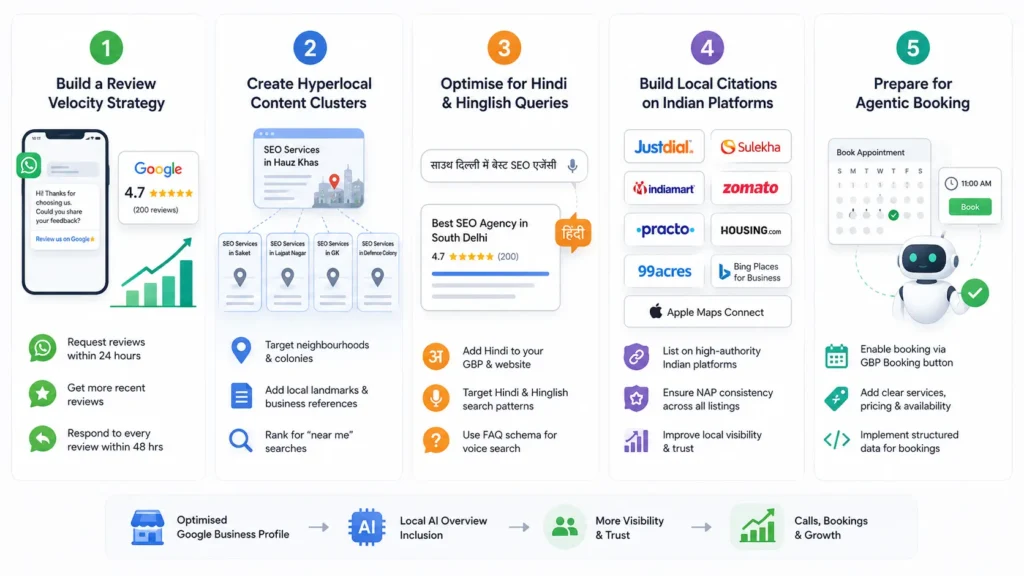
Review quantity and recency are the two most powerful signals for local AI Overview inclusion. Google’s AI systems synthesise review sentiment to assess business quality before recommending it in a generated answer. A business with 200 reviews averaging 4.7 stars, with 20 reviews in the last 30 days, will consistently outperform a competitor with 50 reviews averaging 4.9 stars but no recent activity.
Build review velocity by: sending a WhatsApp message with a GBP review link to every satisfied client within 24 hours of service completion, training front-desk staff to ask for reviews at point of service, and responding to every review (positive and negative) within 48 hours. Responding to reviews is itself a local ranking signal.
2. Create Hyperlocal Content Clusters
Hyperlocal content — blog posts, landing pages, and FAQs specifically targeting your neighbourhood, colony, or district — is one of the highest-leverage local SEO investments in 2026. An SEO agency in South Delhi should have dedicated pages for: SEO services in Saket, SEO services in Hauz Khas, SEO services in Lajpat Nagar, and SEO services in Greater Kailash. Each page should reference local landmarks, nearby businesses, and neighbourhood-specific search patterns.
These hyperlocal pages also serve as AI Overviews citation targets — when a user in Hauz Khas asks Google for “SEO agency near me,” the AI generates its answer from locally relevant, structured content. A generic “SEO Services in Delhi” page cannot compete with a page that specifically addresses the Hauz Khas market.
3. Optimise for Hindi and Hinglish Queries
India is a multilingual search market. A significant portion of local queries in Delhi are typed or spoken in Hindi or Hinglish (Hindi-English mixed). Google’s Personal Intelligence, rolling out in Hindi in 2026, will further increase multilingual local query volumes. Businesses should: include Hindi translations of key service descriptions in their GBP, create at least a few blog posts targeting common Hinglish query patterns, and ensure voice search optimisation for natural-language Hindi queries via schema-marked FAQ sections.
4. Build Local Citations on India-Specific Platforms
International citation platforms (Yelp, Yellow Pages US) have limited authority for Indian local SEO. Priority citation sources for Indian businesses are:
- JustDial — the dominant Indian local business directory with high Google authority
- Sulekha — strong for service businesses and professional services
- IndiaMART — critical for B2B and supplier businesses
- Zomato and Swiggy — mandatory for restaurants and food businesses
- Practo — essential for medical and healthcare professionals
- Housing.com and 99acres — for real estate businesses
- Bing Places for Business — Microsoft Bing powers Bing Copilot, and Indian Bing Copilot usage is growing
- Apple Maps Connect — iPhone users in urban India represent a high-value audience segment
5. Prepare for Agentic Booking — Structure Your Services for AI Transactions
Google’s Agentic Booking system (announced at I/O 2026, launching in the US Summer 2026) allows AI agents to book appointments, make reservations, and initiate phone calls on behalf of users. Businesses preparing for this now should: integrate Google’s booking system via the GBP Booking button, ensure your services have specific, machine-readable pricing and availability data in your GBP, and consider implementing schema-marked booking/appointment structured data on your website.
India-based rollout is anticipated through 2026-2027. Businesses that are fully structured for agentic booking when it arrives will gain a significant competitive advantage over those who onboard reactively.
Measuring Local SEO Success in 2026
The traditional local SEO KPIs (map pack rank, direction requests, calls from GBP) remain relevant but need supplementing with AI-era metrics:
- GBP Impressions in Search and Maps (track monthly trend in GBP Insights)
- Review velocity: number of new reviews per month and average rating trend
- AI Overview appearances: monitor Google Search Console for impression spikes on local branded queries
- Citation consistency score: run a quarterly audit using Bright Local or equivalent
- Direct phone calls and direction requests from GBP: the highest-intent local conversion signals
- Branded search volume: a leading indicator of AI-driven brand discovery
Conclusion
Local SEO in 2026 rewards businesses that are present, structured, and trusted across every surface where Google builds its local knowledge — your GBP, your website, your citations, your reviews, and your on-page content. The AI Overview local recommendation block is not a new ranking factor. It is the summation of every local SEO signal you have been building (or neglecting) for years.
For Indian SMBs, the opportunity is significant. Local AI Overviews in India are still in early rollout, which means the competitive bar is lower than it will be in 12 months. Businesses that optimise their GBP, build hyperlocal content clusters, and earn consistent review velocity in Q3 2026 will occupy AI citation positions that will be extremely difficult to displace once the local AI ecosystem matures.
Start with your Google Business Profile. Make it complete, accurate, and active. Everything else builds from there.
Frequently Asked Questions (AI Query-Based)
Q1: How does local SEO work in 2026?
A: Local SEO in 2026 means optimising your Google Business Profile, local content, and citations to appear in AI-generated local recommendation blocks (AI Overviews), Google Maps results, and the emerging agentic booking layer. The core signals remain: GBP completeness, review quantity and recency, NAP citation consistency, and local content relevance — but these signals now feed AI systems, not just traditional ranking algorithms.
Q2: What is the most important factor for local SEO in India?
A: Google Business Profile completeness and review velocity are the two most important factors for local SEO in India in 2026. A GBP with accurate business categories, complete service listings, active weekly posts, and a consistent flow of genuine customer reviews significantly outperforms competitors in both Google Maps results and local AI Overview citations. JustDial and Sulekha citations are the second priority.
Q3: How do I appear in Google AI Overviews for local searches?
A: Appear in local AI Overviews by: verifying and completing your Google Business Profile with all service categories and photos, building review velocity (10+ new reviews per month), creating hyperlocal content pages targeting your specific neighbourhood and district, implementing LocalBusiness schema on your website, and ensuring NAP consistency across all Indian directories including JustDial, Sulekha, and IndiaMART.
Q4: Does responding to Google reviews help local SEO?
A: Yes. Responding to Google reviews is a confirmed local ranking signal. Google advises businesses to respond to all reviews to show engagement with customers. From an AI citation perspective, review response rate and sentiment are included in the quality signals that determine whether a business is included in AI-generated local recommendations. Respond to all reviews within 48 hours, including critical ones.
Q5: What is Agentic Booking and how does it affect local businesses?
A: Agentic Booking, announced at Google I/O 2026, allows Google’s AI agents to make reservations and initiate phone calls on behalf of users for local service categories. Launching in the US in Summer 2026 with India expansion expected through 2026-2027. Local businesses should prepare by: enabling Google’s GBP booking button, adding service-specific pricing and availability data, and implementing appointment schema markup on their website.
Q6: How many Google reviews do I need for local SEO success?
A: There is no fixed minimum, but competitive analysis in most Indian urban markets suggests a baseline of 50+ reviews with an average of 4.5+ stars is required to appear consistently in the local pack and AI Overview local blocks. Review velocity (recency) matters as much as quantity. A business with 300 reviews but none in the last 3 months will lose ground to a competitor with 80 reviews and 15 in the last month.
Q7: What are the best citation directories for local SEO in India?
A: Priority Indian local citation directories in 2026 are: Google Business Profile (mandatory), JustDial (highest Indian local authority), Sulekha (service businesses), IndiaMART (B2B), Bing Places, Apple Maps Connect, and sector-specific directories (Zomato/Swiggy for restaurants, Practo for healthcare, Housing.com for real estate). Also build citations on international directories: Google Maps, Yelp India, and Facebook Business.
Q8: Should I create separate pages for each area I serve in Delhi?
A: Yes. Separate hyperlocal landing pages for each area you serve (South Delhi, Dwarka, Rohini, Lajpat Nagar, etc.) are significantly more effective than a single generic “Delhi” page. Each area page should reference local landmarks, target area-specific keywords, and include a unique service description. These pages serve as AI Overview citation targets for near-me and area-specific local queries.
Q9: How does voice search in Hindi affect local SEO?
A: Voice search in Hindi is growing rapidly as Google’s Personal Intelligence rolls out in Hindi across India in 2026. Hindi voice queries tend to be longer and more conversational than typed queries. Optimise for them by: adding FAQ sections in Hinglish to your service pages, including common Hindi transliterations of your services in your GBP description, and ensuring your website loads under 2 seconds on mobile (the primary voice search device in India).
Q10: How do I track local SEO performance in Google Analytics 4?
A: Track local SEO performance in GA4 by: monitoring organic sessions segmented by city/region, tracking GBP-to-website traffic (shown as “google / organic” with /gbp/ referral path in older versions, or via the dedicated GBP insights dashboard), tracking phone call conversions via GA4 event tagging, and monitoring brand search volume trends in Google Search Console as a leading indicator of local AI visibility growth.