
86% of SEO professionals now use AI in their workflows. But 93% of the most successful AI content users review all AI-generated content before publishing. The gap between AI-assisted excellence and AI-driven spam is a human quality control process — not a different AI tool.
The debate about whether to use AI for SEO content is over. 86% of SEO professionals now use AI in their workflows. AI-written pages appear in over 17% of top search results. The most successful digital marketing teams in India and globally are using AI tools to accelerate content production significantly — while maintaining the quality and expertise signals that Google’s 2026 algorithm demands.
But the distribution of results from AI-assisted content is not uniform. Some Indian businesses are using AI to produce genuinely better content, faster, with lower costs. Others are using AI to produce content that initially performs and then collapses under Google’s spam enforcement. The difference is not which AI tool you use. It is your process, your quality controls, and your understanding of where AI adds value and where it undermines it.
This blog is about the right AI-powered content workflow for Indian businesses in July 2026. The workflow that produces content that passes Google’s quality evaluation, earns E-E-A-T signals, and builds the topical authority that compounds over time — not content that looks good in a portfolio screenshot but fails under algorithmic scrutiny.
Why Most Indian Businesses Are Using AI Content Wrong
The typical AI content process in Indian digital marketing in July 2026 looks like this: brief a topic to an AI tool, generate a 1,200-word article, make minor edits, publish. This process is fast, cheap, and in many cases, completely counterproductive.
Google’s June 2026 spam update specifically targeted content produced through this process at scale. The enforcement pattern: mass AI pages with no real oversight or expertise often decline over time. The correlation between anonymous authorship, generic AI-generated content, and ranking drops after the 2026 update cycle is not coincidental — it is the direct result of SpamBrain’s increasing ability to identify content that lacks the specific markers of genuine expertise.
The three AI content failure modes:
First: using AI as a replacement for expertise rather than an accelerator of it. AI language models are trained on existing web content. They reproduce patterns, synthesise existing information, and generate plausible-sounding text. What they cannot do is have a first-hand experience, conduct original research, notice something that no published source has documented, or make a judgment call that requires professional qualification. When businesses use AI to replace their human experts rather than assist them, the resulting content is exactly what the spam updates target.
Second: using AI without a consistent quality control process. The critical distinction: 93% of the most successful AI content users review AI-generated content before publishing. The 7% who publish without human review are producing exactly the “mass AI pages with no real oversight” that enforcement actions target.
Third: using AI for the wrong parts of the content process. AI is excellent at research synthesis, outline generation, first-draft production, and formatting. It is poor at generating original insights, conducting actual interviews, producing genuinely verifiable case study data, and making editorial judgments about what information genuinely serves the reader versus what is filler.
The Right AI Content Workflow: A Step-by-Step System for Indian Businesses
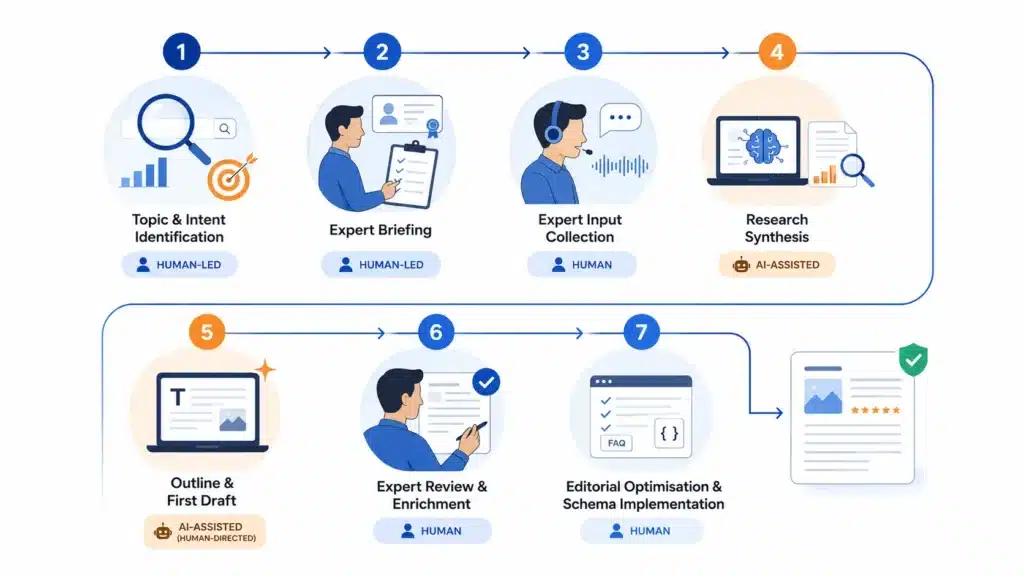
The content workflow that produces SEO-effective, E-E-A-T-compliant content at velocity in July 2026 has seven steps. Each step has a defined human and AI role:
Step 1: Topic and intent identification (Human-led) Define the specific intent cluster you are addressing, the query question in natural language, and the user’s stage in the buying journey. This is strategic work that requires understanding your customers, your market, and the current search landscape. AI tools can assist with competitor content analysis and related query identification, but the strategic prioritisation decision must be human.
Step 2: Expert briefing (Human-led) Identify the specific expert for this piece — the named professional with verifiable credentials who will contribute first-hand perspective. Brief them on the specific questions they need to answer from their professional experience. This step is what converts an AI-assisted article from generic content to E-E-A-T-compliant expert content.
Step 3: Expert input collection (Human) Conduct a 20-30 minute recorded conversation with the expert, or have them answer 5-7 specific questions in writing. This generates the genuine first-hand perspective, specific case examples, and expert judgment that AI cannot produce — and that Google’s systems are increasingly effective at detecting the absence of.
Step 4: Research synthesis (AI-assisted) Use AI tools to synthesise background research, compile relevant statistics with source citations, identify supporting evidence for the expert’s claims, and identify gaps in existing content that your piece should fill. This is where AI adds genuine velocity value without quality risk.
Step 5: Outline and first draft (AI-assisted, human-directed) Use the expert’s input and AI research to generate a structured outline, then produce a first draft that incorporates the expert’s specific insights, case examples, and recommendations. The AI draft should be structured around the expert’s voice, not generic industry content.
Step 6: Expert review and enrichment (Human) The draft returns to the expert for factual verification, addition of specific professional observations, and correction of any AI hallucinations or inaccuracies. This step takes 20-30 minutes for a 1,500-2,000 word article and is what makes the content genuinely E-E-A-T compliant.
Step 7: Editorial optimisation and schema implementation (Human) Final edit for conversational query match, addition of FAQ section, implementation of schema markup, author attribution, and internal linking. This is the SEO optimisation layer that makes technically excellent content search-visible.
The Human Editor-in-Chief Model for Indian Businesses
The most successful content strategy model in July 2026 positions a human professional as Editor-in-Chief of an AI-accelerated production process. From SEO Trends 2026: “The human role shifts to that of a strategic editor, ensuring accuracy, injecting brand voice, verifying sources, and confirming that the content truly satisfies user intent.”
For Indian businesses, this model is practically achievable even with limited content teams. A single professional with deep expertise in the business’s domain, functioning as Editor-in-Chief over an AI-assisted content process, can produce 3-5x more content than they could without AI assistance — while maintaining the quality standards that 2026’s algorithm demands.
The Editor-in-Chief’s core responsibilities in this model:
Content strategy and topic prioritisation. Which intent clusters to target, in which order, using which expert sources. This is not AI-delegatable work — it requires understanding the business’s goals, the competitive landscape, and the customer journey.
Expert source identification and management. For each content type, identifying which professional within the organization or as an external contributor can provide the genuine first-hand perspective that the topic requires.
Factual accuracy verification. Every specific claim, statistic, case study outcome, and expert recommendation in AI-assisted content must be verified before publication. AI language models hallucinate facts with confidence — the human editor’s most critical function is catching and correcting these errors.
E-E-A-T signal injection. Adding the specific case examples, professional observations, and expertise signals that AI drafts consistently lack because they cannot be derived from training data alone.
Brand voice consistency. Ensuring all published content reflects the business’s authentic professional voice — not the average voice of the internet, which is what untrained AI tends to produce.
Content Types and AI Suitability: What to Automate and What to Protect
Not all content types benefit equally from AI assistance — and some content types should be almost entirely human-led to maintain their E-E-A-T value. Here is the content type suitability matrix for Indian businesses:
High AI suitability (AI does 70%+):
- Research synthesis articles that compile existing public information — industry trend roundups, statistics collections, regulatory summary pages
- Product and service description pages where the facts are stable and the information is verifiable from authoritative sources
- FAQ sections where the questions are defined by customer service data and the answers are verified by professionals
- Location-variant service pages that follow a consistent template with location-specific information that can be systematically personalised
Medium AI suitability (AI does 30-50%):
- How-to guides and process documentation — AI produces the structure, human experts verify and add experiential nuance
- Case study writeups — AI formats and drafts from human-provided data; all claims must come from verified records
- Comparison articles — AI compiles the comparative data, human editors add genuine evaluative judgment and India-specific context
Low AI suitability (AI does 10-20%):
- Original research and survey analysis — data collection and interpretation must be human
- First-person expert commentary — the expert’s voice, perspective, and judgment cannot be AI-generated
- YMYL content (healthcare, legal, financial guidance) — must be written and reviewed by qualified professionals with verifiable credentials; AI at most assists with structure
Never fully AI-delegatable:
- Client testimonials and case study quotes — must be genuine
- Author bios and professional credentials — must be accurate and verifiable
- Expert opinions presented as professional recommendations — must come from actual qualified professionals
Indian businesses that misapply AI to the “never AI-delegatable” categories are the ones suffering enforcement consequences from the 2026 spam updates. Those applying AI to the high-suitability categories while protecting the human-essential categories are increasing both content velocity and content quality simultaneously.
Content Freshness as a System — Not a One-Time Task
One of the most impactful improvements available to Indian businesses in July 2026 is converting content freshness from an ad-hoc task to a systematic process. The freshness signal in Google’s 2026 ranking system is genuine and measurable — but it requires real content updates, not just date stamps.
Even your top-performing content from 2023 can lose visibility fast if it contains outdated statistics, superseded regulatory information, or references to products and services that have changed. A healthcare article that references 2022 medical guidelines loses trust signals when 2025 guidelines supersede them. A digital marketing article that does not reference Google I/O 2026 is visibly outdated to any reader — and to Google’s freshness evaluation systems.
The content freshness system that works for Indian businesses:
Monthly freshness audit. Review your top 20 pages by organic traffic. For each, ask: does this page reference any outdated statistics, superseded regulations, changed products, or pre-2026 information? Flag for update.
Quarterly deep refresh. For your 5 most important pages: add new case examples, update all statistics to current-year data, add a new FAQ entry based on the most common question received in the past quarter, and update the dateModified in Article schema.
Annual complete rewrite trigger. Pages older than 2 years in fast-moving categories (digital marketing, technology, regulation) should be completely rewritten with current information, new expert input, and updated internal linking — not patched.
Trend-responsive updates. When a major event in your category occurs — a Google algorithm update, a regulatory change, a significant market development — update your relevant existing pages to reference and address it within 48 hours. This creates a freshness signal at exactly the moment when queries about the topic are spiking.
The Content Velocity Metrics That Actually Matter
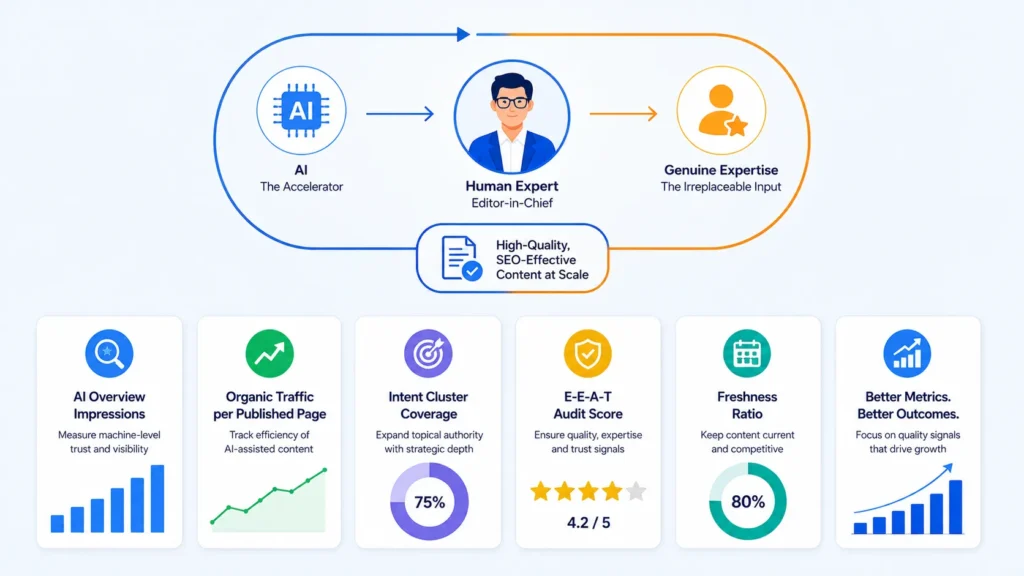
Most Indian businesses measure content production success by volume: articles per month, words per month, pages published. These metrics encourage exactly the wrong behaviours — more, faster, cheaper — and consistently produce the thin, generic content that the 2026 algorithm penalises.
The metrics that correctly incentivise AI-powered content production in July 2026:
Pages with AI Overview impressions per month. Are your new pages earning machine-level trust through citation in AI Overviews? This is the most direct measure of whether your content is meeting 2026’s quality standard.
Organic traffic per published page (normalised at 90 days). Divide total organic traffic by total published pages, comparing AI-assisted production periods to purely human production periods. This reveals whether AI assistance is improving or degrading per-page performance.
Intent cluster coverage. What percentage of your defined intent clusters have at least one comprehensive content asset? Increasing this percentage is a better measure of content strategy progress than increasing raw article count.
E-E-A-T audit score. Monthly review of a random sample of 5 published pages against a standardised E-E-A-T checklist: named author with credentials, specific case examples, verifiable statistics with dates and sources, current dateModified, internal links to supporting content. Score each page 0–5. Track improvement over time.
Freshness ratio. What percentage of your top 50 pages by traffic have been updated in the last 6 months? Target: 80%+. Below 50% signals systematic content debt that is likely causing ranking decay.
The right AI content model: AI is the accelerator; the human expert is the editor-in-chief; genuine expertise is the irreplaceable input. Remove any one of these three elements and the content either fails quality standards or fails to scale.
Building the AI Content Infrastructure for an Indian Business
Implementing an effective AI-powered content system requires both tool selection and process design. Here is the practical infrastructure for Indian businesses:
Tool stack: – Research and first-draft generation: Claude, ChatGPT, or Gemini (any of these with appropriate expert review) – SEO analysis and keyword research: Ahrefs or Semrush for traditional signals; Google Trends for velocity opportunities – Content optimisation: Clearscope or Surfer SEO for semantic optimisation signals – Schema generation: Schema.org generator or Rank Math for WordPress implementation – Workflow management: Trello or Notion for content calendar and status tracking
Process design: – Content calendar structured around intent clusters, not arbitrary topics – Expert interview schedule: one 30-minute conversation per week generates enough input for 2-3 articles – AI draft generation: maximum 45 minutes from brief to first draft – Expert review: maximum 30 minutes per 1,500-word article – Publication checklist: author attribution, schema, internal links, featured image with ALT text, FAQPage section
Team structure for Indian SMEs: – Sole proprietor or micro-team: owner is Editor-in-Chief; AI generates drafts; owner reviews, enriches with personal expertise, and publishes – Small team (3-5 people): one person as content lead and Editor-in-Chief; relevant team members as expert sources; AI accelerates research and drafting – Larger business: dedicated content manager as Editor-in-Chief; internal subject matter experts as contributors; AI accelerates at scale while human quality control maintains standards
The businesses consistently outperforming in Indian SEO in July 2026 are not the ones with the most AI tools. They are the ones with the clearest human quality control process sitting on top of AI acceleration.
The Bottom Line
Content velocity in July 2026 is not about producing the most content. It is about producing the most genuinely useful, expert-attributed, well-structured content per unit of time — using AI to accelerate the process without sacrificing the human expertise signals that Google’s systems have become increasingly effective at detecting and rewarding.
For Indian businesses, the right AI content workflow is achievable at every size and budget. It does not require a large team or expensive tools. It requires the discipline to keep human experts at the centre of the content production process — using AI as an accelerator and the human professional as the editor, quality controller, and expertise source.
The businesses that get this right will compound their content quality advantage through the second half of 2026, building topical authority, E-E-A-T signals, and AI citation presence that purely AI-generated content — however fast and cheap — simply cannot achieve.
DigitalArka builds AI-powered content systems for Indian businesses that produce genuinely expert, algorithmically durable content at scale. Free content audit at digitalarka.com