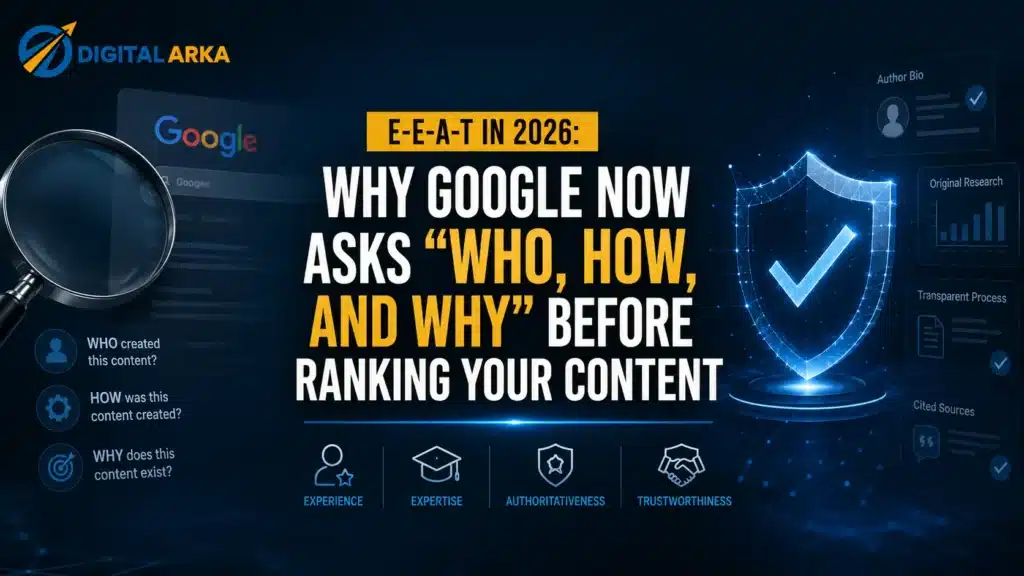

In September 2022, Google added a fourth letter to its quality framework: Experience. E-A-T became E-E-A-T. At the time, most SEOs nodded along and changed a few author bio templates. By mid-2026, that fourth E has become the most consequential update to content quality assessment in a decade — because AI-generated content has made the other three letters almost trivially easy to fake.
This guide breaks down what E-E-A-T means in July 2026, how Google assesses it through its “Who, How, Why” heuristic, which content types are most at risk, and exactly what you need to do to build genuine authority that neither algorithm updates nor AI content farms can replicate.
What Is E-E-A-T? Google’s Updated Quality Framework
E-E-A-T stands for Experience, Expertise, Authoritativeness, and Trustworthiness. It originates in Google’s Search Quality Rater Guidelines (QRG), a document used by thousands of human quality raters to evaluate search results. Google’s ranking systems use the QRG’s principles as training signal targets — not direct ranking inputs.
The four components defined:
- Experience: First-hand, real-world engagement with the topic. A product review written by someone who owned the product. A restaurant guide written by someone who ate there.
- Expertise: Formal or demonstrated knowledge in the subject area. A medical article written by a licensed physician. An SEO audit written by a certified practitioner with a track record.
- Authoritativeness: Recognition by others in the field. Citations from credible sources, backlinks from industry publications, brand mentions in reputable media.
- Trustworthiness: Accuracy, transparency, and safety signals. HTTPS, contact information, privacy policy, date stamps, correction disclosures, and verifiable facts.
Google’s Who / How / Why Test — The Practical E-E-A-T Heuristic
Google’s helpful content guide introduces a practical three-question test that simplifies E-E-A-T assessment into a checklist any content team can use:
- WHO created this content? Is there a visible byline? Does the author have a bio page with verifiable credentials? For YMYL (Your Money or Your Life) topics, is the author a licensed professional or someone with demonstrated lived experience?
- HOW was this content created? Was original research conducted? Are there first-hand observations, photographs, data sets, or personal accounts? If AI-assisted, is there clear human editorial oversight?
- WHY does this content exist? Was it created to genuinely help a specific audience with a specific need? Or was it produced to attract search clicks with no added value beyond what Google already knows?
When all three answers are weak, the page is at elevated risk under core ranking updates. Since the March 2024 core update merged the Helpful Content System into the main algorithm, helpfulness signals are enforced continuously — not in periodic standalone updates.
Why E-E-A-T Matters More in 2026 Than Ever Before
The March 2024 core update, confirmed by Google, removed a reported 40% of AI-generated and unhelpful content from the index — the largest content quality enforcement action in Google history. By July 2026, the pattern has continued through multiple core updates, with each one refining the ability to distinguish genuine expertise from AI-generated approximations.
The AI content proliferation problem is real. Publishing platforms, agencies, and solo operators are generating hundreds of thousands of articles weekly using large language models. The result is a SERP flooded with content that sounds authoritative, reads fluently, but contains no original insight, no first-hand experience, and no accountability to factual accuracy. E-E-A-T is Google’s primary defence against that flood.
For legitimate businesses and content creators, this is a significant opportunity. The signal advantage of genuine expertise has never been higher.
5 Ways to Build Genuine E-E-A-T in 2026
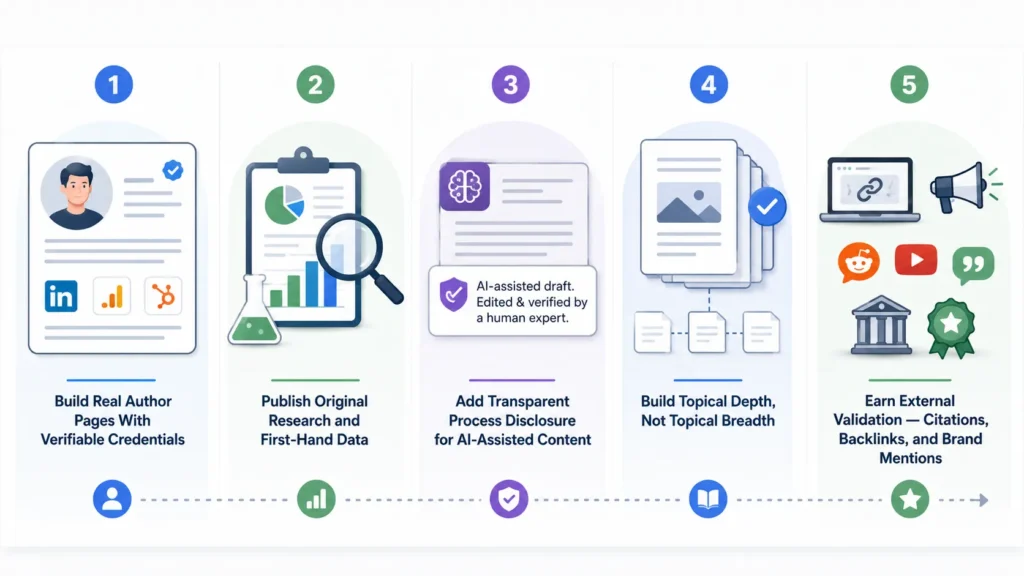
1. Build Real Author Pages With Verifiable Credentials
Every blog post must have a named author. That author must have a dedicated bio page linking to: their LinkedIn profile, any relevant certifications (Google Analytics, HubSpot, industry qualifications), published work on external platforms, and a professional headshot. Anonymous authorship is the single fastest way to fail the “Who” test.
2. Publish Original Research and First-Hand Data
Original research is the highest-E-E-A-T content format in 2026 because AI cannot replicate it. Survey your clients, run experiments on your own site, publish before/after case studies with real numbers. Even a small sample size (20-50 respondents) produces unique data that becomes citable — and AI citation systems actively prefer content with specific, attributable statistics.
3. Add Transparent Process Disclosure for AI-Assisted Content
If you use AI tools in your content workflow, disclose how. Google’s QRG now formally assesses whether content “appears AI-generated” as a quality signal. A simple editorial note — “This article was drafted with AI assistance and edited and verified by [Author Name], [Credential]” — satisfies the “How” test and demonstrates human oversight, which is the key differentiator Google is looking for.
4. Build Topical Depth, Not Topical Breadth
Publishing one authoritative 3,000-word guide on a topic you genuinely understand is more valuable than publishing 20 thin posts covering adjacent topics you do not. Topical authority in 2026 means demonstrating that your site is the most comprehensive and credible resource on a specific subject. This requires depth within a focused niche, not surface-level coverage of everything.
5. Earn External Validation — Citations, Backlinks, and Brand Mentions
Authoritativeness is not self-declared — it is granted by others. In 2026, the signals Google uses to assess authoritativeness include: editorial backlinks from industry publications, brand mentions on Reddit and YouTube (which correlate 3x more strongly with AI visibility than backlinks per Ahrefs December 2025 research), citations in academic or professional contexts, and Google Knowledge Panel presence.
Which Content Types Face the Highest E-E-A-T Risk?
YMYL (Your Money or Your Life) content — any topic where inaccurate information could harm a reader financially, medically, legally, or personally — is subject to the highest E-E-A-T scrutiny. This includes:
- Financial advice, investment guides, tax information
- Medical, health, and wellness content
- Legal advice and regulatory information
- News and current events coverage
- Safety-critical how-to guides (home repair, electrical, food safety)
Non-YMYL content (hobbyist topics, entertainment, general knowledge) faces lower E-E-A-T risk but still benefits significantly from strong authorship and first-hand experience signals.
Conclusion
E-E-A-T is not a checklist you complete once. It is an ongoing investment in genuine quality signals that accumulate over time — the author’s reputation, the brand’s track record, the content’s accuracy history, the external community’s recognition. In a world where AI can produce fluent content instantly, the only defensible moat is real expertise, real experience, and real accountability.
Start with your author pages. Fix them this week. Then audit your top-20 posts against the “Who, How, Why” test. If any post fails all three questions, either enrich it or remove it. The pages that survive that audit are your E-E-A-T foundation.
Frequently Asked Questions
Q1: What does E-E-A-T stand for in SEO?
A: E-E-A-T stands for Experience, Expertise, Authoritativeness, and Trustworthiness. It is Google’s content quality framework, originating in the Search Quality Rater Guidelines. The second E (Experience) was added in September 2022. In 2026, E-E-A-T is the primary framework Google uses to distinguish genuinely helpful content from AI-generated or low-quality pages.
Q2: Is E-E-A-T a direct Google ranking factor?
A: E-E-A-T is not a direct algorithmic ranking factor — Google has confirmed there is no single ‘E-E-A-T score’ that gets added to page rankings. However, it is a training signal framework used by Google’s quality raters, and the principles it describes (unique expertise, author credentials, site trustworthiness) align directly with what core ranking updates reward and penalise.
Q3: What is the difference between E-A-T and E-E-A-T?
A: E-A-T (Expertise, Authoritativeness, Trustworthiness) was the original Google quality framework. In September 2022, Google added a second E for Experience — meaning real, first-hand interaction with the subject matter. This addition was specifically designed to reward content produced by people who have directly experienced what they are writing about, not just researched it.
Q4: How do I improve my website’s E-E-A-T?
A: Improve E-E-A-T by: (1) adding visible author bio pages with credentials and LinkedIn links to all content, (2) publishing original research with your own data, (3) earning editorial mentions and backlinks from industry publications, (4) adding transparent dates and correction policies to your content, and (5) ensuring all YMYL content is authored or reviewed by a qualified professional.
Q5: What is Google’s Who / How / Why test?
A: Google’s helpful content guide introduces a three-question test for content quality: WHO created it (named author with verifiable credentials)? HOW was it created (original research, first-hand experience, human oversight of AI)? WHY does it exist (to genuinely help a specific audience vs. to attract search clicks)? Pages that fail all three questions are at elevated risk in core ranking updates.
Q6: What is YMYL content and why does E-E-A-T matter more for it?
A: YMYL (Your Money or Your Life) content covers topics where inaccurate information could harm readers financially, medically, legally, or personally. Google holds YMYL pages to the highest E-E-A-T standards because the real-world stakes of poor quality are high. This includes medical advice, financial guidance, legal information, and safety-critical how-to content.
Q7: Does AI-generated content hurt E-E-A-T?
A: AI-generated content does not automatically hurt E-E-A-T. Google’s position is that the production method doesn’t matter — what matters is quality, accuracy, and whether the content demonstrates genuine expertise. However, unedited AI content that contains no original insight, no human review, and no author accountability typically fails the ‘Who, How, Why’ test and is at high risk during core updates.
Q8: How do Google Quality Raters assess E-E-A-T?
A: Google Quality Raters — thousands of human contractors worldwide — use the Search Quality Rater Guidelines to evaluate pages against E-E-A-T criteria. They assess: whether the author’s credentials match the topic, whether the site has positive or negative reputation signals online, whether the content demonstrates real-world experience, and whether the page would be trusted by experts in the field.
Q9: Can a small business build strong E-E-A-T?
A: Yes. E-E-A-T is not correlated with site size or domain authority. Small businesses can build strong E-E-A-T by: publishing detailed case studies of their own work, building strong Google Business Profile presence with genuine reviews, having named authors with verifiable credentials write all content, and earning community recognition through local press mentions, industry directories, and Reddit/YouTube presence.
Q10: How does E-E-A-T relate to AI search visibility in 2026?
A: E-E-A-T signals are the primary differentiator for AI citation eligibility in 2026. Google AI Mode, ChatGPT, and Perplexity all preferentially cite sources that demonstrate clear author authority, verifiable expertise, and original data. Anonymous or unverifiable content is systematically deprioritised in AI-generated answers. Strong E-E-A-T is the foundation of both traditional SEO and generative engine optimisation.