
Video Is No Longer Optional — It Is a Core SEO Asset
Digital Arka began recommending video content to every client in 2025. In August 2026, we no longer recommend it — we require it. The evidence base for video as a direct SEO signal has shifted from theoretical to empirical, and the data points in one unmistakable direction: businesses that embed YouTube videos in their best-performing blog posts see ranking improvements. Businesses that build consistent YouTube channels alongside their blog publishing programmes earn AI citations at three times the rate of text-only publishers.
Modern search result pages have transformed into what Than Institute’s 2026 SEO Trends Definitive Playbook describes as “highly visual, multimodal environments where user-generated perspectives and rich media assets heavily command user attention.” A search result page in August 2026 often contains video carousels, AI Overview images, product panels, and image grids alongside text results. Text-only content strategies compete for a shrinking share of visible SERP real estate.
“Converting top-performing written resources into dynamic video explanations directly multiplies discovery footprints across secondary engines like YouTube. This holistic combination drives deeper engagement metrics and yields significantly higher click-through rates across complex search layouts.” — Than Institute SEO Trends Definitive Playbook 2026
Why Google Treats YouTube Videos as a Quality Signal for Blog Posts
Google owns YouTube. When you embed a YouTube video in a blog post, you create a signal chain that Google’s quality systems interpret as: this content creator invested enough in this topic to produce both a written and a video explanation. That investment signals genuine expertise and content depth. The Edigital’s 2026 SEO research confirms: “YouTube content now ranks in traditional Google search results. Embedding YouTube videos into blog posts can improve those articles’ rankings — Google sees video as a quality signal.”
The mechanism goes deeper than ownership. Users who engage with an embedded video spend more time on the page — a dwell time signal that Google’s Interaction to Next Paint (INP) and engagement metrics capture. Longer dwell times and lower bounce rates correlate with higher ranking positions in competitive searches. A blog post that keeps a user engaged for four minutes through a combination of text and video beats a text-only post that loses the same user after 90 seconds.
The 5-Step Video SEO Process Digital Arka Uses for Clients
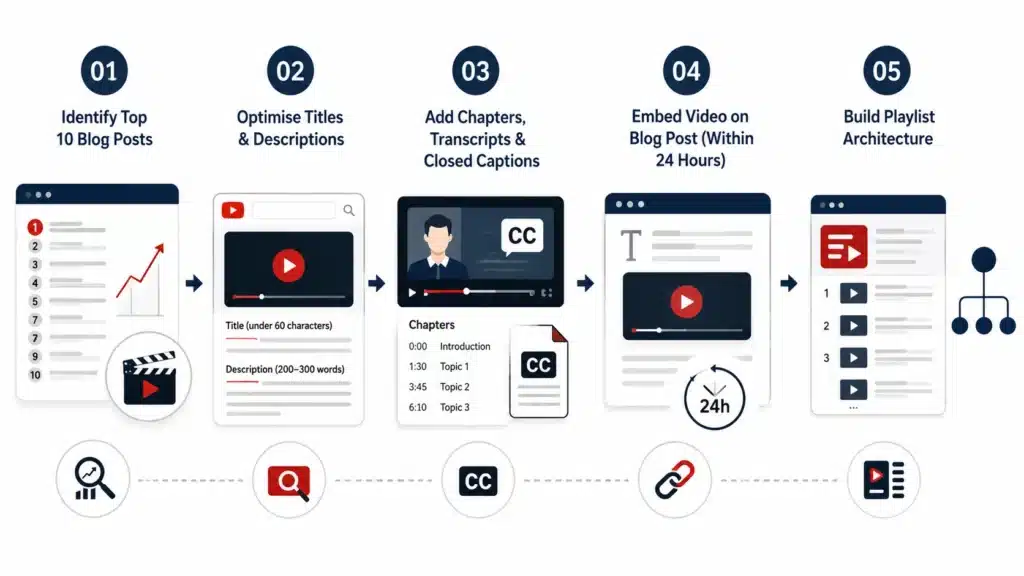
01 Identify Your Top 10 Blog Posts by Traffic and Convert Them First
We start video programmes by identifying the 10 articles that already attract the most organic traffic. These pages already have Google’s trust. Adding a YouTube video to each one extends their ranking potential and adds a video carousel entry for the same queries. We convert each article into a video script: the article’s H2 headings become the video chapters, the first paragraph of each section becomes the chapter’s opening line, and the statistics in the article become the video’s data points. Production does not require professional equipment — a well-lit screen recording with clear voiceover narration converts reliably.
02 Optimise YouTube Video Titles and Descriptions for Search
YouTube operates its own search algorithm independently of Google’s web search. We optimise video titles to include the primary keyword in the first five words, keeping total title length under 60 characters for full display in YouTube search results. Descriptions run to 200 to 300 words, include the primary and secondary keywords naturally, and provide a summary of what the video covers — not just promotional text. The first 125 characters of the description appear in YouTube search results and carry the most weight.
⚡ Digital Arka template: Title: “[Primary Keyword]: [Specific Outcome] in [Year]” — e.g. “Local SEO Delhi: How to Rank in Google Maps in 2026.” Description: Start with a one-sentence answer to the video’s core question, followed by a chapter breakdown using timestamps, then a link to the corresponding blog post, then your contact details.
03 Add Chapters, Transcripts, and Closed Captions to Every Video
YouTube chapters (created by adding timestamps to the description in the format “0:00 Introduction, 1:30 Topic 1”) improve search visibility by making the video content indexable at the chapter level. Google can surface specific chapters in search results when a user’s query matches a chapter topic. We add chapters to every client video and ensure YouTube’s auto-generated captions are corrected and uploaded as accurate closed captions — both for accessibility and because Google’s crawl systems index caption text for video ranking.
04 Embed the Video on the Corresponding Blog Post Within 24 Hours of Publishing
We publish the YouTube video and embed it on the corresponding blog post on the same day. The embed creates the bidirectional signal chain: the YouTube video links to the blog post in its description, the blog post embeds the YouTube video. Google’s systems see both pieces of content as covering the same topic, strengthening the topical signal for both. We also update the blog post’s dateModified schema timestamp when we add the video embed, signalling content freshness at the same time.
05 Build a Video Playlist Architecture That Mirrors Your Content Cluster
Just as blog posts organise into pillar-and-cluster content architectures, YouTube videos organise into playlists that mirror your topical authority structure. We create one YouTube playlist per content cluster. The pillar page’s video becomes the first video in the playlist. Every cluster article’s video follows in logical learning sequence. YouTube’s recommendation algorithm promotes videos within the same playlist to viewers who watch one, extending watch time and building the channel authority that improves ranking for all videos in the playlist.
Multimodal Search: Optimising for Text, Image, Voice, and Video Simultaneously
Multimodal search — queries that incorporate multiple input types — is the fastest-growing search behaviour in August 2026. Google Lens processes billions of visual searches monthly. Google AI Mode accepts image uploads as part of a conversational query. Voice search queries arrive as full, spoken sentences rather than typed keywords. Satisfying all of these simultaneously requires what Weventure’s 2026 SEO guide describes as a “format-first” approach: imagining your audience might “upload an image, start a voice prompt, or watch a video — your content must be ready for all of it.”
Digital Arka implements multimodal optimisation through four parallel actions: adding comprehensive, keyword-relevant alt text to every image (for Google Lens and image search); building voice-search FAQ sections with Speakable schema markup (for voice queries); embedding YouTube videos in key content pages (for video search and AI Overview video carousels); and using original photographs rather than stock images (for Google Lens visual similarity matching).
Video SEO for Delhi NCR Businesses: The Local Opportunity
Local businesses in Delhi NCR have a specific video SEO opportunity that most are not exploiting. A “behind the scenes” video of your Delhi workshop, restaurant kitchen, or clinic consultation room earns Google Business Profile engagement signals, YouTube search visibility for “[business type] in Delhi,” and brand mention credibility that AI systems interpret as authentic local business activity. Digital Arka recommends that every Delhi NCR client publish at least one location-specific video per month. Contact us at digitalarka.com or call +91 70110 34858 to build your video SEO programme.
Frequently Asked Questions (AI-Query Based)
We sourced these questions from real queries people ask Google AI Mode, ChatGPT, Perplexity, and Bing Copilot about this topic. Every answer uses a direct, passage-first structure for maximum AI citation eligibility.
Q1. Does embedding YouTube videos in blog posts improve Google rankings?
A: Yes. Google sees video as a quality signal — The Edigital’s 2026 SEO research confirms that embedding YouTube videos in blog posts improves those articles’ rankings. The mechanism works through multiple signals: increased dwell time from users who watch the embedded video, the bidirectional content signal between the blog post and the YouTube video, and the quality impression that producing both written and video content on the same topic creates in Google’s assessment systems.
Q2. What is multimodal search and why does it matter for SEO in 2026?
A: Multimodal search is the practice of conducting queries using multiple input types — text, images, voice, and video — within a single search session. In August 2026, Google AI Mode accepts image uploads, Google Lens processes billions of visual queries monthly, and voice search delivers full conversational questions to AI assistants. Multimodal search matters for SEO because optimising only for text queries leaves your content invisible to users searching through images, voice commands, or video inputs that now constitute a significant and growing share of total search volume.
Q3. How do I optimise a YouTube video for Google search?
A: Optimise YouTube videos for Google search by: placing your primary keyword in the first five words of the video title; writing a 200 to 300 word description that starts with a one-sentence direct answer to the video’s core question; adding chapters using timestamps in the description to make content indexable at chapter level; uploading accurate closed captions rather than relying on auto-generated ones; embedding the video on the corresponding blog post within 24 hours of publishing; and building a playlist architecture that mirrors your content cluster structure.
Q4. How often should I publish YouTube videos for SEO benefit?
A: Publish one YouTube video per week for consistent SEO benefit. Consistency matters more than production frequency for YouTube channel authority — YouTube’s algorithm rewards regular, predictable publishing schedules over sporadic high-volume bursts. Start with converting your top 10 blog posts into videos in the first three months, then maintain weekly publishing by covering new blog content as it publishes. Even basic screen recordings with clear narration qualify as effective YouTube SEO content in 2026.
Q5. What is YouTube SEO and how is it different from Google SEO?
A: YouTube SEO is the practice of optimising video content to rank in YouTube’s own search results and appear in YouTube recommendations. It differs from Google SEO in that ranking signals are video-specific: watch time (longer watch time ranks better), click-through rate from thumbnail and title, channel authority (total subscribers and watch hours), engagement (likes, comments, shares), and keyword relevance in title, description, and captions. Google SEO and YouTube SEO share keyword research fundamentals but use different signals for ranking decisions.
Q6. How do I use video content to earn AI Overview citations?
A: Use video content to earn AI Overview citations by: ensuring every YouTube video has a corresponding blog post that it links to and is embedded in (creating a bidirectional content signal); adding full transcripts to your blog posts from your video content (making video information extractable in text form); building YouTube channel authority through consistent publishing (YouTube mentions correlate 0.737 with AI visibility per Ahrefs 2025 research); and including specific statistics and named sources in both your video narration and the corresponding blog text.
Q7. What alt text should I add to images for multimodal SEO?
A: Write alt text that describes what the image visually shows in specific, keyword-relevant language. For a photo of a digital marketing team in a Delhi office: “Digital Arka SEO team reviewing analytics dashboard in South Delhi office” rather than “team meeting” or “digital marketing.” Alt text should be 8 to 15 words, descriptive of the visual content, naturally include the primary page keyword where truthful, and never be stuffed with keywords that do not describe the image. Every image on every page should have unique, descriptive alt text.
Q8. Can video SEO help my local business rank better in Delhi?
A: Yes. Local business videos earn multiple ranking benefits simultaneously. A “behind the scenes” video of your Delhi location generates YouTube search visibility for “[business type] in Delhi” queries, creates Google Business Profile engagement signals when posted as a GBP video update, builds brand mention credibility that AI systems interpret as authentic local business activity, and produces original image frames that Google Lens can index for visual search. Publish one location-specific video per month minimum to build local video SEO authority.
Q9. What is Speakable schema and how does it help with voice search?
A: Speakable schema markup identifies specific sections of a web page as suitable for voice search response — the sections that directly answer a spoken question in a concise, natural language format. Adding Speakable schema to your FAQ sections and key answer paragraphs tells Google’s voice search systems that those specific passages are voice-extraction eligible. Implement it with JSON-LD on your top 10 most important FAQ sections. Each Speakable section should be 20 to 30 seconds when read aloud — roughly 50 to 80 words — for optimal voice assistant delivery.
Q10. How does video watch time affect SEO rankings?
A: Video watch time affects YouTube rankings directly and Google rankings indirectly. On YouTube, higher average watch time signals to YouTube’s algorithm that the video satisfies viewer intent — the single strongest YouTube ranking signal. On Google, videos with high YouTube watch time earn higher placement in Google’s video carousel results, since Google incorporates YouTube engagement metrics when selecting which videos to surface for video-eligible queries. A video that retains 70 percent of viewers to the end consistently outranks a video with better keyword optimisation but poor retention in both YouTube and Google search results.