
SEO gets you found. AEO gets you used. Here is how to do both at the same time.
The Goal Has Shifted — And Most Brands Have Not Noticed
In the first article in this series, we introduced the viral infographic that drew the sharpest possible contrast between how people think SEO works and how it actually works in 2026. The old model ends at “#1 on Google.” The new model ends at “Cited AND Ranked.” That second destination — the citation — is the subject of this article.
Answer Engine Optimisation, or AEO, is the discipline of structuring your content so that AI systems — Google AI Overviews, ChatGPT, Perplexity, Gemini — select your pages as the direct source behind their generated answers. Not ranked somewhere in the results. Not linked in a blue list. Quoted. Named. Cited as the authority.
The distinction between ranking and being cited sounds subtle. The business impact is not. Seer Interactive’s 2026 data shows that brands cited inside AI Overviews earn 35 percent more organic clicks and 91 percent more paid clicks than uncited competitors appearing on the same SERP. A brand that is ranked but not cited competes for a shrinking share of the remaining clicks. A brand that is both ranked and cited earns the clicks that survive and the brand impressions that multiply them.
“SEO gets you found. AEO gets you used. Traditional SEO earns a ranking position. AEO earns a citation inside the answer. The goal shifts from driving a click to becoming the trusted reference behind the machine-generated response.” — Contently AEO Definition Guide, 2026
This guide walks through the complete AEO framework — what it is, how it differs from traditional SEO, what the data says about what actually earns citations, and the exact content and structural changes Digital Arka implements for every client to earn both rankings and citations simultaneously.
AEO, SEO, and GEO — Understanding the Three Disciplines
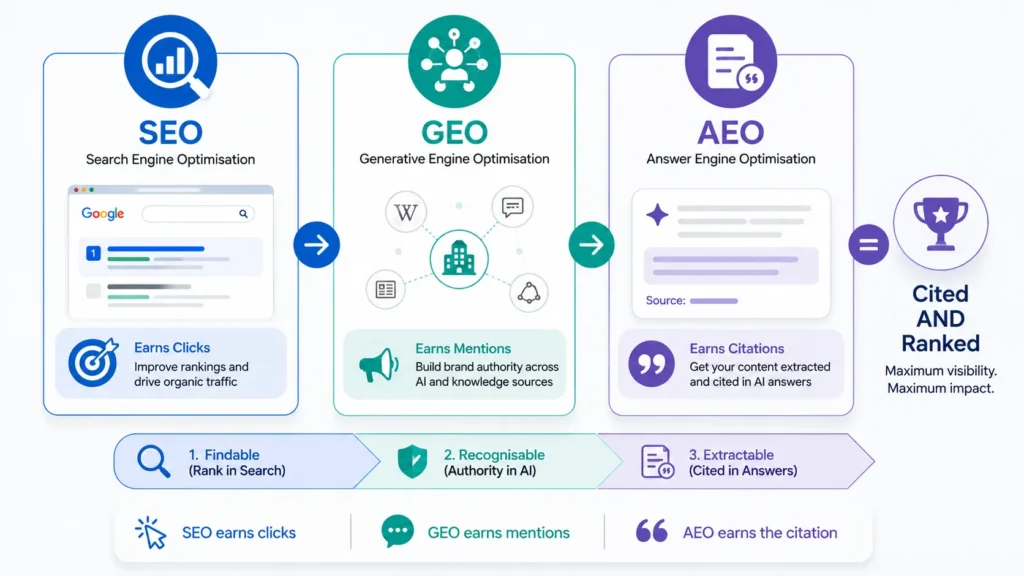
The search marketing world has generated a lot of acronyms in 2026. Before diving into AEO tactics, it helps to be precise about what each term means and how the three disciplines relate to each other.
SEO — Search Engine Optimisation
SEO is the practice of improving the ranking of your pages in search engine results. Its primary metric is position. Its primary mechanism is satisfying the signals that Google’s ranking algorithm uses to evaluate page quality: backlinks, technical health, E-E-A-T, content relevance, and user engagement. SEO earns clicks. It has not become less important in 2026 — it has become the foundation on which the other two disciplines build. According to TryAnalyze.ai’s analysis of 83,670 AI citations, 92.36 percent of AI Overview citations come from domains ranking in Google’s top 10. You cannot skip ranking and jump to citation.
GEO — Generative Engine Optimisation
GEO is the broader discipline of influencing how generative AI systems represent your brand across all surfaces they touch — not just citations in specific answers, but the general entity model AI systems hold about your brand. GEO includes entity clarity work (making sure AI systems can confidently identify and describe your business), brand mention building (appearing on the platforms AI systems use as source material), and Wikidata / Knowledge Graph presence. GEO earns mentions. It is brand-level work that creates the ambient authority AI systems draw on when deciding which sources to trust.
AEO — Answer Engine Optimisation
AEO is the most content-specific discipline of the three. It is the practice of structuring individual pages so that AI extraction systems — the algorithms that decide which passage to pull from which page to use in a generated answer — select your content over a competitor’s. AEO earns citations. It is page-level structural work that turns a ranking page into a citation-eligible page.
The relationship between them is sequential. SEO makes you findable. GEO makes you recognisable as an authority. AEO makes your specific content extractable as the answer. All three must work together for a brand to achieve the “Cited AND Ranked” destination the infographic identifies as the 2026 goal.
“SEO earns clicks; GEO earns mentions; AEO earns the citation. AEO is not a replacement for traditional search optimization. It is an extension of it. The most effective approach is a unified strategy where content ranks in traditional search and gets cited in AI responses.” — Bigeye Agency AEO Guide, 2026
What AI Systems Actually Look for When Selecting Citations
Before you can optimise for AI citations, you need to understand how extraction works. AI systems do not read your page the way a human reads a blog post. They scan for specific structural signals that indicate a passage is citable — clear, specific, attributable, and self-contained.
A Princeton-led study (Aggarwal et al., KDD 2024) found that four content tactics boost AI citation visibility by 30 to 41 percent: adding specific statistics with named sources, citing authoritative external references, using fluent, unambiguous language, and adopting an authoritative, expert voice. None of these are new SEO principles. What is new is that they now determine citation eligibility, not just ranking position.
Frase’s 2026 AEO guide, drawing on millions of citation analyses, ranks the signals that drive AI citation in order of leverage:
- Extractability: can the answer be pulled from your content as a standalone passage without requiring surrounding context? The ideal extractable unit is 40 to 60 words — a direct answer that makes complete sense in isolation.
- Evidence density: does your content include specific statistics, named sources, dates, and measurable claims? Generic opinions are synthesised without citation. Specific data requires a source.
- Freshness: Perplexity cites content published within the last 30 days in 82 percent of its responses. Every AI system shows some recency bias. DateModified timestamps and regular content updates directly affect citation eligibility.
- Entity clarity: does your content clearly identify who you are, what you do, and where your authority comes from? Ambiguous entity signals reduce AI confidence in citing you.
- E-E-A-T signals: named authors with verifiable credentials, original research, and transparent sourcing all raise the trust threshold AI systems apply before citing a source.
- Topical authority: AI systems preferentially cite domains that consistently cover a specific topic area. A site with 15 interlinked posts on local SEO in Delhi earns more citations on that topic than a site with one comprehensive guide.
- Third-party corroboration: AI systems validate claims by cross-referencing multiple sources. Content that states positions also held by other credible sources gets cited more reliably than content making unique claims without supporting evidence.
“AI Overview content changes approximately 70% of the time for the same query. When the answer updates, nearly half of the citations get replaced with new sources. Plan to refresh priority pages every 60 to 90 days.” — Bigeye Agency, 2026
The AEO Content Framework: 7 Structural Changes That Earn Citations
AEO is not a separate content strategy. It is a structural upgrade applied to content that already ranks. The following seven changes, applied to any ranking page, systematically improve its citation eligibility across Google AI Overviews, ChatGPT, Perplexity, and Gemini.
Step 1 — Rewrite Every Section Opening as a Direct Answer
The first 40 to 60 words of every H2 section are the primary extraction target for AI systems. If your section opens with context, background, or a question rather than a direct answer, AI systems skip it. Rewrite every section opener to state the answer first, then expand. “What is AEO?” should be answered in the first sentence: “Answer Engine Optimisation (AEO) is the practice of structuring content to earn direct citations in AI-generated answers from ChatGPT, Perplexity, and Google AI Overviews.” The explanation follows. Never leads.
Step 2 — Add One Specific Statistic Per Section With a Named Source
According to the Princeton study, adding statistics raises AI citation visibility by 30 to 41 percent. But the statistic must be specific and attributed. “Traffic is declining” earns no citation. “68 percent of Google searches ended without a click in early 2026, according to SparkToro and Similarweb” earns a citation because it gives the AI a specific, attributable fact it can anchor its answer to. Add one named statistic per section minimum — and link to the original source in your page copy.
Step 3 — Use Question-Based H2 and H3 Headings
AI extraction systems match heading text against user query patterns. “Content Structure” is a topic label. “How should I structure content for AI citation?” is a query pattern. Rewrite your H2 and H3 headings as natural language questions wherever the content addresses an answerable question. This alignment between heading and user intent is one of the strongest structural signals for AI Overview inclusion, because it makes your content a direct candidate when the query matches the heading.
Step 4 — Add FAQPage Schema to Every FAQ Section
FAQPage schema marks up your question-and-answer pairs in structured data that AI systems — particularly Perplexity and Bing Copilot — actively parse and cite. Google’s own May 2026 guidance confirms that structured data remains valuable for AI citation across non-Google surfaces even as its direct impact on Google AI Overviews remains debated. Implement FAQPage schema on every FAQ section on your site. Each answer should be under 300 characters for full display compatibility.
Step 5 — Update dateModified on Every Page You Touch
AI systems weight freshness as a citation signal. Perplexity cites content under 30 days old in 82 percent of its responses. Pages updated within 90 days receive measurably higher citation rates than older content across all AI platforms. Every time you edit a page — even a minor addition of a statistic or a section rewrite — update the dateModified timestamp in your Article schema. Set your CMS to do this automatically on every save. This single technical change improves citation eligibility for every page on your site.
Step 6 — Build Self-Contained Answer Blocks of 134 to 167 Words
Research on optimal citation passage length identifies 134 to 167 words as the ideal block size for AI extraction. Each block should answer one question completely — without requiring the reader to have read the surrounding sections for context. Think of each H2 section as a standalone card: question implied by the heading, direct answer in the opening sentence, supporting evidence in the body, specific data point in the middle, and a closing sentence that completes the thought. This structure is extractable at any point the AI enters the page.
Step 7 — Diversify Your Citation Surface Across All Three Platforms
Google AI Overviews, ChatGPT, and Perplexity use different signals for citation selection. Optimising only for Google AI Overviews leaves ChatGPT and Perplexity traffic on the table. ChatGPT leans on Wikipedia, domain authority, and established brand entities. Perplexity prioritises freshness and community discussion. Google AI Overviews weight E-E-A-T, ranking position, and schema signals. A complete AEO strategy addresses all three: Wikipedia or Wikidata presence for ChatGPT entity recognition, regular publishing cadence for Perplexity freshness, and E-E-A-T infrastructure for Google.
Measuring AEO: The Metrics That Actually Tell You If It Is Working
Traditional SEO measurement — rank position, organic sessions, CTR — does not capture AEO performance. You can earn 50 AI citations per week and see those sessions appear as direct traffic in GA4, making the citations invisible to your reporting. Measuring AEO requires adding new metrics alongside traditional ones.
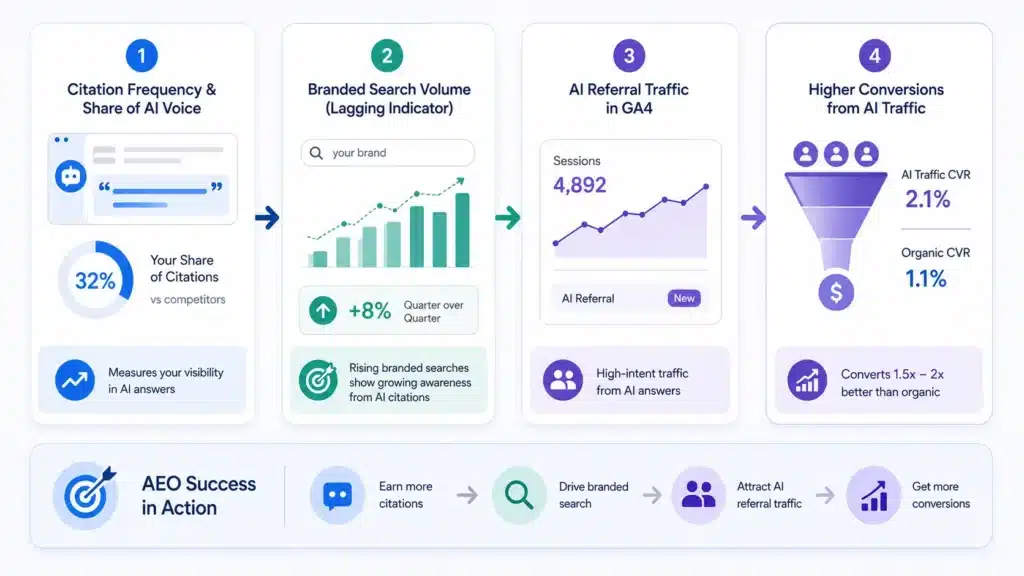
Citation frequency and share of AI voice
Track how often your brand is cited in AI-generated answers for your target queries. Use tools like Otterly.ai, Peec AI, or Promptmonitor to monitor citation frequency across ChatGPT, Perplexity, and Google AI Overviews. Measure your citation share against the two to three competitors most likely to occupy the same citation slots. This is the AEO equivalent of rank position tracking — your relative standing in the AI answer space.
Branded search volume as a lagging indicator
AI citations drive branded search. Users who see your brand cited in an AI answer frequently search for your brand name directly in the days and weeks following. Branded search volume in Google Search Console is therefore a reliable lagging indicator of citation programme success. Track it monthly. A consistent 5 to 10 percent quarter-over-quarter rise in branded search volume indicates your citations are building the brand awareness that drives high-intent direct traffic.
AI referral traffic in GA4
Google added a native AI referral channel group to GA4 in May 2026. Enable it in your channel groupings and track AI-referred sessions separately from organic. These sessions arrive with higher context and higher intent than cold organic traffic — they already know your brand from the citation. Track the conversion rate of AI-referred traffic separately from organic. In most client accounts at Digital Arka, AI-referred sessions convert at 1.5 to 2 times the rate of equivalent organic sessions.
“Only 14% of marketers currently use AI citation tracking, despite 43% naming AI search optimization as a core 2026 strategy. That gap — between concern and action — is where your competitive opportunity lives.” — Goodfirms 2026 Survey
AEO for Indian Businesses: The Delhi NCR Context
Indian businesses face a specific timing advantage in AEO in 2026. Google AI Overviews are rolling out progressively across Indian search — the citation competition for Hindi, Hinglish, and Indian-English queries is significantly lower than for equivalent queries in the US or UK market. An Indian business that builds AEO infrastructure now — structured content, FAQPage schema, entity clarity, brand mentions on relevant Indian platforms — enters a citation competition where the bar is still low.
The most valuable immediate AEO investments for Delhi NCR businesses specifically: claim and optimise your Google Search Profile (launched July 2026), build JustDial and IndiaMart citations for entity corroboration, publish bilingual FAQ content targeting both English and Hinglish query patterns, and earn mentions in Indian digital marketing publications (Economic Times Tech, YourStory, Inc42). Each of these actions builds the entity authority that earns citations when AI Overviews fully expand in the Indian market.
Conclusion: The Citation Is the New Position One
Position one on Google once meant being first in a list of ten options. A citation inside an AI Overview means being the answer — the single source an AI system names when synthesising a response for a user who may never see the list at all. The competitive value of that distinction grows every month as AI Overviews appear on more queries and absorb more clicks.
AEO is not a replacement for SEO. It is the layer that sits on top of ranking and converts it into citation. Without the ranking, there is nothing for the AI to cite. Without the AEO structure, a well-ranked page gets passed over for a competitor whose content is more extractable, more specific, and more directly structured as an answer.
At Digital Arka, we implement AEO as a standard component of every content strategy engagement. We audit extraction eligibility, restructure section openings, add FAQPage schema, build citation tracking dashboards, and monitor branded search volume as the most reliable lagging indicator of citation programme success. Contact us at digitalarka.com or call +91 70110 34858 to find out how your content scores on the seven AEO criteria above.