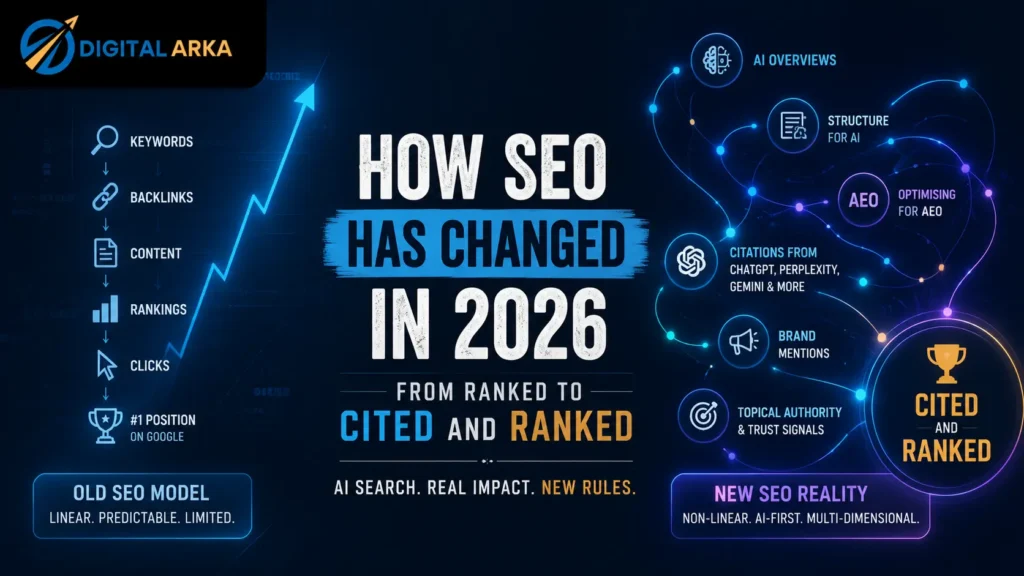

Ask most business owners what SEO involves and they will give you the same answer they would have given in 2019: keywords, backlinks, content, rankings, clicks, and a number one position on Google. Clean. Linear. Logical. And in 2026, almost entirely wrong.
A viral infographic circulating across the SEO community in July 2026 captures the gap between these two realities better than any long-form report. The top half shows the old model — a clean upward arrow moving from keywords through backlinks, content, rankings, and clicks straight to the coveted number one position on Google. The bottom half shows what the journey actually looks like today — a chaotic, looping, multi-directional path that winds from strong SEO foundations through AI Overviews, structure for AI, optimising for AEO, earning citations from ChatGPT, Perplexity, and Gemini, collecting brand mentions, and eventually arriving at a destination that does not even say “ranked” alone. It says: Cited AND Ranked.
That shift — from ranked to cited AND ranked — is the most important change in the history of organic search. This article breaks down what it means, why it happened, and exactly what businesses in India and across the world need to do to win in both dimensions simultaneously.
Part 1: The Way People Think SEO Still Works
The old SEO model was beautifully simple. You identified the keywords your audience searched for. You built backlinks to signal authority to Google. You created content targeting those keywords. Your content climbed the rankings. Users clicked your result. You won.
This model worked because Google’s job, for most of its history, was to present a ranked list of ten blue links and let users decide which one to click. Your goal as an SEO professional was to get your link as close to the top of that list as possible. Everything — keyword research, on-page optimisation, link building, content length, title tag formatting — served that single purpose: rank higher so more people click.
The metrics confirmed it. Position 1 earned a click-through rate of 28 to 35 percent. Position 2 dropped to 15 percent. Position 10 barely registered. The higher you ranked, the more you earned. The model rewarded a clear, measurable input-output relationship that entire agencies, tools, and career paths were built to serve.
“In classic SEO, the unit of measurement is rank. In AI search, the unit is mention. AI engines do not return ten blue links. They synthesize an answer that names two to six sources.” — TryAnalyze.ai AEO vs SEO Report, 2026
This model is not dead. But it is no longer the complete picture. And businesses that treat it as the complete picture in 2026 are optimising for a game that has fundamentally changed the rules halfway through.
Part 2: How SEO Actually Looks in 2026 — The Messy, Non-Linear Reality
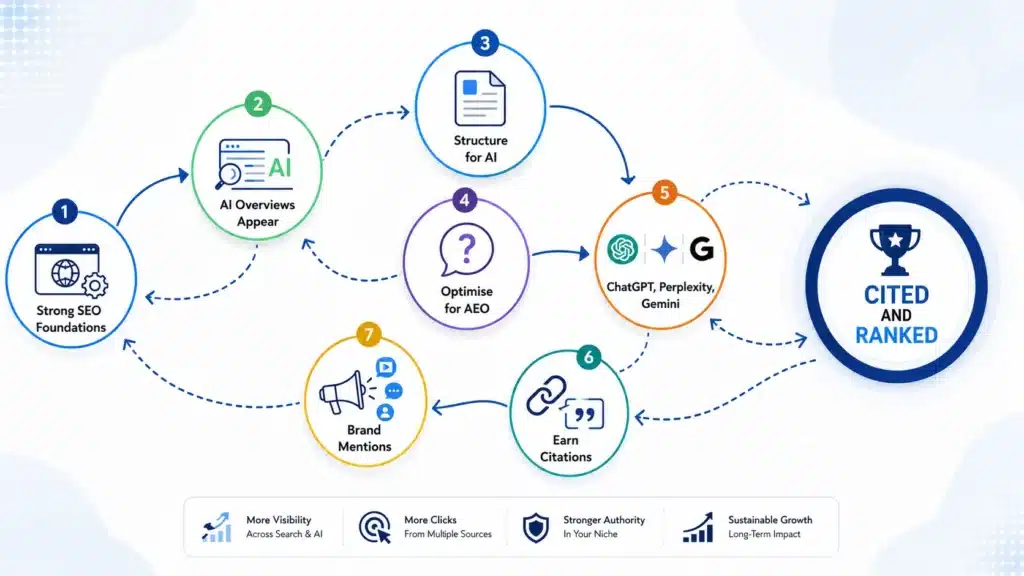
The bottom half of the infographic does not look like a strategy. It looks like a tangle. Arrows cross each other. The path loops back on itself. There are multiple nodes to visit, no fixed sequence, and the end goal — Cited AND Ranked — sounds like two things at once because it is two things at once.
That tangle is not a design flaw. It is an accurate map of how search works in 2026. Let us walk through each node and what it actually demands.
① Strong SEO Foundations — The Floor Has Not Moved
Before anything else — before AI Overviews, before AEO, before brand mentions — your site must have clean technical SEO foundations. Google AI Overviews appear for roughly 47 to 64 percent of all queries in 2026. And according to a 2026 analysis by TryAnalyze.ai drawing on 83,670 AI citations, 92.36 percent of AI Overview citations come from domains ranking in Google’s top 10. AI systems do not discover content independently — they cite what Google already considers authoritative.
Strong foundations mean: fast loading pages (LCP under 2.0 seconds), mobile-first design, clean internal linking, accurate schema markup, correct canonical tags, and crawlable content that Googlebot and AI crawlers can access without JavaScript barriers. These requirements have not changed. They have become more important because they are now the prerequisite for two games: traditional ranking and AI citation eligibility.
“92.36% of AI Overview citations come from domains ranking in Google’s top 10. Domain authority is the single strongest predictor of whether AI engines cite you.” — Dataslayer / SE Ranking, 2026
Read Also: Brand SEO in 2026: Why Your Brand Is Now Your Most Valuable — and Most Measurable — Ranking Asset
② AI Overviews Appear — The SERP Changed Before Your Strategy Did
Google AI Overviews now appear on roughly half of all Google searches. For informational queries — the “what is,” “how to,” “best way to” questions — the trigger rate runs as high as 80 to 88 percent in some industries. When an AI Overview appears, organic clicks at position one drop by an average of 34.5 percent. For some queries, the click rate drops to near zero.
This is the inflection point where the old model breaks. You can rank number one and still lose most of your potential traffic to the AI Overview that sits above you. The infographic captures this perfectly — AI Overviews Appear is a node on the path to success, not an obstacle to route around. Your strategy must account for it and work within it.
③ Structure for AI — Content Architecture Becomes the Differentiator
Once you accept that AI Overviews exist and will not disappear, the strategic question becomes: how do you get cited inside them rather than displaced by them? The answer is content structure.
AI systems extract passages, not pages. They look for the first clear, direct answer to a question in the first 40 to 60 words of a section. They prefer self-contained answer blocks of 134 to 167 words. They follow question-based headings. They trust content that leads with the answer and then expands — not content that buries the answer at the end of a long introduction.
Structuring for AI means rewriting your content architecture, not just adding new content. Every section of every page should open with a declarative answer to the implied question of that section heading. Think of each H2 as a question your user asks and your first paragraph as the answer Google’s AI will extract and cite.
“44.2% of all LLM citations come from the first 30% of an article — your intro section is your most powerful asset.” — RankTrends Future of SEO, 2026
④ Optimise for AEO — Answer Engine Optimisation Is Now a Discipline
Answer Engine Optimisation — AEO — is the practice of structuring content to earn citations inside AI-generated answers from Google AI Overviews, ChatGPT, Perplexity, and Gemini. As SEO Sherpa’s AI Lead put it in 2026: “AEO focuses on getting directly cited, referenced, and selected by answer engines, not just ranked in traditional search results.”
AEO has its own tactical requirements that sit on top of traditional SEO. It demands: FAQPage schema on every FAQ section, direct-answer passage structure in every content block, cited statistics and named expert sources (AI systems prefer content with specific, attributable data), question-based headings that match natural language query patterns, and regular content freshness updates with accurate dateModified timestamps that signal recency to AI systems.
The key distinction between SEO and AEO is this: SEO optimises for the ranking algorithm. AEO optimises for the extraction algorithm — the system that decides which passage from which page to quote inside the synthesised answer. You can rank without being cited. You can be cited while ranking below position five. Both outcomes now matter.
⑤ ChatGPT, Perplexity, Gemini — The Multi-Platform Citation Challenge
The infographic names three AI platforms explicitly in a single node: ChatGPT, Perplexity, and Gemini. This is deliberate. Optimising for Google AI Overviews alone leaves a growing share of AI search traffic unaddressed.
Each platform has different citation behaviour. Perplexity shows a strong freshness bias — approximately 82 percent of its cited content was published within the last 30 days, which means regular, timely publishing is essential for Perplexity visibility. ChatGPT leans heavily on Wikipedia and sources with high domain authority for factual queries. Gemini — powering Google AI Mode, which crossed one billion monthly users at I/O 2026 — prioritises content that aligns with Google’s E-E-A-T signals.
A multi-platform citation strategy requires: consistent brand entity clarity (the same name, description, and facts about your business across all platforms), a presence on Wikipedia or Wikidata for established brands, regular publishing to satisfy Perplexity’s freshness requirement, and strong E-E-A-T infrastructure (author bios, credentials, original research) for Gemini and Google AI Mode.
“Brands cited inside an AI Overview earn 35% more organic clicks and 91% more paid clicks than uncited brands on the same query.” — Seer Interactive, 2026
⑥ Earn Citations — The New Ranking Currency
Citations are what position one used to be. When an AI system names your brand inside its synthesised answer, it is granting you the most powerful visibility signal in modern search: a direct endorsement from the answer system itself. And unlike a ranking position, which users see as one option among ten, a citation presents you as the source — a singular point of authority on the subject.
Earning citations at scale requires building content that is extractable, specific, and verifiable. Extractable means directly answering a question in the first sentence of every section. Specific means including named data, cited sources, and measurable outcomes rather than vague claims. Verifiable means linking to primary sources, citing your own research methodology, and maintaining factual accuracy that AI systems cross-reference.
According to RankTrends’ 2026 analysis, earned media and digital PR can increase AI citations by a median lift of 239 percent. Brands are 6.5 times more likely to be cited through third-party sources than through their own domains — which means getting your brand covered in industry publications, news sites, and community forums is more citation-effective than publishing ten more pages on your own site.
⑦ Brand Mentions — The Signal That Connects All the Others
Brand mentions have always mattered for SEO. In 2026, they matter more than almost anything else, and for a reason that goes beyond traditional link-building logic. AI systems build their entity models of your brand from every mention of your name across the web — on Reddit, YouTube, LinkedIn, news sites, review platforms, and industry forums. The more frequently and positively your brand appears in these contexts, the more confidently AI systems include you in synthesised answers.
Ahrefs’ December 2025 research found that YouTube mentions correlate 0.737 with AI visibility — the strongest single signal in their study of 75,000 brands. Reddit mentions appear in 46.7 percent of Perplexity responses. A single credible mention on a high-authority platform can unlock citation eligibility that dozens of internal page optimisations cannot.
Building brand mentions requires an outreach strategy that goes beyond your website: participate genuinely on Reddit threads in your industry, create YouTube content that earns organic discussion, pursue editorial coverage in industry publications, and respond to every Google review and social mention to demonstrate active brand presence.
⑧ Cited AND Ranked — The 2026 Definition of SEO Success
The infographic ends not at “ranked” but at “Cited AND Ranked.” This dual destination is the most precise summary of what success means in 2026. It means your content earns a traditional organic ranking position in the blue links below the AI Overview. And it means your brand earns a citation inside the AI Overview above those links.
Achieving both simultaneously is not as difficult as the messy path on the infographic suggests. The same inputs that produce strong rankings — authoritative content, strong backlinks, technical health, E-E-A-T signals — also increase AI citation eligibility. The difference is in how you structure and promote that content. Citation-optimised content that also ranks is simply ranking content rebuilt with passage-first structure, direct-answer openers, and multi-platform brand presence layered on top.
Read Also: Zero-Click Search at Scale
Part 3: What This Means for Your Business Right Now
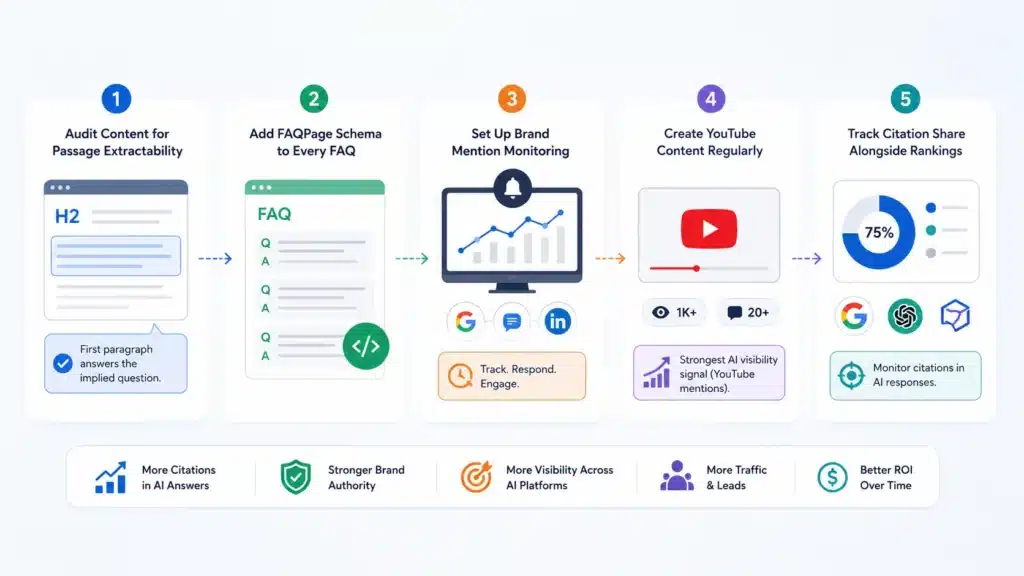
The infographic is a diagnosis. This section is the prescription. Here is what the shift from the old model to the new one demands in practical terms, broken down into the most impactful actions you can take immediately.
▶ Action 1: Audit your content for passage extractability. Open your top 10 most important pages and read only the first paragraph of each H2 section. If those first paragraphs do not directly answer the implied question of the heading, rewrite them. This single change improves AI citation eligibility for every page it touches.
▶ Action 2: Add FAQPage schema to every FAQ section on your site. FAQPage schema does not guarantee AI Overview citations, but it signals to Google, Perplexity, and ChatGPT that your content is structured as question-and-answer pairs — the exact format AI extraction systems prefer.
▶ Action 3: Set up brand mention monitoring. Use Google Alerts, Brand24, or Ahrefs Mentions to track every mention of your business name across the web. Respond to every mention within 24 hours. Engage authentically on Reddit threads and LinkedIn posts where your industry is discussed. Each engagement builds the brand entity signals that AI systems use to decide whether to cite you.
▶ Action 4: Build at least one YouTube video per month on your core topic. YouTube mentions are the single strongest AI visibility signal in Ahrefs’ research. A 3-minute explainer video that earns 1,000 views and 20 comments builds more AI citation authority than 10 additional blog posts.
▶ Action 5: Track citation share alongside rankings. Open Google Search Console and check the AI performance report. Use third-party tools like Otterly.ai or Peec AI to monitor your brand’s citation rate inside ChatGPT and Perplexity responses. According to Goodfirms’ 2026 survey, only 14 percent of marketers currently track AI citations — which means starting now puts you ahead of 86 percent of your competitors.
📞 Digital Arka runs full AI citation audits alongside traditional SEO audits for every client engagement. Contact us at digitalarka.com or call +91 70110 34858 to find out exactly where your brand stands in the cited AND ranked landscape.
Conclusion: The Messy Path Is the Only Path
The old SEO model felt clean because it was linear. Every step led logically to the next. Every metric pointed in one direction. That clarity was comforting — and it produced real results for over two decades.
The new model in 2026 feels messy because it is genuinely more complex. You must maintain strong technical foundations while simultaneously structuring content for AI extraction, building brand presence across platforms you cannot control, earning citations from systems that do not reveal their ranking logic, and tracking metrics that did not exist three years ago. The arrow on the infographic loops and crosses because that is what the modern search journey actually requires.
But here is the critical insight the infographic also communicates: the businesses that navigate the messy path arrive at a better destination. “Cited AND Ranked” is more valuable than “number one on Google” alone. A citation inside an AI Overview that 47 percent of users see before any blue link is more powerful brand exposure than any ranking position. A brand that appears in ChatGPT, Perplexity, and Google AI Overviews simultaneously occupies a share of mind in the search experience that no single ranking position can match.
SEO does look different today. It is harder to navigate, harder to measure, and harder to explain to a client who still thinks the goal is a number one ranking. But for businesses willing to embrace the full complexity of the new model — foundations, structure, AEO, citations, brand mentions, and the dual goal of cited AND ranked — the rewards are proportionally larger than they have ever been.
At Digital Arka, we help businesses across Delhi NCR navigate exactly this journey. From technical SEO foundations to AI citation strategy to brand mention building, we build the complete modern SEO infrastructure that earns visibility in both blue links and AI answers. The game has changed. Let us help you win the new one.