
You Are Getting Impressions. You Are Losing Clicks. Here Is What to Do.
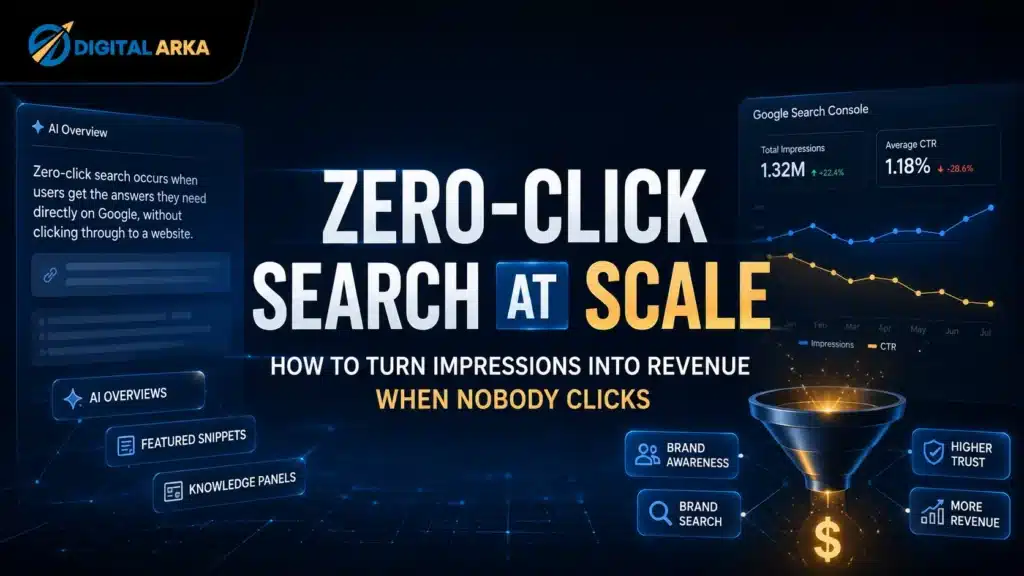
Open Google Search Console for your website right now. Filter by any informational keyword that matters to your business. Look at the impressions column, then look at the CTR column. For most businesses in July 2026, the pattern is the same: impressions are stable or rising, CTR is falling. The gap between those two lines on the GSC performance chart is not a mystery — it is the zero-click effect, measured in real time.
The July 2026 Google Webmaster Report noted that Google’s search team spoke explicitly about “AI clicks” this month — a confirmation that Google tracks and analyses the traffic routing that happens when AI Overviews intercept organic clicks. CMA, the UK Competition and Markets Authority, also ordered Google this month to share how its rankings work — a regulatory signal that the zero-click environment has become significant enough to attract antitrust scrutiny.
At Digital Arka, we work with clients who initially frame zero-click search as a threat. We reframe it as a channel — one that requires different metrics, different content structures, and different conversion strategies than traditional organic search, but one that generates genuine business value when approached correctly. This post explains how.
“Over 60% of all Google searches and 77% of mobile searches resulted in zero-clicks by end of 2025. The CMA ordered Google to share how its rankings work — a signal that zero-click search has reached regulatory significance.” — Google Webmaster Report, July 2026
Understanding Zero-Click Search in July 2026
Zero-click search occurs when a user receives a complete or satisfactory answer to their query within the search results page itself — in an AI Overview, a featured snippet, a knowledge panel, a local pack, or a Google Business Profile card — and does not click through to any website. The Digital Bloom found that over 60 percent of all Google searches in 2026 end this way. For mobile, the figure is 77 percent.
Zero-click search is not uniformly distributed across query types. The AI Overview trigger rates reported by Circles Studio in March 2026 reveal the pattern:
- Informational queries: 80 to 88 percent AI Overview trigger rate in some industries — the majority of these end without a click
- Commercial queries (comparing options, reading reviews): 8.69 percent AI Overview trigger rate — much lower, with more click-through behaviour
- Transactional queries (buying intent, booking intent): 1.76 percent AI Overview trigger rate — users who intend to purchase almost always click through
- Navigational queries (finding a specific brand or website): 1.43 percent AI Overview trigger rate — brand destination searches still drive clicks
This distribution reveals the zero-click strategy. Informational content cannot be optimised for clicks in 2026 — it should be optimised for impressions, citations, and brand exposure. Commercial and transactional content retains strong click-through behaviour and should still be optimised for traditional CTR.
The New Revenue Model for Zero-Click Traffic
Impressions without clicks still generate revenue — but through brand influence, not direct traffic conversion. Research on AI-driven search behaviour consistently shows that users who encounter a brand in an AI Overview, and then later search for that brand directly, convert at dramatically higher rates than cold organic traffic. The journey is: AI Overview creates brand awareness → user remembers brand name → user searches for brand directly → high-intent brand visit → conversion.
Amsive research found that branded queries earn approximately 18 percent higher CTR under AI Overviews than non-branded queries. Seer Interactive data suggests brands cited inside AI-generated answers earn approximately 35 percent more clicks than non-cited competitors. The mechanism is straightforward: being cited in an AI Overview is the highest possible brand endorsement from Google, and users respond to it by seeking out the cited brand directly.
Read Also- SEO for Zero-Click Searches
“Brands cited inside AI-generated answers earn approximately 35% more clicks than non-cited competitors. Branded queries earn 18% higher CTR under AI Overviews than non-branded queries.” — Seer Interactive / Amsive, cited by Circles Studio 2026
5 Strategies to Generate Revenue From Zero-Click Impressions
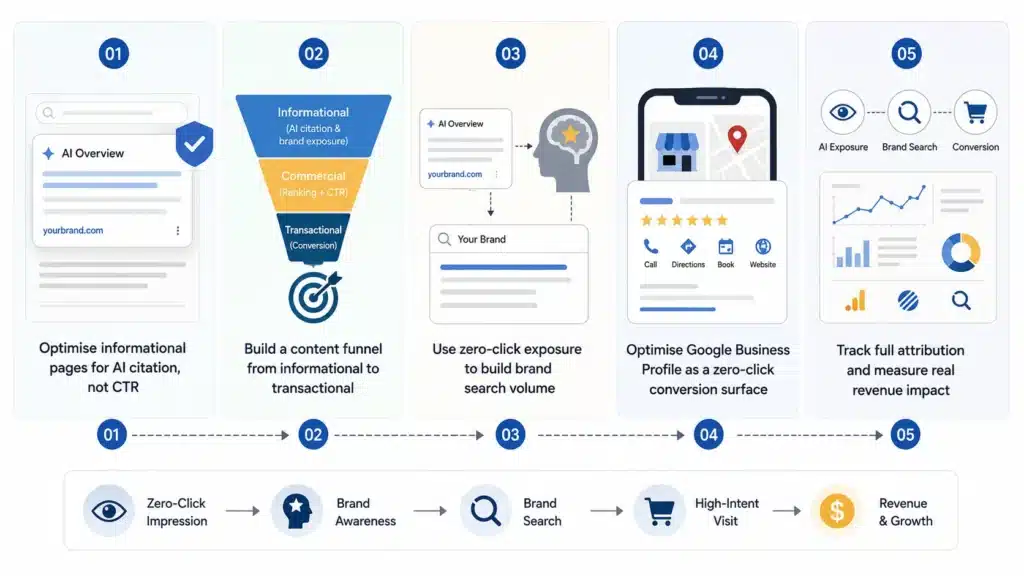
01 Optimise Every Informational Page for AI Citation, Not CTR
Informational pages — how-to guides, definition articles, comparison content — have the lowest click-through rates in 2026 and will not recover them. The correct goal for these pages is AI citation: appearing in the AI Overview that absorbs the click. Being cited means your brand name appears in the synthesised answer, even when the user does not visit your site. Restructure informational pages to front-load direct answers in each section, use question-based H2 headings that match natural language queries, and add FAQPage schema to increase citation eligibility across Google, Perplexity, and ChatGPT.
02 Build a Content Funnel That Moves From Informational to Transactional
Zero-click search absorbs informational intent. Transactional and commercial intent still clicks through. Build a content funnel that uses informational content (optimised for AI citation and brand exposure) to create awareness, and commercial or transactional content (optimised for CTR and conversion) to capture the resulting demand. The bridge between them is brand recognition: users who encounter your brand in an AI Overview on an informational query are more likely to click your result when they reach a commercial or transactional query later.
⚡ Digital Arka content funnel example: Informational → “What is local SEO?” (optimised for AI citation) → Commercial → “Best SEO agencies in Delhi” (optimised for ranking + CTR) → Transactional → “Hire Digital Arka for local SEO” (optimised for conversion). Each stage serves a different role in the zero-click revenue model.
03 Use Zero-Click Exposure to Build Brand Search Volume
Every time your brand appears in an AI Overview, a featured snippet, or a Google Business Profile card — without generating a click — it deposits brand awareness in the user’s memory. Over time, this accumulated awareness drives branded search volume. Track your branded search volume in Google Search Console monthly. Rising branded search volume is the most reliable downstream measure of zero-click brand exposure working correctly. Set a target of 10 percent quarterly growth in branded search volume and build your zero-click citation strategy to hit it.
04 Optimise Google Business Profile as a Zero-Click Conversion Surface
For local businesses, the Google Business Profile card is the primary zero-click conversion surface. Users who receive your GBP information in a local pack or AI Overview response can call you, get directions, book an appointment, or visit your website — all without visiting your main site first. Optimise your GBP as a standalone conversion page: complete all service listings with prices, publish weekly GBP posts with clear CTAs, enable the booking button, and maintain a consistent flow of 10 or more new reviews per month. The GBP conversion rate from zero-click searches is consistently higher than the equivalent conversion rate from organic clicks for local service businesses.
Read Also- Google AI Mode & Zero-Click Search
05 Track the Full Attribution Path — Not Just Last-Click
Zero-click revenue is invisible in last-click attribution models. A user who encountered your brand in an AI Overview three times over two weeks and then searched for your brand name and converted will appear in your analytics as a direct or branded organic conversion — with no record of the AI Overview exposures that created the intent. Implement GA4 AI referral channel tracking (added natively in the May 2026 GA4 update), track branded search volume as a leading revenue indicator, and use Marketing Mix Modelling to attribute the downstream revenue value of zero-click impressions. Without these tools, you will consistently under-value your zero-click strategy and over-invest in low-volume informational content with direct CTR goals it will never achieve.
What Zero-Click Strategy Looks Like in Practice
At Digital Arka, we restructured a client’s content strategy in Q1 2026 around the zero-click model. We stopped measuring informational content by CTR and started measuring it by AI citation share and downstream branded search volume. We restructured 40 informational pages for AI passage extraction, added FAQPage schema site-wide, and built a content funnel connecting awareness to commercial intent queries.
Within 90 days, branded search volume grew 28 percent. Direct traffic grew 19 percent. GSC AI performance impressions grew 340 percent. Revenue attributable to organic search increased 22 percent despite organic CTR on informational pages falling a further 12 percent. The zero-click model works — but only when you measure the right metrics.
Conclusion: Impressions Are Revenue — If You Measure Them Correctly
Zero-click search in 2026 is not a bug in the system. It is the system. Google built it deliberately to keep users in the search experience. The businesses that succeed in this environment are the ones that understand it as a brand channel rather than a traffic channel — and build their content, GBP, and attribution models accordingly.
Digital Arka helps businesses in Delhi NCR rebuild their organic search strategy for the zero-click reality. Contact us at digitalarka.com to see how we can redesign your content funnel, GBP optimisation, and attribution model for 2026’s search landscape.
Frequently Asked Questions (AI-Driven Queries)
These questions reflect real queries people ask AI search engines — Google AI Mode, ChatGPT, Perplexity, and Bing Copilot — about this topic. Each answer follows passage-first structure for maximum citation eligibility.
Q1. What is zero-click search and why is it growing in 2026?
A: Zero-click search occurs when users receive a complete answer to their query within the search results page — in an AI Overview, featured snippet, knowledge panel, or local pack — without clicking through to any website. The Digital Bloom found that over 60% of all Google searches and 77% of mobile searches ended without a click by end of 2025. The primary driver is Google’s AI Overview, which now appears on 80-88% of informational queries in some industries and provides synthesised answers that satisfy user intent without requiring a click.
Q2. How do I make money from zero-click search if nobody clicks to my website?
A: Generate revenue from zero-click search through brand influence, not direct traffic conversion. Being cited in an AI Overview creates brand awareness that drives branded search volume — and users who search for your brand directly convert at dramatically higher rates than cold organic traffic. Seer Interactive data shows brands cited in AI-generated answers earn 35% more clicks than non-cited competitors. Measure success through branded search volume growth, direct traffic trends, and GBP conversion rates rather than informational page CTR.
Q3. What types of queries still generate clicks in 2026?
A: Transactional queries (buying intent, booking intent) have a 1.76% AI Overview trigger rate — users who intend to purchase almost always click through. Commercial queries (comparing options, reading reviews) have an 8.69% trigger rate with significant click behaviour. Navigational queries (finding a specific brand) have a 1.43% trigger rate. Informational queries have 80-88% AI Overview trigger rates in some industries — these rarely generate clicks. Zero-click strategy focuses brand exposure on informational queries and CTR optimisation on commercial and transactional queries.
Q4. How does Google Business Profile help with zero-click conversion?
A: Google Business Profile is the primary zero-click conversion surface for local businesses. Users who see your GBP in a local pack or AI Overview can call, get directions, book an appointment, or visit your site without ever reaching your main website. Optimise your GBP as a standalone conversion page: complete all service listings with prices, publish weekly posts with CTAs, enable booking, maintain 10+ new reviews per month, and respond to all reviews within 48 hours. GBP conversion rates from zero-click searches are consistently higher than equivalent organic CTR for local service businesses.
Q5. What is AI Overview trigger rate and which industries are most affected?
A: AI Overview trigger rate is the percentage of queries in a given category that return an AI Overview at the top of Google’s search results. As of 2026, informational queries trigger AI Overviews at 80-88% in some industries (health, education, technology); commercial queries at 8.69%; transactional queries at 1.76%; and navigational queries at 1.43%. Industries with the highest informational query share — health, legal, finance, education — face the most significant zero-click pressure and benefit most from AI citation optimisation strategies.
Q6. How does AI Overview citation affect my brand differently from a regular organic ranking?
A: An AI Overview citation places your brand name inside Google’s synthesised answer — the equivalent of Google endorsing your brand to the user. Research shows this endorsement effect drives 35% more downstream clicks than equivalent organic rankings without AI citations (Seer Interactive). Regular organic rankings generate clicks only when users scroll past the AI Overview. AI Overview citations generate brand impressions regardless of whether users click — creating a brand awareness dividend that accumulates into branded search volume over time.
Q7. What content structure earns the most AI Overview citations?
A: AI Overview citations favour content that: front-loads a direct, declarative answer in the first sentence of each section; uses question-based H2 headings that match natural language queries; contains self-contained answer blocks of 134-167 words per section; includes specific statistics with cited sources; has FAQPage schema marking up the FAQ section; and demonstrates E-E-A-T through named author credentials, original data, and external validation. Pages that embed the answer inside a narrative intro or bury it after multiple paragraphs of context consistently earn fewer citations.
Q8. How do I track zero-click search impact in Google Analytics 4?
A: Track zero-click impact in GA4 through four signals. First, enable the AI referral channel group (added natively in GA4 May 2026 update) to capture AI Mode-referred sessions. Second, monitor branded search volume in Google Search Console monthly as the primary leading indicator of zero-click brand exposure working. Third, track direct traffic trends — users who discover your brand via AI Overviews and return via direct navigation appear as direct traffic. Fourth, review GSC AI performance reports for impression growth on your target informational queries.
Q9. Should I still create informational content in 2026 if it generates zero-click results?
A: Yes — but with the correct goal. Informational content should be optimised for AI citation and brand exposure, not direct CTR. Being cited in AI Overviews on informational queries builds the brand awareness that drives branded search volume, which drives high-intent direct traffic that converts. The mistake is measuring informational content by the CTR it cannot achieve in a zero-click environment. Measure it instead by AI citation share (GSC AI performance report) and downstream branded search volume growth.
Q10. What is the biggest mistake businesses make in response to zero-click search?
A: The biggest mistake is abandoning informational content investment because CTR fell. Businesses that stop creating informational content lose AI citation share, which reduces brand exposure, which reduces branded search volume, which reduces high-intent direct traffic over 6-12 months. The correct response is to restructure informational content for AI citation (direct-answer structure, FAQ schema, strong E-E-A-T), invest in GBP as a zero-click conversion surface, and shift attribution measurement from last-click to brand signal leading indicators including branded search volume and direct traffic trends.