

A page can pass the Schema Markup Validator with a clean bill of health and still show zero rich results in Google Search. This surprises a lot of people who assume “valid schema” and “eligible for rich results” mean the same thing. They genuinely do not, because the two tools are checking against two different standards, one broad and vocabulary-wide, one narrow and Google-specific.
What the Schema Markup Validator Actually Checks
The Schema Markup Validator, maintained by Schema.org itself, checks whether your structured data is syntactically correct and correctly uses the schema.org vocabulary as a whole. It confirms your JSON-LD (or Microdata/RDFa) is properly formatted, that you are using real schema.org properties and types, and that required and recommended fields for that type are present according to the general schema.org specification, not according to any single search engine’s specific requirements.
What Google’s Rich Results Test Actually Checks
Google’s Rich Results Test checks something narrower and more commercially relevant: whether your structured data qualifies for one of the specific rich result types Google actually displays in search results, FAQ snippets, recipe cards, product listings with review stars, and others from Google’s specific, limited list. Google supports only a subset of the full schema.org vocabulary for rich results, and applies its own additional requirements on top of what schema.org itself requires.
Why a Page Can Pass One and Fail the Other
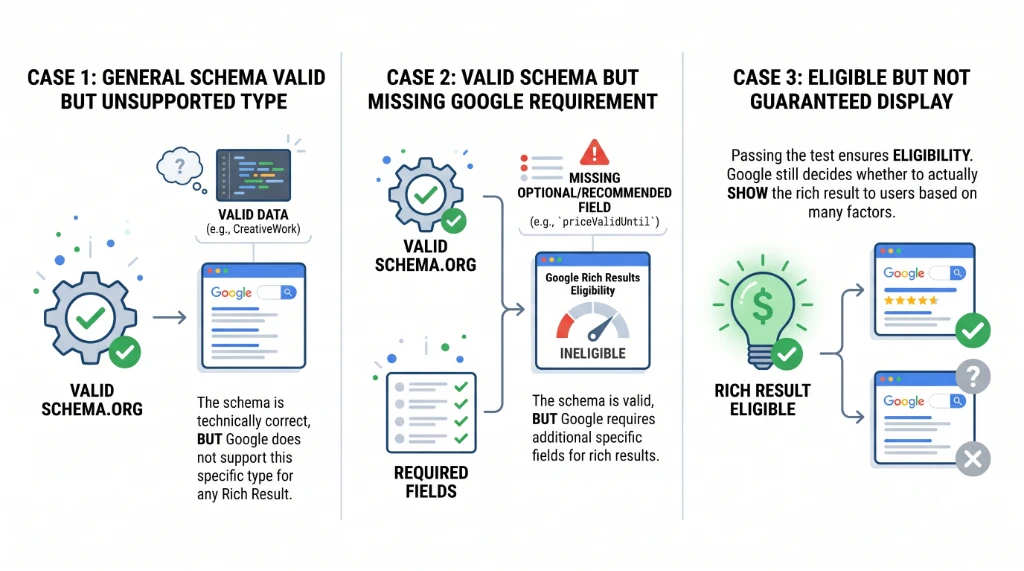
- Valid but not rich-result-eligible – your schema markup might be perfectly valid schema.org structured data for a type Google simply does not support as a rich result at all.
- Valid schema.org, but missing a Google-specific requirement – Google sometimes requires additional fields beyond what schema.org itself lists as required for a given type to actually qualify for the rich result.
- Rich-result-eligible today, but not guaranteed to display – passing Google’s test confirms eligibility, not guaranteed display; Google ultimately decides whether and when to actually show a rich result, even for fully eligible, correctly marked-up pages.
| Aspect | Schema Markup Validator | Google Rich Results Test |
|---|---|---|
| Maintained by | Schema.org | |
| Checks against | Full schema.org vocabulary | Google’s specific supported rich result types |
| Confirms | Structurally valid, correct schema.org usage | Eligibility for a Google rich result specifically |
| Covers other search engines? | Yes, format is universal | No, Google-specific only |
| Guarantees the rich result will display? | N/A | No, only confirms eligibility |
Which Tool Should You Actually Use?
Use both, for different reasons. Check the Schema Markup Validator to confirm your structured data is genuinely correct, well-formed schema.org markup, useful since other search engines and AI systems beyond Google also read schema.org data for their own purposes, including the AI citation and GEO visibility now shaping how content gets surfaced in AI Overviews and chatbot answers. Then check Google’s Rich Results Test specifically to confirm eligibility for Google’s visible rich result features, since that is the tool that actually reflects what might show up in a Google search result.
Conclusion
The Schema Markup Validator answers “is this correct structured data?” Google’s Rich Results Test answers a narrower, more commercial question: “will this specific page potentially earn a visible rich result in Google Search?” A page can pass one and fail the other, and understanding why prevents the common mistake of treating “valid schema” as the same thing as “eligible for a rich result,” when in Google’s system, it genuinely is not.