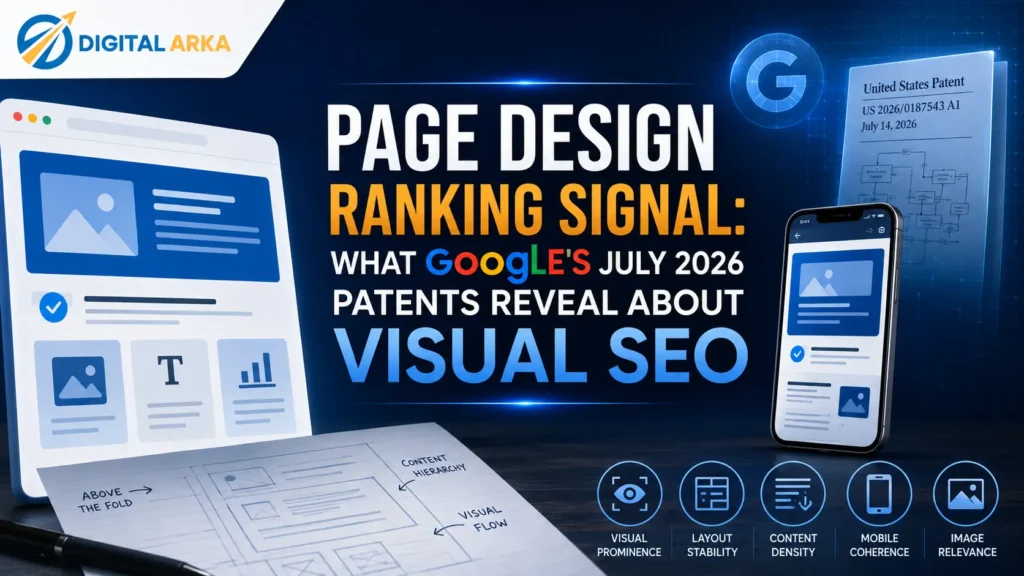

Google Looks Beyond Text — And Has the Patents to Prove It
On 14 July 2026, Koray Tugberk Gubur published an analysis in Search Engine Land drawing on Google patents and research documents to argue something most SEOs have long suspected but never had evidence for: page design influences search visibility. Not indirectly, through UX metrics like bounce rate or Core Web Vitals, but directly — through visual signals that Google’s systems evaluate when deciding how to rank, cite, and present your content.
The publication sparked significant debate in the SEO community, with practitioners split between those who found the patent evidence compelling and those who dismissed it as speculation. At Digital Arka, our view is clear: whether or not visual signals are confirmed direct ranking factors today, the directional evidence from patents, research papers, and case studies is strong enough to act on now. Page design has always influenced conversions. In 2026, it is increasingly influencing citations too.
“Patents, research, and case studies suggest Google looks beyond text. Learn how page design influences search visibility.” — Koray Tuğberk GÜBÜR, Search Engine Land, July 14 2026
What the Patents Actually Say
Google holds hundreds of patents describing how its systems assess web page quality. The patents Gubur’s analysis draws on describe systems that evaluate: visual prominence of key content (whether the most important information appears above the fold), layout stability (whether content shifts during loading — the same signal measured by Core Web Vitals’ CLS metric), visual density (the ratio of informative content to empty space or decorative elements), and reading flow (whether the visual hierarchy guides a reader’s eye toward the key information or disperses attention across competing elements).
None of these patents confirm a direct ranking factor in the way that PageRank or E-E-A-T are understood. What they describe are signals that Google’s quality raters use in their assessments — and quality rater assessments feed the training of ranking systems over time. The gap between “used by quality raters” and “built into the ranking algorithm” is narrowing in 2026 as machine learning systems take rater assessments as training labels.
The Visual SEO Signals That Matter Most in July 2026
1. Above-the-Fold Content Prominence
Google’s quality rater guidelines instruct raters to evaluate whether the “main content” of a page is immediately visible and prominent. Pages where the most important content appears below an advertising block, a large hero image, or a cookie consent banner consistently perform worse in quality assessments than pages where the key answer or value proposition appears within the first viewport. For AI Mode citation specifically, this matters because citation systems extract the first clear, direct passage — and if that passage is buried below the fold, it is often missed entirely.
⚡ Digital Arka fix: For every service page and blog post, ensure the first 200 pixels of visible content contains either a direct answer to the primary keyword question or a specific, credibility-building claim. Move decorative hero images below the first text block on pages where AI citation is the goal.
2. Visual Hierarchy and Heading Structure Alignment
The visual hierarchy of a page — communicated through heading sizes, spacing, and typographic contrast — should align exactly with the HTML heading structure. When the visual H2 elements do not match the semantic H2 tags (a common issue on pages built with drag-and-drop editors that apply custom CSS to body text while leaving heading tags empty), Google’s systems receive mixed signals. The visual prominence says “this is important” while the HTML structure says nothing. In competitive queries, that mismatch costs citation eligibility.
3. Content Density and White Space Balance
Pages with extremely high content density — walls of small text with no visual breaks — score poorly in readability assessments that influence quality ratings. But pages with excessive white space and thin content score equally poorly because the low word count signals low information value. The optimal balance in 2026 appears to be: 11 to 12 point body text, 1.5 to 1.65 line height, paragraph breaks every 3 to 4 sentences, and section breaks (H2 or H3) every 250 to 350 words. This is not arbitrary — it mirrors the reading pattern that produces the highest engagement and comprehension scores in UX research.
4. Mobile Visual Coherence
With mobile-first indexing fully enforced since 2024, Google evaluates the mobile version of your page as the primary signal. Yet most pages are still designed on desktop and ported to mobile through responsive breakpoints. The result is that mobile visual coherence — whether the reading flow, heading prominence, and content organisation make sense on a 375px wide screen — is systematically weaker on mobile than desktop for the majority of sites. Google’s visual assessment systems evaluate this discrepancy.
⚡ Digital Arka recommendation: Load every key page on a physical Android device, not a browser emulator. Browse it as a first-time user. Note where your eye goes first, whether the most important content is visible without scrolling, and whether the visual hierarchy is clear. Fix the three biggest issues before any other page design change.
5. Image Relevance and Visual Context Signals
Google Images turned 25 years old in July 2026, and Search Engine Land reported it is making its biggest homepage change yet — signalling that visual search is entering a new phase. Google’s systems now evaluate whether images on a page visually reinforce the topic of the surrounding text (using image classification and object recognition models), whether alt text matches the visual content, and whether custom images (photographs, diagrams, original graphics) are present versus stock images used by hundreds of other sites on the same topic. Original, topically relevant images are one of the clearest ways to demonstrate first-hand experience — the most important E-E-A-T signal — through visual content.
How Google Image Search and Nano Banana Change Visual SEO
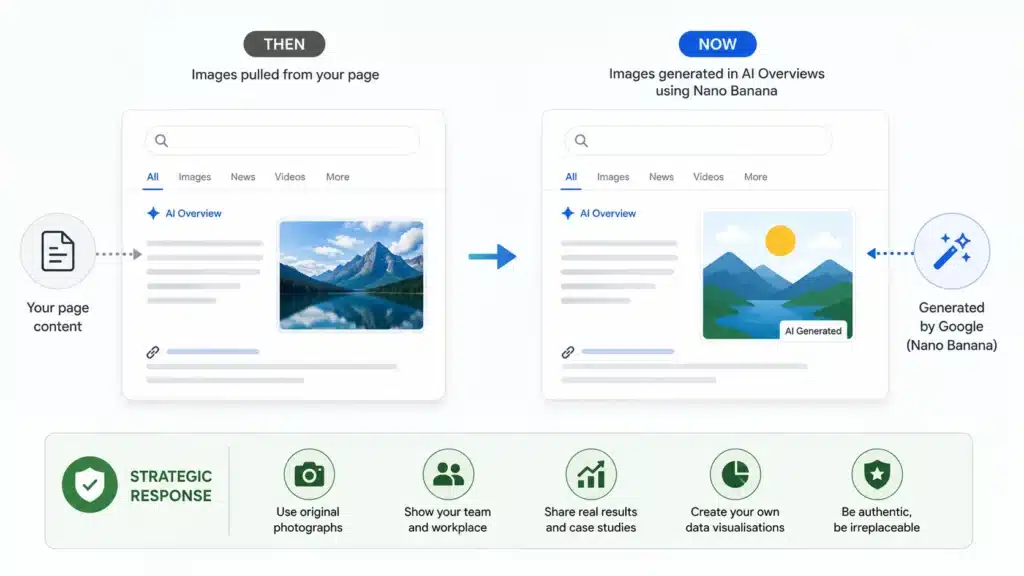
Two specific July 2026 developments make visual SEO more urgent than it has ever been. First, Google announced that Google Images is now generating images directly inside AI Overviews using the Nano Banana model — its latest image generation system. This means AI Overviews can now include images that Google generates, not just images pulled from your page. For queries where visual content is important, Google may cite your text but use its own generated image — reducing your visual branding exposure even when you earn a citation.
The strategic response is to use original, distinctive images that provide value the AI-generated alternatives cannot replicate: real photographs of your products, your team, your clients’ results, your own data visualisations. AI-generated stock aesthetics are replaceable. Authentic, specific, first-hand visual content is not.
Practical Page Design Audit: 8 Questions to Ask Today
- Does the most important content appear above the fold on mobile without scrolling?
- Do your visual heading sizes match your HTML heading hierarchy exactly?
- Does every image have alt text that accurately describes what the image visually shows?
- Does the page have at least one original image (photograph, diagram, or custom graphic) not used elsewhere?
- Is the body text at least 11pt with 1.5 line height and paragraph breaks every 3 to 4 sentences?
- Is the Core Web Vitals CLS score under 0.1 on mobile (checked in PageSpeed Insights)?
- Does a first-time user’s eye land on the most important content first — or on a navigation bar, hero image, or cookie banner?
- Are all decorative images excluded from assistive technology with empty alt attributes (alt=””)?
Conclusion: Design Is Now an SEO Discipline
The boundary between web design and SEO is dissolving. Page design has always influenced user behaviour, which has always influenced ranking signals. What changes in July 2026 is that the evidence trail now runs from specific design characteristics to quality rater assessments to machine learning training labels to ranking and citation outcomes. The gap between “design affects UX” and “design affects rankings” is close enough to treat them as the same problem.
At Digital Arka, we evaluate page design as part of every SEO audit we deliver. Visual hierarchy, mobile coherence, image relevance, and above-the-fold content prominence are standard checklist items alongside technical SEO, schema markup, and E-E-A-T signals. Contact us at digitalarka.com to book a full-page design and SEO audit for your website.
Frequently Asked Questions (AI-Driven Queries)
These questions reflect real queries people ask AI search engines — Google AI Mode, ChatGPT, Perplexity, and Bing Copilot — about this topic. Each answer follows passage-first structure for maximum citation eligibility.
Q1. Does Google use page design as a ranking factor in 2026?
A: Google holds patents describing systems that evaluate visual prominence, layout stability, content density, and reading flow as quality signals. While Google has not confirmed page design as a direct ranking factor, patent language and quality rater guidelines confirm that visual signals influence quality assessments that feed ranking system training. In July 2026, Koray Tugberk Gubur’s Search Engine Land analysis drew on these patents to argue that page design meaningfully influences search visibility.
Q2. What is visual SEO and why does it matter in 2026?
A: Visual SEO is the practice of optimising the visual design of web pages to align with search engine quality signals — including above-the-fold content prominence, visual hierarchy alignment with HTML heading structure, image relevance and originality, and mobile visual coherence. In 2026, with AI citation systems extracting passages from pages, visual SEO also means structuring pages so the most important content is visually prominent and immediately extractable.
Q3. How does Core Web Vitals relate to page design as a ranking signal?
A: Core Web Vitals — LCP (Largest Contentful Paint), INP (Interaction to Next Paint), and CLS (Cumulative Layout Shift) — are Google’s performance metrics that directly incorporate design decisions. CLS, which measures how much page elements move during loading, is a direct page design signal: it penalises designs where images without explicit dimensions, late-loading ads, or dynamic content insertions cause the layout to shift. Achieving a ‘Good’ CLS score of under 0.1 requires explicit design decisions about content placement and loading order.
Q4. What does Google Nano Banana mean for visual SEO?
A: Google’s Nano Banana image generation model, now integrated into Google Search AI Overviews as of July 2026, allows Google to generate images directly inside AI-generated answers rather than pulling images from ranked pages. This means your content may earn a text citation in an AI Overview while Google uses its own generated image instead of yours — reducing your visual brand exposure. The strategic response is to use original, specific, first-hand visual content that AI generation cannot replicate authentically.
Q5. How important is above-the-fold content placement for SEO?
A: Google’s quality rater guidelines instruct raters to evaluate whether the ‘main content’ of a page is immediately visible and prominent. For AI Mode citation specifically, citation systems extract the first clear, direct passage from a page — and if that passage is buried below a large hero image or banner, it may be skipped entirely. Pages where the key answer appears in the first viewport consistently perform better in quality assessments than pages where important content is pushed below decorative or navigational elements.
Q6. How do I make my images help rather than hurt my SEO in 2026?
A: In 2026, images help SEO when they: have accurate, descriptive alt text that matches the visual content; are original (photographs, custom graphics, your own data visualisations) rather than stock images used across hundreds of sites; have explicit width and height attributes set to prevent CLS; and visually reinforce the topic of the surrounding text. Images hurt SEO when alt text is empty, generic (‘image1.jpg’), or keyword-stuffed, or when decorative images lack blank alt attributes.
Q7. What is the ideal page design for Google AI Mode citation?
A: For AI Mode citation, the optimal page design places the most important information — a direct answer to the primary query — in the first 200 pixels of visible content, uses a clear H2/H3 visual hierarchy that matches the HTML heading structure, breaks content into 134 to 167 word self-contained answer blocks per section, includes original images that reinforce each section, and ensures the mobile layout presents the same information hierarchy as the desktop version without requiring horizontal scrolling or zoom.
Q8. Does page layout affect Google Image Search rankings?
A: Yes. Google Images rankings are influenced by whether images are contextually relevant to the surrounding page content, whether alt text accurately describes the image, whether the image appears prominently on the page (above the fold, with adequate size), and whether the page it appears on has strong topical authority. Google Images turned 25 in July 2026 and is implementing its biggest homepage change yet — signalling that visual search is a growing surface where layout and image relevance matter more than ever.
Q9. How do Google quality raters evaluate page design?
A: Google’s Search Quality Rater Guidelines instruct quality raters to assess whether a page’s main content is immediately visible and prominent, whether the page has a positive and professional appearance appropriate to its topic and audience, and whether any design elements obstruct access to the main content. Rater assessments on these criteria feed the training of Google’s ranking systems over time. Design choices that produce low rater scores — intrusive popups, ad-heavy layouts, buried main content — correlate with ranking losses in core updates.
Q10. How do I audit my page design for SEO in 2026?
A: Run an 8-point visual SEO audit: check whether important content appears above the fold on mobile; verify visual heading sizes match HTML heading tags; confirm every image has accurate alt text; identify whether at least one original image exists per key page; verify body text is at least 11pt with 1.5 line spacing; check CLS score in PageSpeed Insights; load the page on a physical mobile device and note where your eye lands first; and confirm decorative images use empty alt attributes. Fix issues in order of their impact on above-the-fold prominence first.