In the battle of analytics giants, PostHog and Google Analytics each offer unique advantages. But which tool truly reigns supreme for your business?
Overview of PostHog
PostHog is an open-source product analytics platform that has been gaining traction for its robust feature set and flexibility. Unlike many traditional analytics tools, PostHog allows users to have complete control over their data, as it can be self-hosted. This means that businesses can manage their analytics data without relying on third-party servers, leading to enhanced data privacy and security. Additionally, PostHog’s open-source nature means that it is continuously evolving, with a global community contributing to its development and improvement.
One of the standout features of PostHog is its ability to offer real-time event tracking and analysis. This allows businesses to gain immediate insights into user behavior, making it easier to make data-driven decisions on the fly. The platform also provides advanced features such as session recording, feature flags, and A/B testing, which can be incredibly useful for product teams looking to optimize their offerings. Furthermore, PostHog’s user-friendly interface and customizable dashboards make it accessible even for those who may not have extensive technical expertise.
Moreover, PostHog integrates seamlessly with a variety of other tools and platforms, making it a versatile choice for businesses of all sizes. Whether you are a startup looking to grow or an established enterprise seeking more control over your analytics data, PostHog offers a comprehensive suite of tools to meet your needs. Its open-source model also means that it can be tailored to fit specific requirements, providing a level of customization that is often lacking in more traditional analytics platforms.
Overview of Google Analytics
Google Analytics is one of the most widely used web analytics services globally, and for good reason. Launched by Google in 2005, it has evolved into a comprehensive tool that offers a wide range of features designed to help businesses understand their website traffic and user behavior. One of the most significant advantages of Google Analytics is its integration with other Google services, such as Google Ads, Search Console, and Data Studio, making it a powerful tool for digital marketers.
Google Analytics provides detailed reports on various aspects of user interaction, including page views, session duration, bounce rate, and conversion tracking. These metrics are invaluable for businesses looking to optimize their websites and improve user experience. The platform also offers advanced features such as cohort analysis, user segmentation, and multi-channel attribution, which can provide deeper insights into user behavior and the effectiveness of marketing campaigns. Additionally, Google Analytics supports custom reporting and dashboard creation, allowing businesses to tailor the data to their specific needs.
Moreover, Google Analytics has a relatively user-friendly interface, although it can be overwhelming for newcomers due to the sheer volume of data available. Fortunately, Google offers extensive documentation and support resources, including tutorials, webinars, and a dedicated help center, to assist users in getting the most out of the platform. The platform’s free version is robust enough for most small to medium-sized businesses, while the premium version, Google Analytics 360, offers additional features and support for larger enterprises.
Key Features Comparison
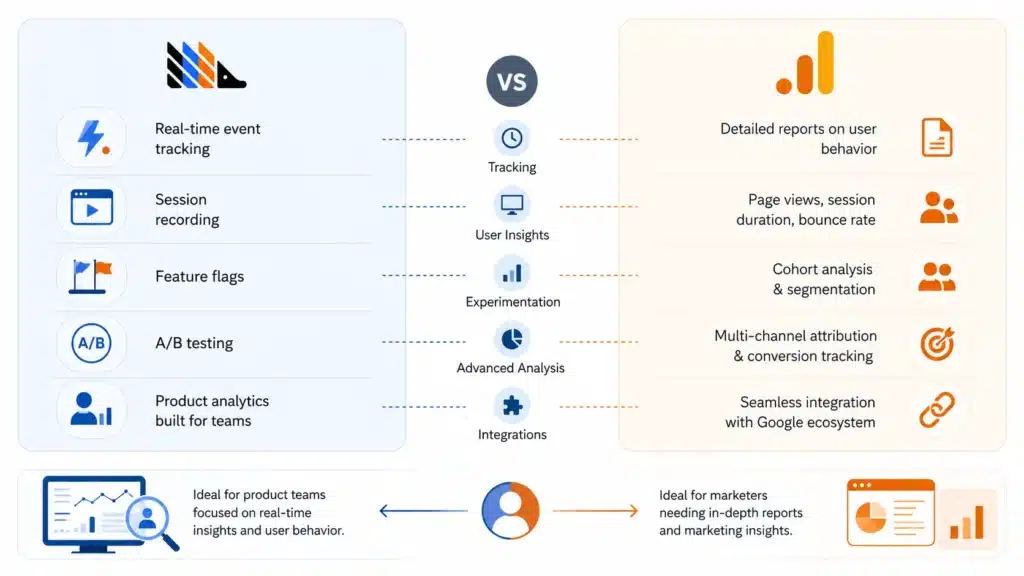
When comparing PostHog and Google Analytics, it’s essential to consider the key features each platform offers. Both tools provide robust analytics capabilities, but there are some significant differences that could influence your decision.
PostHog’s real-time event tracking is one of its most compelling features. This allows businesses to monitor user behavior as it happens, providing immediate insights that can be used to make quick adjustments and improvements. Additionally, PostHog offers advanced features such as session recording, which enables businesses to see exactly how users interact with their product. This can be particularly useful for identifying pain points and areas for improvement. Feature flags and A/B testing are other notable features, allowing businesses to experiment with different versions of their product and determine which performs best.
On the other hand, Google Analytics excels in providing detailed reports on user behavior, including metrics such as page views, session duration, and bounce rate. These reports can be customized to focus on specific aspects of user interaction, making it easier to identify trends and patterns. Google Analytics also offers advanced features such as cohort analysis, which groups users based on shared characteristics, and multi-channel attribution, which helps businesses understand the impact of different marketing channels on conversions. Additionally, Google Analytics integrates seamlessly with other Google services, providing a comprehensive view of your digital marketing efforts.
While both platforms offer powerful analytics capabilities, the choice between PostHog and Google Analytics may come down to your specific needs and preferences. If real-time tracking and user session recording are critical for your business, PostHog may be the better choice. However, if you need detailed reports and advanced marketing insights, Google Analytics could be the more suitable option.
Ease of Use: PostHog vs Google Analytics
Ease of use is a crucial factor when choosing an analytics tool, as it can significantly impact how effectively you can leverage the platform’s features. Both PostHog and Google Analytics have their strengths and weaknesses in this regard.
PostHog is designed with user-friendliness in mind, offering an intuitive interface that makes it easy to navigate and access the various features. The platform’s customizable dashboards allow users to tailor the view to their specific needs, making it easier to find and analyze the data that matters most. Additionally, PostHog’s self-hosted model means that businesses have complete control over their data, which can simplify compliance with data privacy regulations. However, setting up and managing a self-hosted instance can be more complex than using a cloud-based service, and may require some technical expertise.
Google Analytics, while also user-friendly, can be more overwhelming for newcomers due to the sheer volume of data and features available. The platform’s interface is well-organized, but it can take some time to learn how to navigate and make the most of the various reports and tools. Fortunately, Google provides extensive documentation and support resources, including tutorials, webinars, and a dedicated help center, to assist users in getting started. Additionally, Google Analytics’ integration with other Google services can streamline the process of setting up and managing your analytics data.
Ultimately, the ease of use of each platform will depend on your specific needs and level of technical expertise. If you value simplicity and control over your data, PostHog may be the better choice. However, if you need a comprehensive tool with extensive support resources, Google Analytics could be the more suitable option.
Read Also: Google Search Profiles Are Live:
Pricing Models: Which Tool Offers More Value?
Pricing is another critical factor to consider when choosing an analytics tool. Both PostHog and Google Analytics offer different pricing models, each with its own set of advantages and disadvantages.
PostHog operates on a freemium model, offering a free tier with basic features and paid plans for more advanced capabilities. The free tier includes essential analytics features such as event tracking, user segmentation, and dashboard customization. For businesses that need more advanced features, such as session recording and A/B testing, PostHog offers several paid plans that scale based on usage. This pricing model can be advantageous for startups and small businesses, as it allows them to start with the free tier and upgrade as their needs grow. Additionally, the ability to self-host PostHog means that businesses can avoid the recurring costs associated with cloud-based services.
Google Analytics also offers a freemium model, with a robust free version that provides a wide range of analytics features. The free version is sufficient for most small to medium-sized businesses, offering detailed reports on user behavior, traffic sources, and conversion tracking. For larger enterprises that need more advanced features and support, Google offers Google Analytics 360, a premium version with additional capabilities such as more in-depth data analysis, higher data limits, and dedicated support. The premium version comes with a higher price tag, but it can provide significant value for businesses that require advanced analytics and dedicated support.
When comparing the pricing models of PostHog and Google Analytics, it’s essential to consider your specific needs and budget. If you are a small business or startup looking for a cost-effective solution, PostHog’s free tier and scalable paid plans may offer more value. However, if you require advanced features and dedicated support, Google Analytics 360 could be the better investment.
Data Privacy and User Control
Data privacy and user control have become increasingly important considerations for businesses in recent years. Both PostHog and Google Analytics offer features to help businesses comply with data privacy regulations, but there are some key differences between the two platforms.
PostHog’s self-hosted model provides a significant advantage when it comes to data privacy and user control. By hosting the platform on your own servers, you have complete control over your analytics data, ensuring that it is not shared with third parties. This can simplify compliance with data privacy regulations such as GDPR and CCPA, as you can manage data access and retention policies directly. Additionally, PostHog’s open-source nature means that you can audit the platform’s code and make any necessary modifications to meet your specific privacy requirements.
Google Analytics, as a cloud-based service, requires businesses to share their analytics data with Google. While Google provides robust data privacy features and complies with various data protection regulations, some businesses may prefer to retain full control over their data. Google Analytics offers tools to help businesses comply with data privacy regulations, such as data anonymization, data retention controls, and user consent management. However, the fact that data is stored on Google’s servers may be a concern for businesses with stringent data privacy requirements.
Read Also: Zero-Click Search at Scale
When it comes to data privacy and user control, PostHog’s self-hosted model offers a significant advantage. However, Google Analytics provides robust privacy features that can help businesses comply with data protection regulations. The choice between the two platforms will depend on your specific privacy requirements and your preference for cloud-based versus self-hosted solutions.
Integration with Other Tools and Platforms
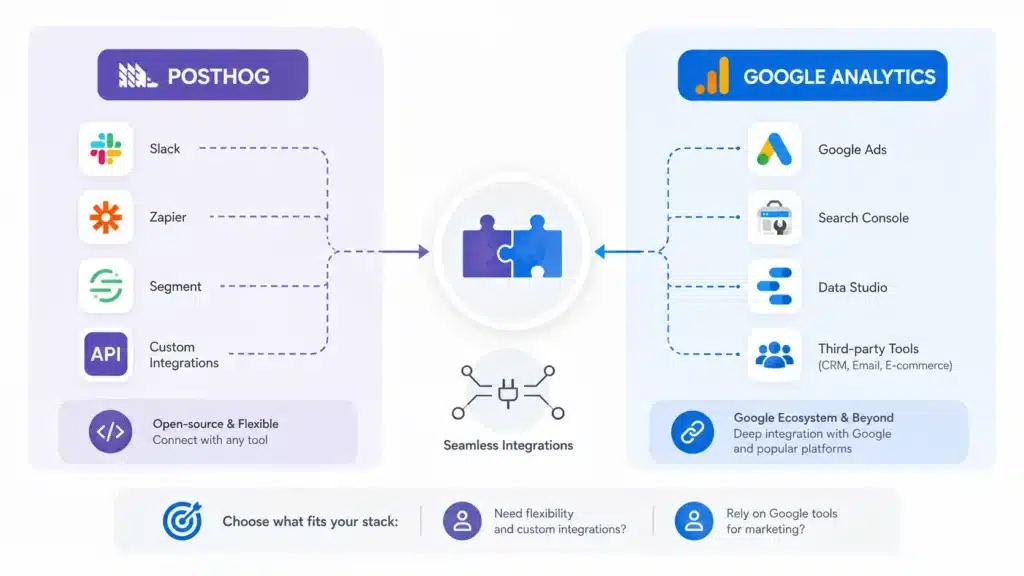
The ability to integrate with other tools and platforms is a crucial factor to consider when choosing an analytics tool. Both PostHog and Google Analytics offer robust integration capabilities, but there are some key differences between the two platforms.
PostHog supports integration with a wide range of tools and platforms, making it a versatile choice for businesses of all sizes. The platform offers built-in integrations with popular tools such as Slack, Zapier, and Segment, as well as APIs that allow for custom integrations. This flexibility makes it easy to connect PostHog with your existing tech stack and streamline your analytics workflow. Additionally, PostHog’s open-source nature means that the community is continuously developing new integrations, ensuring that the platform remains up-to-date with the latest tools and technologies.
Google Analytics, as part of the Google ecosystem, offers seamless integration with other Google services, such as Google Ads, Search Console, and Data Studio. This makes it a powerful tool for digital marketers, as it provides a comprehensive view of your marketing efforts and allows for more effective campaign optimization. Google Analytics also supports integration with a wide range of third-party tools and platforms, including CRM systems, email marketing platforms, and e-commerce solutions. The platform’s extensive documentation and support resources make it easy to set up and manage these integrations.
When comparing the integration capabilities of PostHog and Google Analytics, it’s essential to consider your specific needs and the tools you are currently using. If you rely heavily on Google services, Google Analytics may be the better choice due to its seamless integration with the Google ecosystem. However, if you need a more flexible and customizable solution, PostHog’s robust integration capabilities and open-source nature may offer more value.
Read Also: Search Generative AI Performance Reports Explained
Case Studies: Real-World Applications of Both Tools
To better understand the strengths and weaknesses of PostHog and Google Analytics, it’s helpful to look at real-world applications of both tools. Case studies can provide valuable insights into how businesses are using these platforms to improve their analytics and make data-driven decisions.
One notable case study for PostHog involves a SaaS company that was looking to gain deeper insights into user behavior and optimize their product. The company chose PostHog due to its real-time event tracking and session recording capabilities, which allowed them to see exactly how users were interacting with their product. By analyzing this data, the company was able to identify pain points and areas for improvement, leading to a significant increase in user retention and satisfaction. Additionally, the ability to self-host PostHog gave the company complete control over their data, ensuring compliance with data privacy regulations.
On the other hand, a case study for Google Analytics involves a large e-commerce retailer that wanted to optimize their marketing campaigns and improve conversion rates. The retailer chose Google Analytics due to its seamless integration with Google Ads and other Google services, which provided a comprehensive view of their marketing efforts. By analyzing the data from Google Analytics, the retailer was able to identify which marketing channels were driving the most conversions and optimize their campaigns accordingly. This led to a significant increase in sales and a higher return on investment for their marketing efforts.
These case studies highlight the different strengths of PostHog and Google Analytics. PostHog’s real-time tracking and session recording capabilities make it a powerful tool for product optimization, while Google Analytics’ integration with Google services and advanced marketing insights make it an excellent choice for digital marketers. The choice between the two platforms will depend on your specific needs and the type of insights you are looking to gain.
Read Also: PostHog’s Blogs and Case studies
Conclusion: Choosing the Right Tool for Your Needs
In the battle of analytics giants, both PostHog and Google Analytics offer unique advantages that can help businesses gain valuable insights and make data-driven decisions. The choice between the two platforms will depend on your specific needs, budget, and preferences.
PostHog’s real-time event tracking, session recording capabilities, and self-hosted model make it a powerful tool for businesses looking for more control over their data and the ability to gain immediate insights into user behavior. The platform’s flexible and customizable nature, combined with its robust integration capabilities, make it a versatile choice for businesses of all sizes.
On the other hand, Google Analytics’ detailed reports, advanced marketing insights, and seamless integration with other Google services make it an excellent choice for digital marketers. The platform’s extensive documentation and support resources, combined with its robust free version, make it accessible for businesses of all sizes.
Ultimately, the choice between PostHog and Google Analytics will depend on your specific needs and the type of insights you are looking to gain. By carefully considering the key features, ease of use, pricing models, data privacy, integration capabilities, and real-world applications of both tools, you can make an informed decision that will help you achieve your business goals.