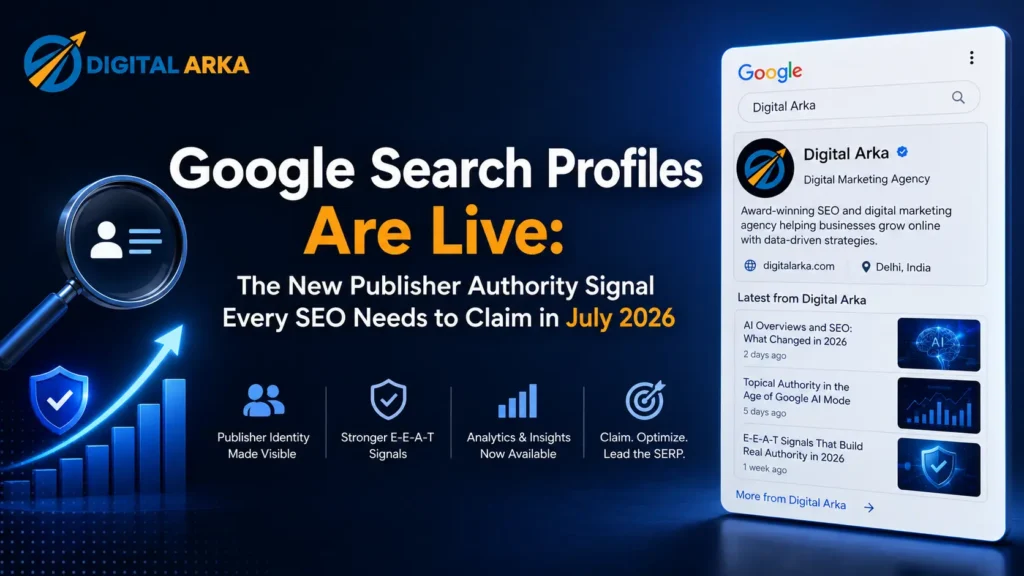

Google Quietly Launched One of Its Most Important Publisher Features of the Decade
In a month dominated by volatility headlines and AI Overview updates, the most structurally important SEO development of July 2026 barely made the front page of most industry blogs. Google Search Profiles — publisher-facing profile pages designed to showcase a site’s authority and recent coverage — went officially live this month. Google then moved faster than expected, rolling out a dedicated analytics and insights view for them within days of launch.
The Numinix July 2026 SEO update report described them as “publisher-facing profile pages designed to showcase a site’s authority and recent coverage.” Search Engine Roundtable covered the analytics rollout separately, confirming that Google acted quickly to provide publishers with visibility data for their new profiles.
At Digital Arka, we believe Google Search Profiles will become one of the most important E-E-A-T signals of the next 12 months. This is not speculation — it is a logical extension of a pattern Google has been building toward for two years: shifting from anonymous web pages to identifiable entities with documented authority. Search Profiles make that entity identity visible, verifiable, and trackable. Publishers who claim and optimise theirs now build a structural advantage that competitors who wait will not easily close.
“Google launched Search Profiles and was quick to give us analytics for that… Google is testing a lot of new user interfaces and search features, including updates to Google Business Profiles.” — Google Webmaster Report, July 2026, Search Engine Roundtable
What Are Google Search Profiles?
Google Search Profiles are publisher-level identity pages that appear in Google Search when users search for a publication, blog, or website by name. Think of them as the publisher equivalent of a Google Business Profile for local businesses, or a Google Knowledge Panel for public figures — but specifically designed for websites, blogs, and content publishers.
A Search Profile displays: the publisher’s name and logo, a brief description of what the publication covers, links to recent articles, audience signals (what topics the site covers and who searches for it), and editorial credibility markers including author roster and content history. The analytics view Google released alongside the profiles gives publishers data on how users interact with their Search Profile — impressions, clicks, and engagement signals that mirror the data previously only available for Google Business Profiles.
The strategic significance is this: Search Profiles give Google a single entity reference point for a publisher that functions independently of any individual URL. Previously, Google assessed publisher authority through aggregate signals across all indexed pages. Search Profiles create a top-level entity layer above individual pages — a publisher identity node in the Knowledge Graph that all individual articles inherit authority from.
Why Search Profiles Are an E-E-A-T Breakthrough
E-E-A-T’s authoritativeness component has always been the hardest to build and the hardest to measure. Expertise lives on the page (author bios, credentials, original research). Trustworthiness lives in technical signals (HTTPS, contact info, accurate content). But authoritativeness lives in what the rest of the web says about you — backlinks, mentions, and reputation signals that are difficult to observe directly.
Search Profiles change this by creating a Google-managed surface where authoritativeness becomes directly visible: how many searches include your publication name, how users engage with your profile, which topics you cover consistently, and which of your articles Google associates with your publisher entity. Publishers who establish clear, complete Search Profiles give Google’s quality rater systems a direct signal of editorial legitimacy that previously required cross-referencing dozens of indirect sources.
5 Ways to Maximise Your Google Search Profile for SEO Authority
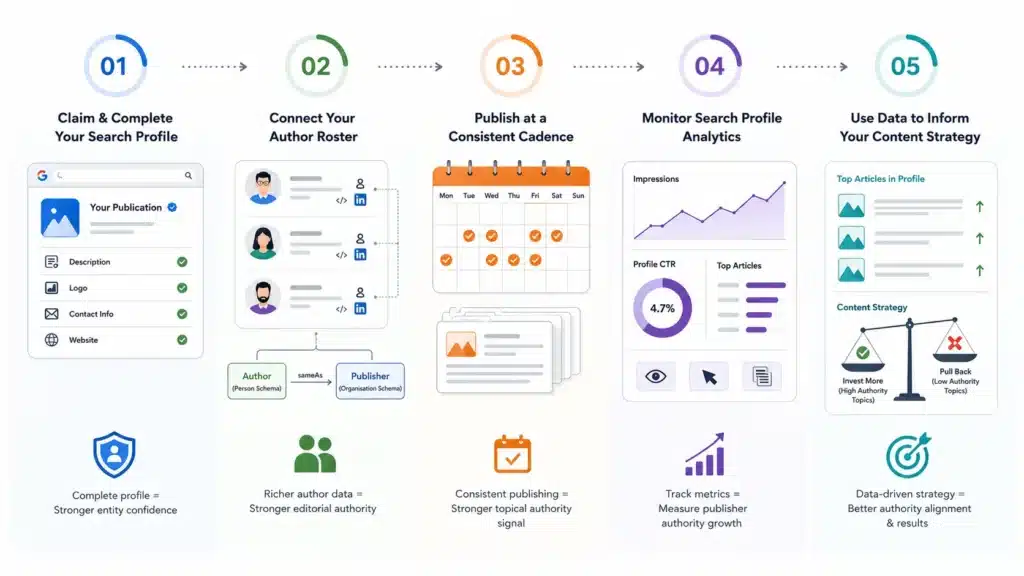
01 Claim and Complete Your Search Profile Immediately
Access Google Search Profiles through Google Search Console — look for the new Search Profiles section in the left navigation. Complete every available field: publication name (exactly matching your site’s canonical brand name), description (focus on your specific topical territory and audience, not generic marketing language), logo (high-resolution, square format, matching your schema Organisation logo), and contact information. Incomplete profiles convey less authority than complete ones — Google interprets missing fields as lower entity confidence.
⚡ Digital Arka note: Use exactly the same brand name in your Search Profile as in your Organisation schema, your Google Business Profile, and your Wikidata entry. Entity consistency across all four platforms signals a strong, unambiguous brand identity to the Knowledge Graph.
02 Connect Your Author Roster to Your Publisher Profile
Search Profiles display author information linked to the publisher entity. Ensure every author who contributes to your site has: a named bio page on your website with their photo and credentials, a Person schema entity linking their author page to your Organisation schema via the sameAs property, and a LinkedIn profile URL included in their Person schema. The richer your author roster data, the stronger the editorial authority signal your Search Profile projects.
03 Publish at a Consistent Topical Cadence
Search Profiles surface recent articles from your publication. The articles that appear are selected based on topical relevance and recency — which means publishing consistently on your core topics builds both the profile’s content display and Google’s confidence in your topical authority. Erratic publishing schedules (three posts this week, none for the next month) weaken the topical signal. Consistent, three-to-five posts per week on your core subject areas build the pattern Google’s systems associate with reliable publishing authority.
04 Monitor Search Profile Analytics as a Publisher Authority KPI
The analytics view Google released for Search Profiles provides publisher-level impression and engagement data. Track these metrics monthly: Search Profile impressions (how many times your publisher profile appeared in search results for branded queries), profile CTR (how often users click through from your profile to your articles), and which articles Google surfaces most frequently in your profile. Rising profile impressions alongside consistent topical publishing is the strongest measurable signal of growing publisher authority in 2026.
05 Use Search Profile Data to Inform Your Content Strategy
The articles Google surfaces in your Search Profile are not random — they reflect which of your content Google associates most strongly with your publisher entity and considers most representative of your editorial authority. If your Search Profile consistently surfaces articles on topics you consider secondary to your core focus, it signals a disconnect between what you publish most and what Google values most from you. Use this data to decide where to invest more editorial resource and where to pull back.
Search Profiles and the Subscription Linking Update
Google also introduced subscription linking for news publishers in July 2026 — a feature that connects paid subscriptions more directly with Search, allowing publishers to signal that certain content requires a paid subscription. Combined with Search Profiles, this creates a publisher-identity infrastructure that goes beyond SEO: it enables publishers to surface their brand, editorial identity, and subscription offer simultaneously in the search experience.
For non-news businesses, subscription linking is less immediately relevant, but the underlying principle applies: Google is building identity and trust infrastructure that rewards publishers who invest in clear entity signals, consistent editorial identity, and transparent audience relationships. Search Profiles are the first consumer-visible output of that infrastructure. More features will follow.
Conclusion: Publisher Identity Is Now a Ranking Asset
Google Search Profiles transform publisher identity from an abstract SEO concept into a measurable, trackable, analytics-backed entity signal. Publishers who claim, complete, and optimise their profiles in July 2026 establish a first-mover advantage in a feature that Google clearly intends to expand. The structural bet is straightforward: entity clarity at the publisher level will compound in value as AI search systems rely increasingly on entity models rather than page-level signals to determine citation authority.
Digital Arka helps clients across Delhi NCR claim and optimise their Google Search Profiles as part of our technical SEO and brand SEO engagements. Contact us at digitalarka.com or call +91 70110 34858.
Frequently Asked Questions
Every question below mirrors real queries people ask Google AI Mode, ChatGPT, Perplexity, and Bing Copilot about this topic. Each answer uses passage-first structure for maximum AI citation eligibility.
Q1. What are Google Search Profiles and when did they launch?
A: Google Search Profiles are publisher-facing identity pages that appear in Google Search when users search for a publication or website by name. They display the publisher’s brand name, logo, description, recent articles, and editorial authority signals. They went officially live in July 2026, with Google quickly following up with a dedicated analytics and insights view. Access is available through Google Search Console for eligible publishers.
Q2. How do Google Search Profiles help with SEO?
A: Google Search Profiles improve SEO by creating a top-level publisher entity in the Google Knowledge Graph that individual articles inherit authority from. A complete, well-maintained Search Profile strengthens E-E-A-T authoritativeness signals, improves entity clarity for the publisher brand, and provides Google’s quality rater systems with a direct signal of editorial legitimacy. Publishers with strong Search Profiles are better positioned for AI Overview citations because AI systems rely on entity confidence to make citation decisions.
Q3. How do I access and set up my Google Search Profile?
A: Access Google Search Profiles through Google Search Console — look for the Search Profiles section in the left navigation panel. Complete all available fields: publication name (exactly matching your canonical brand name across all platforms), description (focused on your topical territory and audience), logo (high-resolution, square format), and contact information. Ensure your brand name matches your Organisation schema, Google Business Profile, and Wikidata entry exactly for entity consistency.
Q4. Are Google Search Profiles the same as Google Knowledge Panels?
A: No, but they are related. Google Knowledge Panels are entity information boxes that appear for any notable entity — people, companies, places, products. Google Search Profiles are specifically designed for publishers and websites, with a focus on editorial authority signals: recent articles, topic coverage, author roster, and publishing history. A publisher can have both a Knowledge Panel and a Search Profile. Search Profiles carry additional publisher-specific data that Knowledge Panels do not include.
Q5. What analytics data does Google provide for Search Profiles?
A: Google provides publisher-level analytics for Search Profiles including: impressions (how many times the profile appeared in search results for branded queries), click-through rate (how often users navigate from the profile to articles), and article-level data showing which content Google most frequently associates with the publisher entity. This data is available in Google Search Console under the Search Profiles analytics section and updates with the same reporting lag as standard GSC performance data.
Q6. How does publishing consistency affect my Google Search Profile?
A: Publishing consistency directly affects which articles Google surfaces in your Search Profile and how strongly it associates your brand with specific topic areas. Consistent, regular publishing (three to five posts per week on core topics) builds the topical pattern recognition Google’s systems use to classify editorial authority. Erratic publishing schedules weaken this signal. The articles Google chooses to surface in your profile reflect which content it considers most representative of your editorial authority — monitor this data to align your content strategy with Google’s assessment.
Q7. What is subscription linking and how does it relate to Search Profiles?
A: Google subscription linking, introduced in July 2026, is a feature for news publishers that connects paid subscriptions more directly with Search — allowing publishers to signal that specific content requires a paid subscription. Combined with Search Profiles, it creates a publisher-identity infrastructure in Search that surfaces brand, editorial identity, and subscription offers simultaneously. For non-news businesses, subscription linking is less immediately relevant, but the underlying principle — rewarding clear publisher entity signals — applies across all content types.
Q8. Do Google Search Profiles affect AI Overviews citation decisions?
A: Yes. Google AI Mode and AI Overviews use entity models to assess citation confidence. A publisher with a complete, well-maintained Search Profile has a higher-confidence entity in the Knowledge Graph, which increases the AI system’s confidence in citing that publisher’s content. Publishers without Search Profiles or with incomplete entity data face lower citation confidence. In 2026, entity clarity at the publisher level is a direct input into AI citation decisions, making Search Profile optimisation an AI SEO priority, not just a traditional SEO action.
Q9. How long does it take for a Google Search Profile to improve SEO metrics?
A: Google Search Profile improvements compound over time rather than producing immediate ranking changes. Within 30 days of a complete profile setup, expect improved branded search visibility and higher profile impressions. Within 60 to 90 days of consistent, topically aligned publishing, expect measurable improvements in which articles Google surfaces in the profile and stronger E-E-A-T signals in quality rater assessments. Full compounding effects — where publisher entity authority lifts individual article rankings — typically take 90 to 180 days of consistent profile maintenance.
Q10. Can small businesses and agencies use Google Search Profiles, or are they only for major publishers?
A: Google Search Profiles are available to any publisher — large news organisations, niche blogs, small business websites, and agencies. There is no minimum size, readership, or publishing volume requirement. Small businesses benefit from Search Profiles as much as large publishers because the entity clarity signal they provide helps Google confidently classify the business and improves local AI Overview citation rates. A Delhi NCR digital agency with a complete Search Profile, consistent blog publishing, and strong author bios competes for AI citation on industry topics alongside much larger national brands.