
Let’s address the central question first: do backlinks still matter for SEO in July 2026?
Yes — but the relationship between links and rankings has changed significantly. Backlinks build trust; topical authority builds expertise signals. In 2026, you need both, and the link strategies that work are fundamentally different from the tactics that dominated SEO three years ago.
The Google June 2026 spam update — which took only two days to roll out and was described as “substantial” by the search community — specifically targeted link networks. The June 2026 spam update, combined with the March 2026 spam update that preceded it, has made one thing unambiguously clear: aggressive link acquisition tactics are now not just ineffective. They are actively dangerous.
The link building framework that works in July 2026: Build topical authority through content clusters FIRST. Let authoritative links follow naturally from genuine expertise. Amplify with targeted digital PR. Never manufacture links through networks, paid placements, or reciprocal schemes.
What Has Definitively Stopped Working
The clarity that the 2026 spam updates have provided is actually useful — the guesswork about which tactics are risky has been largely resolved. Here is what is no longer viable for Indian businesses:
Guest Post Networks and Scaled Outreach
Guest posting as a link acquisition strategy — where the primary purpose is the backlink rather than genuinely contributing expertise to a publication’s audience — has been progressively devalued through every Google spam update since 2023. The June 2026 spam update further tightened enforcement. Sites with large volumes of outbound links to guest-posted content are themselves being flagged as low-quality link sources.
The signal Google uses to identify manipulative guest posts is sophisticated: it evaluates whether the author has genuine expertise in the publication’s topic, whether the content adds original value, and whether the link placement is contextually natural. Bulk outreach to dozens of generic blogs with templated article content fails every one of these checks.
Private Blog Networks (PBNs) and Link Exchanges
Expired domain networks lost 90%+ visibility in Google’s enforcement actions through 2025 and 2026. The March 2026 spam update specifically targeted scaled link abuse. Indian businesses still using PBN links — even those that survived previous updates — are carrying accumulated risk that could materialise with any subsequent enforcement action.
Reciprocal link exchanges (“I’ll link to you if you link to me”) were identified as a spam signal years ago and remain so. The sophistication of SpamBrain, Google’s AI-based spam prevention system, has made reciprocal link pattern detection more accurate with each update.
Paid Links Without Proper Disclosure
Paid link placements without rel=”sponsored” attribution violate Google’s spam policies and are now more actively enforced following the May 2026 extension of spam policies to AI surfaces. A paid placement without disclosure creates spam risk on both the paid layer (traditional SEO) and the AI layer (GEO visibility).
What Is Actually Working for Indian Businesses in July 2026
The link building strategies that work in 2026 share a common characteristic: they earn links as a consequence of genuine expertise and useful content, rather than manufacturing links through manipulation. Here is what is delivering measurable results:
1. Original Data and Research
The single highest-performing link acquisition strategy in 2026 is publishing original research, surveys, or data that no other page on the internet has. Indian businesses are uniquely positioned for this: you have direct access to India-specific market data, customer behaviour data, and industry insights that global publications cannot generate.
A Delhi real estate company that publishes quarterly data on NCR property price trends earns links from news publications, other real estate blogs, and financial media without any outreach required — because journalists and bloggers need data sources and will naturally link to the original study. A Bangalore SaaS company that surveys 500 Indian SMBs about their software adoption patterns generates linkable data that earns citations from industry publications worldwide.
The investment is real — original research requires data collection, analysis, and professional presentation. The return is also real: a single well-executed research study can generate 50–200+ organic backlinks from relevant publications, a volume that would cost lakhs to replicate through paid placements.
2. Digital PR: Earning Editorial Mentions
Digital PR — the practice of earning editorial mentions in credible publications by providing journalists with expert commentary, data, and story angles — is the legitimate evolution of link building in 2026. The difference between digital PR and traditional link building is fundamental: in digital PR, you are providing genuine value to a journalist who has a story to tell. In traditional link building, you are manufacturing a link placement that serves no editorial purpose.
For Indian businesses, the highest-value digital PR opportunities are:
- HARO responses (Help A Reporter Out) — providing expert commentary on your specific domain when journalists are researching stories. A Delhi healthcare provider quoted in Economic Times, Hindustan Times, or India Today on a health topic earns editorial links that no paid placement can match for authority.
- Industry publication contributions — genuine expert articles in YourStory, Inc42, Economic Times SME, or sector-specific trade publications. These require genuine expertise and original perspective — not promotional content dressed as editorial.
- Data contributions to roundup journalism — journalists writing “State of X in India 2026” pieces regularly source data and expert quotes. Being the source of India-specific data in a Business Standard or Livemint article earns both a high-authority link and significant brand credibility.
3. Unlinked Brand Mentions — the Easiest Wins
Set up Google Alerts and Mention.com alerts for your brand name. Every time your business is mentioned online without a link, reach out to the publisher and politely request that the mention be turned into a hyperlink. This is the most time-efficient link building activity available — you already earned the mention, you just need to formalise the link. Most publishers will convert unlinked mentions to linked mentions with a single polite email.
4. Linkable Asset Development
Create content specifically designed to be linked to — tools, calculators, databases, comprehensive guides, and templates that other websites in your industry will naturally reference. An Indian real estate company that publishes a free “NCR Flat Buyers’ Due Diligence Checklist” will find it linked to by legal blogs, property news sites, and homebuyer forums for years. A Delhi CA firm that publishes a “GST Registration Requirements Checker” earns links from small business publications and entrepreneur communities.
These assets require upfront investment but generate links passively — and each link earns authority transfer without ongoing effort or risk.
The Link Quality Hierarchy in July 2026
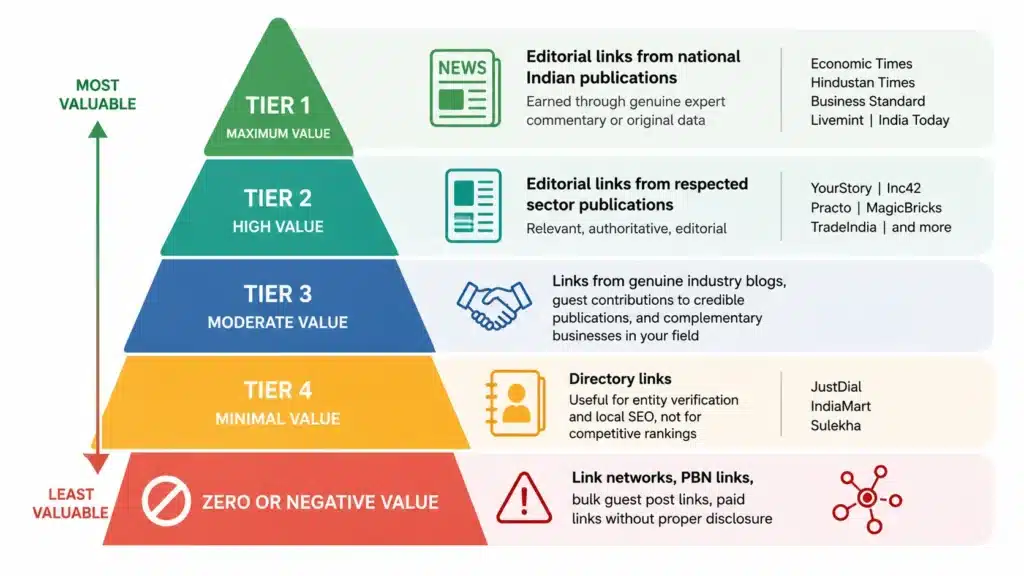
Not all links deliver equal value. In July 2026, the link quality hierarchy — from most to least valuable — looks like this:
- Tier 1 (Maximum value): Editorial links from national Indian publications (Economic Times, Hindustan Times, Business Standard, Livemint, India Today) — earned through genuine expert commentary or original data
- Tier 2 (High value): Editorial links from respected sector publications (YourStory, Inc42, Practo for healthcare, MagicBricks for real estate, TradeIndia for manufacturing) — relevant, authoritative, editorial
- Tier 3 (Moderate value): Links from genuine industry blogs, genuine guest contributions to credible publications, and links from complementary businesses in your field
- Tier 4 (Minimal value): Directory links (JustDial, IndiaMart, Sulekha) — useful for entity verification and local SEO, not for competitive keyword rankings
- Zero or negative value: Link network links, PBN links, bulk guest post links, paid links without proper disclosure
The Monthly Link Building Rhythm for Indian Businesses
A realistic, sustainable link acquisition programme for an Indian business in July 2026 looks like this:
- Weekly (30 minutes): Check brand mentions, convert unlinked mentions to links, respond to HARO journalist requests in your domain
- Monthly: Pitch one genuinely useful expert commentary piece to one relevant Indian industry publication
- Quarterly: Publish one original data piece, case study, or linkable asset. Promote it to relevant journalists and publications.
- Annually: Conduct one comprehensive original research study or industry survey. This is your anchor link asset for the year.
This approach builds 5–15 high-quality editorial links per month at low cost and zero risk. Over 12 months, it creates a backlink profile that no spam update can touch — because every link in it was earned through genuine expertise and editorial merit.
DigitalArka builds digital PR and link acquisition programmes for Indian businesses. Get a free backlink audit at digitalarka.com