
Most SEO industry coverage of Google I/O 2026 focused on AI Mode crossing one billion users and the new conversational search box. But the most structurally significant announcement for SEO practitioners was buried in the second half of the keynote: Information Agents.
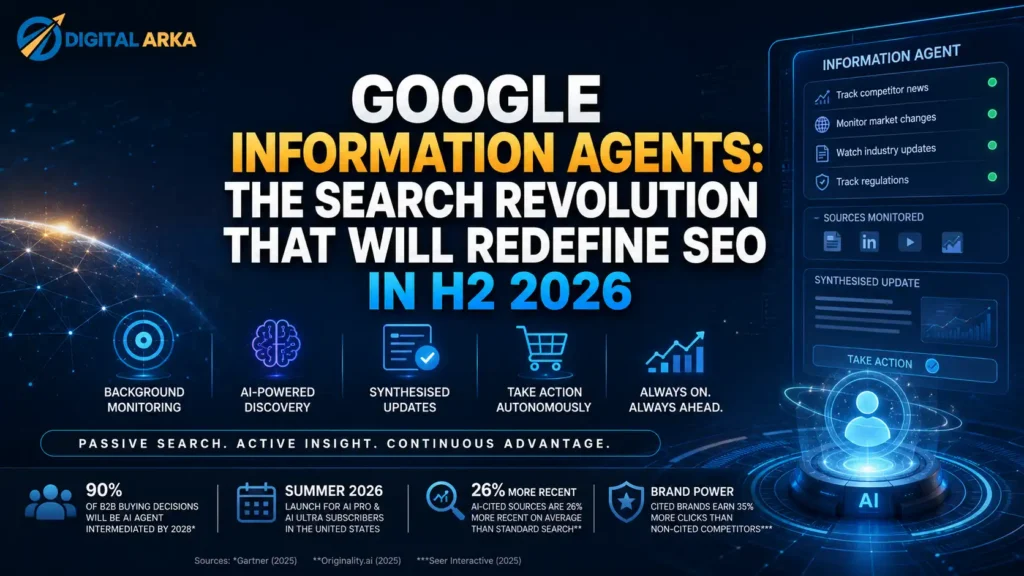
Information Agents are background-running AI systems that monitor the web continuously on a user’s behalf — tracking competitor news, market developments, vendor options, and regulatory changes — and deliver synthesised updates with the ability to take action. They do not generate search sessions. They do not create click events. They do not show the user a list of links. They find, evaluate, and summarise autonomously.
This guide explains what Information Agents are, why they represent the most disruptive shift to search behaviour in 20 years, and what SEO professionals must do today to remain visible in a world where the search is passive.
What Are Google Information Agents?
Information Agents, announced by Liz Reid at Google I/O 2026, are AI agents that run in the background without user prompting. A user sets up a monitoring goal — “track SEO tool pricing changes,” “alert me when a competitor publishes about X,” “monitor new regulations affecting my industry” — and the agent runs perpetually, scanning blogs, news sites, social posts, and Google’s real-time data (finance, shopping, sports) to deliver synthesised updates.
Key specifications announced:
- Launch timeline: Summer 2026 for Google AI Pro ($19.99/mo) and AI Ultra ($99.99/mo) subscribers in the United States
- Multiple agents can run simultaneously on different monitoring goals
- Sources monitored: blogs, news sites, social posts, Google real-time finance and shopping data
- Output: synthesised updates delivered to the user with ability to take action (booking, purchasing, contacting)
- No user-initiated query required — search becomes passive and continuous
Why Information Agents Are the Most Disruptive SEO Development of 2026
Traditional SEO is optimised for a moment in time: a user types a query right now and you want your page to appear. Information Agents eliminate that moment. The agent has already searched, already synthesised, and already delivered the answer before the user ever opens a browser. Marie Haynes, quoted in PPC Land coverage of I/O 2026, framed the implication precisely: “You are no longer optimising for a single snapshot in time. You are optimising for continuous tracking.”
Gartner projected in 2025 that by 2028, 90% of B2B buying decisions will be AI agent intermediated — pushing over $15 trillion of B2B spend through AI agent exchanges. With Information Agents launching in the summer of 2026, that projection has become an immediate concern rather than a future planning item.
For SEO, the implications are profound:
- Last-click attribution breaks completely — the discovery event happens inside the agent, not in a trackable browser session
- Brand visibility during the “off” moments (when users are not actively searching) becomes the primary competitive advantage
- Content freshness gains enormous importance — agents monitor for new information, making recently published content a stronger retrieval signal
- Structured, machine-readable content is prioritised — agents need to parse and extract information without human-guided browsing behaviour
5 SEO Strategies for the Information Agent Era
1. Publish Fresh, Time-Stamped Content Consistently
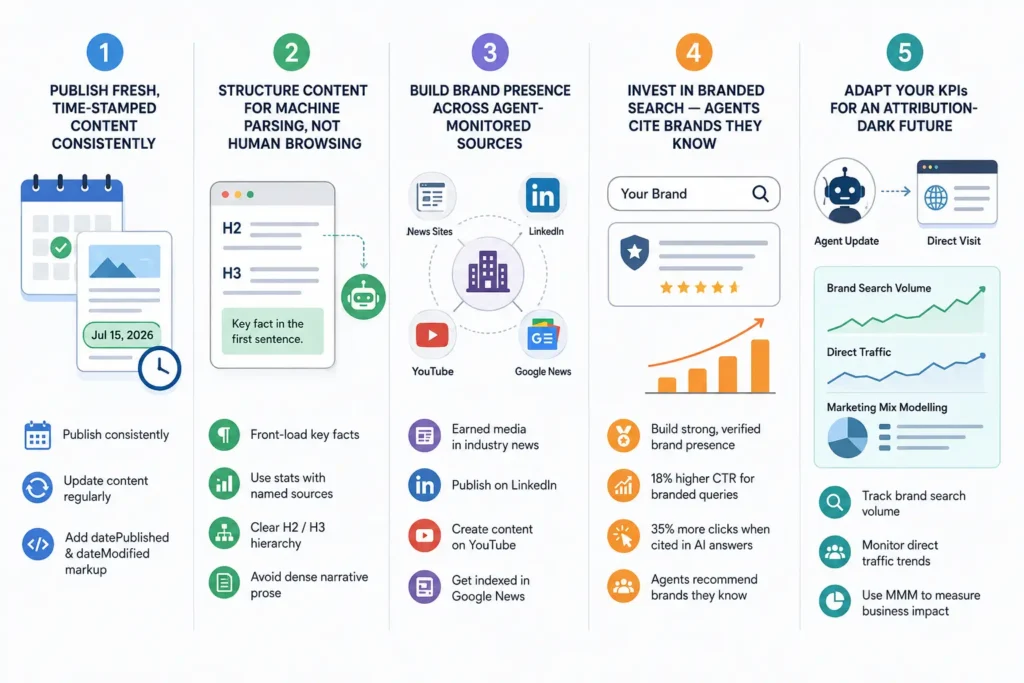
Information Agents show a strong preference for recently published sources — AI-cited sources are approximately 26% more recent on average than equivalent sources in standard search results. For SEO teams, this means content freshness is no longer a nice-to-have. Publish at a consistent cadence, update existing posts with new data quarterly, and add explicit machine-readable datePublished and dateModified markup to every page.
2. Structure Content for Machine Parsing, Not Human Browsing
Information Agents do not browse websites the way humans do. They extract structured passages, evaluate factual density, and synthesise across sources. Content structured for agent extraction should: front-load key facts in the first sentence of each section, include specific statistics with named sources, use clear H2 and H3 hierarchies, and avoid dense narrative prose that buries the extractable fact inside paragraphs of context.
3. Build Brand Presence Across Agent-Monitored Sources
Information Agents monitor blogs, news sites, social posts, and real-time data feeds. A brand that exists only on its own website is invisible to agent monitoring. Build presence across: industry news publications (earned media coverage), LinkedIn (posts that appear in professional news feeds), YouTube (content that surfaces in topic-based monitoring), and Google News (index your blog for Google News eligibility).
4. Invest in Branded Search — Agents Cite Brands They Know
Amsive research found branded queries earn approximately 18% higher CTR under AI Overviews compared to non-branded queries. Seer Interactive data suggests brands cited inside AI-generated answers earn approximately 35% more clicks than non-cited competitors. Information Agents will compound this effect — they are more likely to recommend brands that have consistent, verified entity presence across multiple sources. Brand building is now an SEO strategy.
5. Adapt Your KPIs for an Attribution-Dark Future
Information Agent interactions will not appear as trackable sessions in GA4. Users who discover your brand through an agent update and later visit your site directly will appear as direct traffic. Prepare for this by: increasing investment in brand search volume as a leading indicator, tracking direct traffic trends as a proxy for agent-driven brand discovery, and adopting Marketing Mix Modelling to measure business impact beyond last-click attribution.
The SEO Metrics That Matter in an Agent-First World
The traditional SEO dashboard (rank position, organic sessions, CTR) needs significant restructuring for 2026 and beyond:
- Brand search volume: the primary leading indicator of brand visibility in agent-monitored feeds
- Citation share: what percentage of AI-generated responses for your target queries reference your brand
- AI-referred sessions: tracked via GA4 AI referral channel group (added May 2026 natively)
- Direct traffic trend: a proxy for agent-driven discovery that bypasses tracked referral paths
- Share of voice in industry publications: how frequently your brand appears in the sources agents monitor most
- Zero click searches which increased at large scale after AI mode and AI overview introduction.
Conclusion
Information Agents represent the most fundamental shift in search behaviour since Google replaced directory browsing with keyword search in 2000. When search becomes passive and continuous, the businesses that win are not those with the best keyword targeting — they are the ones with the strongest real-world brand presence, the freshest content, and the most structured, machine-readable information architecture.
The preparation starts now. Audit your content freshness. Build brand presence beyond your own domain. Structure every page for extraction, not just human readability. The agents are coming — make sure they find you.
Frequently Asked Questions
Q1: What are Google Information Agents?
A: Google Information Agents are background-running AI systems announced at Google I/O 2026 that monitor the web continuously on behalf of users. A user sets a monitoring goal (track competitor news, market changes, vendor options) and the agent scans blogs, news sites, social posts, and real-time data to deliver synthesised updates — without the user initiating a search query.
Q2: When will Google Information Agents launch?
A: Google Information Agents are scheduled to launch in Summer 2026, initially available to Google AI Pro ($19.99/month) and Google AI Ultra ($99.99/month) subscribers in the United States. Broader availability is expected to expand through late 2026 and into 2027 based on previous Google product rollout patterns.
Q3: How do Information Agents affect SEO?
A: Information Agents fundamentally change SEO by making search passive and continuous. They do not generate trackable sessions or clicks — discovery happens inside the agent before the user opens a browser. This breaks last-click attribution, elevates content freshness as a ranking signal, and makes brand presence across agent-monitored sources (news, LinkedIn, YouTube) a primary SEO strategy.
Q4: What content performs best for Google Information Agents?
A: Content that performs best for Information Agent retrieval is: recently published (agents prefer sources 26% more recent than standard search), structured with front-loaded facts and specific statistics, published on agent-monitored platforms (industry blogs, LinkedIn, news sites), and machine-parseable without requiring human browsing behaviour. Dense narrative prose performs poorly.
Q5: How can I track traffic from Information Agents in Google Analytics?
A: Information Agent interactions will not appear as standard referral sessions in GA4 because agents do not create browser sessions. Track the downstream effects via: brand search volume trends in Google Search Console, direct traffic growth in GA4, the AI referral channel group (added natively in May 2026 GA4 update), and Marketing Mix Modelling to attribute offline-influenced conversions.
Q6: Will Information Agents replace traditional Google Search?
A: Information Agents will not replace traditional Google Search — they operate alongside it for different use cases. Traditional Search handles active queries (“how do I do X right now”). Information Agents handle passive monitoring (“alert me when something relevant changes in my industry”). Both surfaces require different but overlapping optimisation strategies.
Q7: What is the Gartner prediction about AI agents and B2B buying?
A: Gartner predicted in 2025 that by 2028, 90% of B2B buying decisions will be AI agent intermediated — pushing over $15 trillion of B2B spend through AI agent exchanges. With Google Information Agents launching in Summer 2026, this prediction has moved from a future concern to an immediate strategic priority for B2B marketers and SEO professionals.
Q8: How do Information Agents relate to agentic commerce?
A: Google also announced Agentic Booking at I/O 2026 — expanding agent capabilities to include making reservations and initiating phone calls on behalf of users for local services like home repair and pet care. This creates a direct link between Information Agent discovery and transactional agent completion, making local SEO and structured service data critically important for businesses in eligible categories.
Q9: Does content freshness matter more because of Information Agents?
A: Yes. Research on AI-cited sources shows they are approximately 26% more recent on average than non-cited sources in standard search. Information Agents that continuously monitor for new information will compound this freshness preference. SEO teams should publish at a consistent cadence, update existing posts quarterly with new data, and add machine-readable datePublished and dateModified markup to every page.
Q10: What is the difference between an Information Agent and an AI Overview?
A: An AI Overview appears at the top of a standard Google Search results page when a user actively types a query. An Information Agent is a background-running autonomous system that monitors specified topics continuously without any user-initiated search. AI Overviews are reactive (triggered by a query). Information Agents are proactive (running permanently on pre-set goals). Both require content to be structured, fresh, and citable.