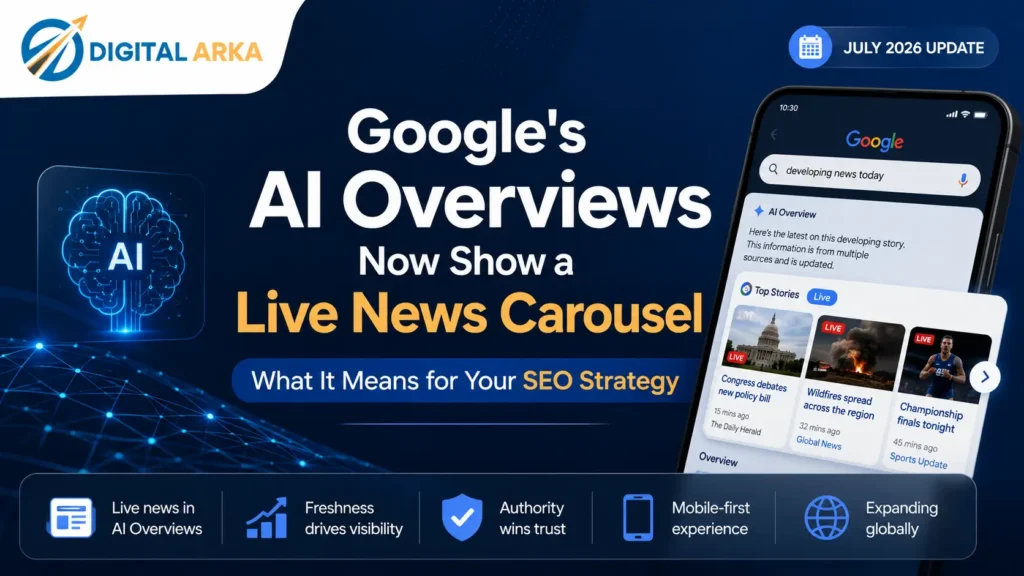

Google Just Wired Live News Into Its AI Answers — Here Is Why That Changes Everything
On July 17, 2026, Google confirmed what SEO analysts had spotted in testing since late June: a Top Stories news carousel is now fully live inside AI Overviews for US mobile users. The announcement came through a quote already published in May — “Now, for some searches when you have a question about a developing topic, you’ll start seeing a prominent carousel, which will also highlight your Preferred Sources. This will help make timely articles more visible on a wider range of queries” — but July 17 marked the moment Google delivered on that promise.
At Digital Arka, we track every structural change to the AI Overviews surface because it directly determines where our clients’ content appears — or disappears — in front of search users. This development is not a cosmetic update. It rewires the relationship between freshness, authority, and AI citation in ways that demand an immediate strategic response from every publisher, journalist, and business running a content programme.
The signal that Lily Ray spotted the carousel in testing on June 29, followed by Barry Schwartz replicating it in ‘one of my browser sessions — not all,’ followed by Google’s July 17 confirmation, is the canonical pattern of a Google feature that is real, growing, and worth acting on now rather than waiting for the full rollout.
“Google confirmed on July 17, 2026 that a Top Stories news carousel is fully live inside AI Overviews for US mobile users, with expansion stated as intent rather than commitment.” — DigitalApplied, July 2026
What the AI Overviews Top Stories Carousel Actually Is
Before this update, AI Overviews appeared as a static block at the top of Google search results. They pulled from indexed web pages, synthesised an answer, and displayed a row of source citations. The content was synthesised at crawl time — not updated in real time as news broke.
The Top Stories carousel changes this for developing-topic queries. When a user searches for something with active news coverage — a breaking story, an unfolding event, a recent product launch — the AI Overview now includes a horizontally scrolling carousel of recent news articles at the top of the generated answer. These articles are the same ones that populate the classic Top Stories SERP feature, which means inclusion in Google News is now a direct pathway into AI Overviews for time-sensitive topics.
Two additional changes landed alongside the carousel. Google also launched AI-generated images inside AI Overviews using the Nano Banana model, and redesigned Google Images — both of which compound the shift toward AI-first visual search that Digital Arka flagged in our July technical SEO audit coverage.
“Google’s AI Overviews now appear on almost half of all searches, and this week Google switched on news carousels inside them, with AI-generated images on the way.” — Maple Leaf Agency Search Update, July 21, 2026
Which Sites Win From the AI Overviews News Carousel?
The carousel surfaces content from publishers already eligible for Google Top Stories. Inclusion in Top Stories requires: indexing in Google News (publishers must apply via the Google Publisher Center), structured Article or NewsArticle schema with accurate datePublished markup, AMP support or strong Core Web Vitals on mobile, E-E-A-T signals including named authors with verifiable credentials, and content that is topically timely and distinctly original.
Publishers who already satisfy these requirements gain a new surface inside AI Overviews without changing anything. Publishers who do not — especially businesses and agencies that publish blog content but have not applied for Google News indexing — gain nothing from the carousel today, even if they publish timely, high-quality content.
The practical implication for our clients at Digital Arka: if your content strategy includes covering industry news, regulatory changes, product launches, or local developments, apply for Google News Publisher Centre eligibility immediately. The carousel is expanding beyond the US, and publishers who establish Google News eligibility now will already hold carousel positions when the feature reaches Indian search results.
5 Actions to Take Right Now for AI Overviews News Carousel Visibility
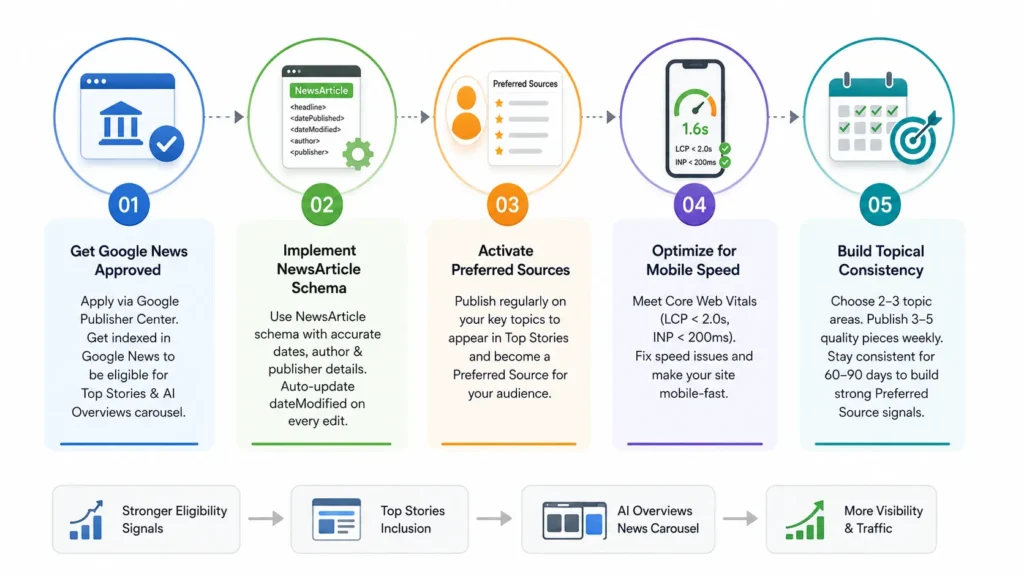
01 Apply for Google Publisher Center Immediately
Visit publishercenter.google.com and submit your site for Google News indexing. Approval typically takes two to four weeks. Required: a dedicated news or blog section with regularly updated content, clear author bylines on every article, an About page explaining your editorial standards, and a contact page. Once approved, your timely articles automatically become eligible for Top Stories — and now, for the AI Overviews news carousel.
02 Implement NewsArticle Schema on All Timely Posts
Switch from generic Article schema to NewsArticle schema for any post covering a developing or time-sensitive topic. NewsArticle schema signals to Google that the content is news-type material eligible for Top Stories. Required properties: headline (under 110 characters), datePublished, dateModified (update this every time you substantively update the article), author with valid Person schema, and publisher linked to your Organisation entity.
⚡ Digital Arka implementation note: Set dateModified to update automatically whenever you edit a post, not manually. Many WordPress configurations fail to do this by default — check your theme or use a plugin that updates schema timestamps on every save.
03 Activate Google Preferred Sources for Your Target Audience
Google’s announcement mentions Preferred Sources — the personalised list of publishers users can set to control which news sources appear in their AI Overviews carousel. This means your brand appearing consistently in Top Stories builds a direct pathway to becoming a preferred source for your audience segment. Publish at a consistent daily or near-daily cadence on topics where you want carousel presence. Consistency matters more than volume for Preferred Source eligibility.
04 Optimise for Mobile Speed — Carousel Is Mobile-First
The AI Overviews Top Stories carousel launched for US mobile users first. Mobile Core Web Vitals are the primary eligibility filter for Top Stories on mobile, which means your LCP must be under 2.0 seconds and your INP under 200ms on a median mobile device. Run a PageSpeed Insights check (pagespeed.web.dev) on your most important news content pages and fix the single largest LCP bottleneck first — typically an unoptimised hero image or a render-blocking script.
Read Also: Page Design as a Ranking Signal
05 Build Preferred Source Signals Through Topical Consistency
Google’s Preferred Sources feature rewards publishers who consistently cover specific topic areas. Choose two or three topic territories where your brand has genuine expertise — for Digital Arka, that is SEO, digital marketing, and AI search in Delhi NCR — and publish at least three to five timely, original pieces per week in those territories. Topical consistency over 60 to 90 days builds the pattern recognition Google’s systems use to classify you as a reliable source on those subjects.
What This Means for Non-News Businesses
If your business is not a publisher or news organisation, the AI Overviews Top Stories carousel still affects you in one important way: it creates new competition for AI Overview real estate on queries that previously showed only synthesised text answers. A user searching for information about your industry or products may now see a news carousel above the synthesised answer, pushing static content further down the AI Overview.
The strategic response for non-publishers is to double down on the content formats AI Overviews still pull from non-news sources: comprehensive guides with direct-answer passage structure, FAQPage schema, deep topic cluster pages, and strong E-E-A-T signals. The carousel is one component of AI Overviews — the synthesised text answer, which draws from the full web, remains the primary citation opportunity for non-news content.
Conclusion: Freshness Is Now a Surface, Not Just a Signal
The AI Overviews Top Stories carousel transforms freshness from a ranking tiebreaker into a dedicated surface with its own real estate, its own eligibility requirements, and its own competitive dynamic. Publishers who act on Google News eligibility and NewsArticle schema now build a structural advantage that compounds as the carousel expands globally.
At Digital Arka, we help Delhi NCR businesses and publishers build the technical and editorial infrastructure to compete in every AI search surface — from static AI Overview citations to live news carousels. Contact us at digitalarka.com or call +91 70110 34858 to discuss your AI Overviews news carousel strategy.
Frequently Asked Questions
Every question below mirrors real queries people ask Google AI Mode, ChatGPT, Perplexity, and Bing Copilot about this topic. Each answer uses passage-first structure for maximum AI citation eligibility.
Q1. What is the Google AI Overviews Top Stories carousel?
A: The Google AI Overviews Top Stories carousel is a horizontally scrollable news feed that Google added to AI Overview responses on July 17, 2026, for US mobile users. It surfaces recent, timely news articles inside the AI-generated answer for developing-topic queries. The carousel pulls from Google News-eligible publishers and highlights Preferred Sources selected by users. It launched for mobile users in the United States first, with expansion to other markets and devices planned.
Q2. How do I get my articles into the Google AI Overviews news carousel?
A: Earn inclusion in the AI Overviews news carousel by: applying for Google News eligibility through Google Publisher Center; implementing NewsArticle schema with accurate datePublished and dateModified properties; ensuring strong mobile Core Web Vitals (LCP under 2.0s, INP under 200ms); publishing timely, original content with named authors and verifiable credentials; and maintaining a consistent publishing cadence in your topic area. Publishers already eligible for Google Top Stories qualify for the carousel automatically.
Q3. Does the AI Overviews news carousel affect regular websites that do not publish news?
A: Yes, indirectly. The carousel creates additional real estate inside AI Overviews for developing-topic queries, which reduces the visible space for synthesised text answers. Non-news websites competing for AI Overview citations on time-sensitive topics face increased competition from news carousel placements. Non-publishers should focus on comprehensive guide content, FAQPage schema, and deep topical authority — areas where news carousels do not compete directly.
Q4. What is Google Publisher Center and how do I apply?
A: Google Publisher Center (publishercenter.google.com) is the portal where publishers apply for Google News indexing. Approved publishers become eligible for Top Stories and now for the AI Overviews news carousel. To apply: submit your site with a dedicated news section, clear author bylines, an About page with editorial standards, and a contact page. Approval typically takes two to four weeks. Google evaluates content originality, author authority, site transparency, and update frequency during review.
Q5. What is NewsArticle schema and how is it different from Article schema?
A: NewsArticle schema is a Schema.org type specifically for news-type content — breaking stories, developing topics, and time-sensitive articles. It is a subtype of Article schema and carries the same core properties (headline, author, datePublished, dateModified, publisher) but signals to Google that the content is eligible for News-specific features including Top Stories and the AI Overviews carousel. Switch from Article to NewsArticle for any post covering a developing topic, industry update, or time-sensitive subject.
Q6. What are Google Preferred Sources and how do they affect AI Overviews?
A: Google Preferred Sources is a personalisation feature that lets users designate specific publishers whose content they want prioritised in news surfaces including AI Overviews carousels. Publishers who consistently appear in Top Stories for a user build a natural pathway to Preferred Source status. This makes topical consistency — publishing regularly on specific subject areas — a direct strategy for earning priority placement in personalised AI Overviews carousel results.
Q7. Did Google also launch AI-generated images inside AI Overviews in July 2026?
A: Yes. Alongside the Top Stories carousel, Google launched AI-generated images inside AI Overviews using the Nano Banana image generation model, and redesigned Google Images. AI-generated images appear in AI Overviews when relevant, which means Google can now illustrate AI Overview answers with generated visuals instead of pulling images from ranked pages. Publishers who previously supplied images to AI Overviews now compete with Google-generated imagery — making original, distinctive photographs and custom graphics more strategically important than ever.
Q8. How does the AI Overviews news carousel affect CTR on news articles?
A: The carousel creates a new click pathway for news publishers inside AI Overviews. Users can click individual carousel items to visit the source article. This is potentially significant because AI Overviews have historically reduced CTR by answering queries without requiring a click. The news carousel introduces a browsing behaviour inside AI Overviews — users scroll headlines and click into stories that interest them — which generates clicks rather than consuming them. Publishers with strong headlines and topical authority stand to gain net-positive CTR from carousel inclusion.
Q9. When will the AI Overviews news carousel reach India and other markets?
A: Google confirmed the carousel is live for US mobile users as of July 17, 2026, and stated expansion as intent without committing to a specific timeline for other markets. Based on the pattern of Google AI Overview rollouts — which reached India in phases throughout 2025 — expect the news carousel to arrive in India within three to six months of the US launch. Publishers in India should apply for Google News eligibility now so they hold indexed status when the carousel reaches the Indian market.
Q10. What content format wins the most AI Overview citations alongside the news carousel?
A: For non-news content, comprehensive guides with passage-first structure earn the most AI Overview citations. Each section should open with a direct, declarative answer in the first 40 to 60 words before expanding with supporting detail. Add FAQPage schema to all FAQ sections. Build topical clusters — 10 to 15 interlinked posts on the same subject area — to signal topical authority. For news-type content, NewsArticle schema with accurate timestamps, named authors, and original reporting earns carousel placement. Both formats can earn AI Overview presence simultaneously on different query types.