
International SEO for Indian businesses requires three things that domestic SEO does not: explicit geographic targeting signals (hreflang), content genuinely adapted for international buyers (not just translated), and authority signals that build credibility in each target market independently. Get any one of these wrong and your international content may be invisible to the audience it was designed for.
India is increasingly a country of global digital ambition. Bangalore’s SaaS companies target US and European enterprise buyers. Hyderabad’s pharmaceutical manufacturers export to regulated markets across 80 countries. Jaipur’s jewellery exporters sell to wholesale buyers in Dubai, Amsterdam, and New York. Delhi’s IT services companies pitch enterprise accounts in London, Singapore, and Tokyo. Noida’s coaching institutes attract students from Southeast Asia and the Gulf.
For all of these businesses, SEO that works only in India is SEO that is leaving money on the table. The difference between appearing in Google Search results when a UK procurement manager searches for “IT services provider India” and not appearing — with an online business that can serve that market — is the difference between a revenue channel that costs almost nothing to maintain and an opportunity that simply does not exist.
International SEO in July 2026 is more complex than it has ever been — but also more achievable for Indian SMEs than ever before. Google’s Personal Intelligence expansion to 98 languages, the consolidation of AI Mode as the default experience globally, and the shift to entity-based ranking signals have created both challenges and specific opportunities for Indian businesses targeting international audiences. This blog covers the complete international SEO strategy for Indian businesses in July 2026.
Why International SEO Is Different from Domestic SEO — and Why It Matters More in 2026
International SEO addresses three challenges that domestic SEO does not:
Geographic targeting signals. Google’s systems need to understand which geographic markets your content is intended for. A page written in English by an Indian business could be targeting Indian consumers, UK buyers, US enterprises, or Australian clients — and the optimisation strategy for each is different. Without explicit geographic targeting signals, Google may show your content to the wrong geographic audience, or may allocate your crawl budget inefficiently across markets.
Language and search pattern differences. Even within English-language international SEO, search patterns differ significantly between markets. A UK buyer searching for “IT outsourcing partner India” uses different terminology than an Australian buyer (“India software development company”) or a US enterprise (“offshore development team India”). Multilingual international SEO adds the additional complexity of language variants — German, French, Spanish, Arabic, Japanese — each with distinct search patterns that require language-native keyword research.
Trust signal calibration for international buyers. Indian businesses face a specific credibility challenge in international markets: international buyers have less inherent familiarity with Indian brands and may apply higher initial scepticism. International SEO strategy must address this trust gap explicitly — through international client testimonials, case studies from international projects, international certification displays, and content that addresses the specific concerns international buyers have about working with Indian vendors.
In July 2026, the Personal Intelligence expansion to 98 languages and Google’s AI Mode global default mean that international buyers are increasingly getting AI-generated answers to their vendor search queries. The implication: Indian businesses must not only rank internationally but earn AI citation in international AI-generated search responses — which requires the same GEO foundation as domestic AI visibility but calibrated for international query patterns.
The International SEO Technical Foundation: hreflang, ccTLDs, and URL Structure
International SEO begins with technical signals that tell Google which pages target which countries and languages. Getting these signals wrong is one of the most common reasons Indian businesses fail to achieve international visibility despite having good content.
hreflang tags: the international targeting signal.
hreflang tags tell Google “this page, in this language, is for users in this country.” For Indian businesses targeting multiple English-speaking markets — UK, US, Australia, Singapore — hreflang implementation allows you to serve appropriately localised versions to each market while avoiding duplicate content penalties.
The most common hreflang mistakes by Indian businesses:
Using en for all English pages regardless of country target, rather than en-gb for UK, en-us for US, en-au for Australia, en-in for India. This single mistake means all your English content is equally eligible for all English markets — when in reality your content may be specifically calibrated for one market over another.
Implementing hreflang only on some pages rather than all pages. Hreflang must be consistent across your entire international content set — if page A has a hreflang annotation pointing to page B, page B must have a hreflang annotation pointing back to page A.
Not including a self-referencing hreflang annotation. Every page must include a hreflang annotation pointing to itself, not just to its translated or localised variants.
URL structure for international content:
Option 1 (Recommended for most Indian businesses): Subdirectory structure — yoursite.com/uk/, yoursite.com/us/, yoursite.com/in/. Uses your existing domain authority, simpler to implement, less maintenance overhead.
Option 2: Subdomain structure — uk.yoursite.com, us.yoursite.com. Slightly more flexibility for market-specific technical configuration, but requires more careful canonicalisation management.
Option 3: Country code top-level domains (ccTLDs) — yoursite.co.uk, yoursite.com.au. Strongest geographic signal, but requires separate domain authority building for each market. Generally only recommended when a market is a significant revenue priority with dedicated local investment.
For most Indian businesses targeting international markets without local offices, the subdirectory structure with proper hreflang implementation provides the best balance of international signal strength and implementation simplicity.
Market-Specific SEO Strategy: What Changes for Each International Target
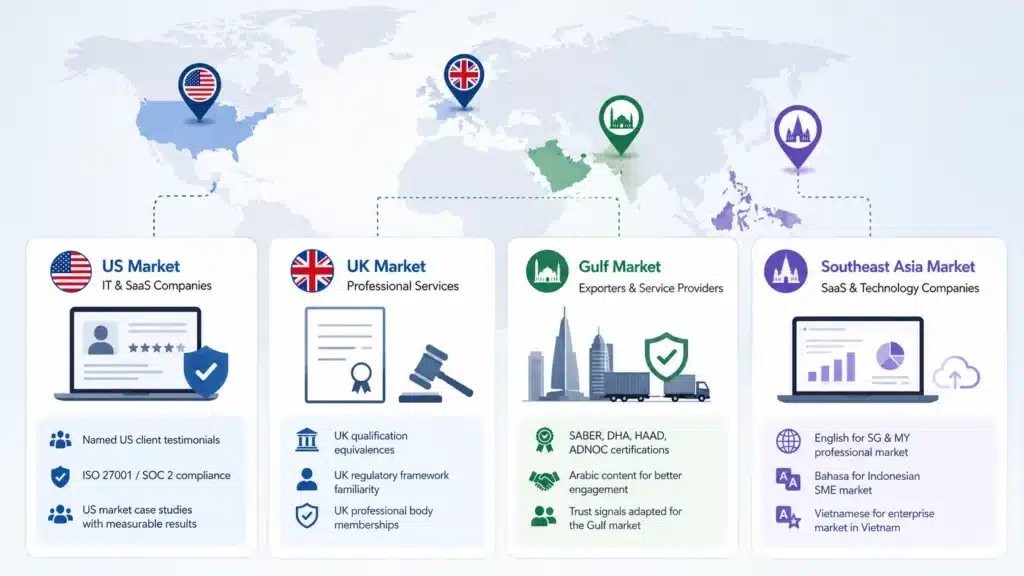
Effective international SEO is not one strategy applied to multiple markets. It is market-specific strategy built on genuine understanding of each target market’s search behaviour, buyer psychology, and trust signals.
US market SEO for Indian IT and SaaS companies:
The US enterprise buyer searching for Indian IT vendors is conducting due diligence, not discovery. They already know they want to evaluate an Indian vendor. Their queries reflect evaluation intent: “India IT company reviews,” “offshore development India quality,” “India software company portfolio.” Content targeting the US market must address the specific concerns of US enterprise buyers: IP protection, communication quality, timezone overlap, project management methodology, and client references in the US market.
Trust signals that matter for US buyers: named US client testimonials with company names and project outcomes (with permission), US-based reference contacts, ISO 27001 and SOC 2 compliance documentation, and US market-specific case studies with measurable outcomes.
UK market SEO for Indian professional services:
The UK professional services buyer — legal, financial, consulting — is primarily concerned with regulatory equivalence and professional credentials. UK-facing content from Indian CA firms, law practices, and consultancies must address UK qualification equivalences, demonstrate familiarity with UK regulatory frameworks, and reference UK-specific professional bodies.
Query patterns differ significantly from US: UK buyers use “India accountancy firm” rather than “India accounting firm,” “India solicitor” rather than “India lawyer,” “India management consultant” rather than “India business consultant.”
Middle East and Gulf SEO for Indian exporters and service providers:
The Gulf market represents a uniquely important international SEO target for Indian businesses across multiple categories: manufacturing exporters, healthcare tourism (Indian hospitals attracting Gulf patients), IT services, education, and jewellery and textiles.
Arabic language SEO is now increasingly important for Gulf markets — Google’s Personal Intelligence expansion to 98 languages includes Arabic, meaning Gulf searchers increasingly receive personalised Arabic-language AI responses. Indian businesses with Arabic-language content targeting Gulf audiences have a significant first-mover advantage.
The Gulf buyer’s trust signals differ from Western markets: SABER certification display for Saudi market, DHA and HAAD accreditation for UAE healthcare, ADNOC approval for energy sector suppliers. Including these certification signals on Gulf-targeted pages is a prerequisite for credibility.
Southeast Asia SEO for Indian SaaS and technology:
Singapore, Malaysia, Indonesia, Vietnam, and the Philippines represent a growing market for Indian SaaS products — particularly in the fintech, HR technology, and ERP categories where Indian companies have competitive pricing relative to US alternatives.
English-language SEO is the primary channel for the Singapore and Malaysia professional market. Indonesian Bahasa content is increasingly important for the Indonesian SME market. Vietnamese language content is valuable for the Vietnamese enterprise market.
Read Also: Predictive SEO: How to Win the Rankings Game Before the Algorithm Even Changes
International Content Localisation: More Than Translation
The most common international SEO mistake by Indian businesses is treating content localisation as translation. True localisation requires adapting not just language but examples, references, pricing context, cultural assumptions, and buyer pain points for each market.
What needs to be localised for effective international SEO:
Case studies and client references. A case study about a Delhi coaching institute may be irrelevant to a UK buyer evaluating an edtech platform. Rewrite case studies with the international buyer’s market context — “how we helped a UK-based corporate training provider” if that is your relevant international experience, or “how we helped companies similar to UK organisations in terms of size and complexity” if you don’t have direct UK experience.
Currency and pricing context. Pages targeting UK buyers should reference GBP pricing or at minimum USD pricing with clear GBP equivalents. Pages targeting Gulf buyers should reference AED or SAR equivalents. Referencing INR pricing only on international-targeted pages signals that the page is for Indian buyers, not the international audience.
Regulatory and compliance references. UK buyers care about GDPR compliance. US buyers care about SOC 2 and data residency. Gulf buyers care about local data protection laws. Include the specific regulatory standards relevant to each target market on market-specific pages.
Testimonial and social proof sources. A testimonial from a client in Bangalore carries less persuasion weight with a London buyer than a testimonial from a London client — or from a globally recognisable company that any buyer would know. Prioritise international client testimonials for international-facing pages.
Cultural communication style. US buyers respond to direct, confident, outcome-focused content. UK buyers respond to understated, credentials-focused, case-evidence content. Gulf buyers respond to relationship-emphasising, trust-building, long-form content. Adapt writing style for each market — not just vocabulary.
More To Read: Top 10 AI SEO Tools
International Link Building and Brand Authority for Indian Businesses
Building international backlink authority is qualitatively different from domestic Indian link building. The link sources that build international authority are not the Indian business directories that matter for local SEO. They are international industry publications, international partner directories, and earned editorial mentions in the countries you are targeting.
International editorial mentions (highest value).
For UK-targeting Indian IT companies: editorial mentions in The Guardian Technology, Computing.co.uk, IT Pro Portal, or The Register. For US-targeting companies: editorial mentions in Forbes Technology, Business Insider, TechCrunch, or sector-specific trade publications. These are earned through genuine expert commentary, original research with international relevance, and relationships with technology journalists.
International directory and ecosystem listings.
For Indian SaaS companies: G2, Capterra, and Software Advice provide platform-specific citation authority in international markets. Clutch.co is the most important international directory for IT services — international enterprise buyers consistently use Clutch as a vendor discovery and due diligence platform. A Clutch profile with 20+ verified reviews from international clients is a prerequisite for international IT market credibility.
For Indian manufacturing exporters: Alibaba and Global Sources remain important for international B2B buyer discovery, but their link profiles are less valuable for international SEO than industry-specific export directories (TradeIndia for export, sector-specific trade association directories).
For Indian healthcare: JCI accreditation listing, Medical Tourism Association membership, and international health plan provider directories carry significant trust weight for international patient targeting.
International partnership and case study citations.
If your Indian business has provided services to international companies, request that they mention your collaboration on their website with a link. A mention from a US Fortune 500 company (“we work with [Indian company] for software development”) carries extraordinary international backlink authority that no link outreach programme can replicate.
Managing International SEO and Domestic SEO Together: Avoiding Cannibalisation
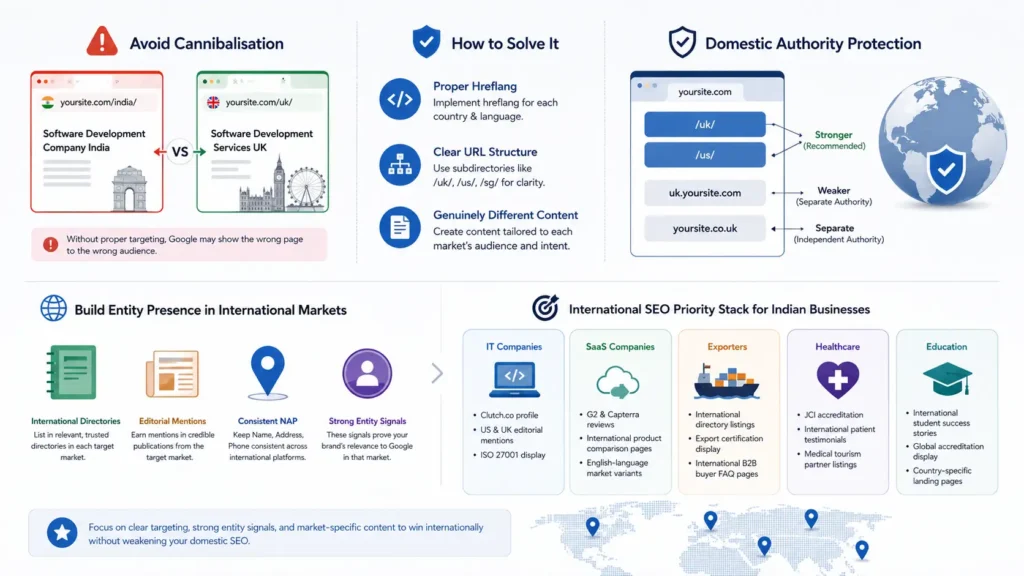
One of the most significant practical challenges for Indian businesses pursuing international SEO is avoiding domestic-international cannibalisation — the situation where your international content competes with your domestic content for the same queries, or where your international strategy inadvertently weakens your domestic Indian SEO.
The cannibalisation risk:
An Indian IT company that creates a page targeting “software development services UK” and also has a page targeting “software development company India” may find that Google is confused about which page to show Indian searchers versus UK searchers — if the geographic targeting signals are not explicit and clear.
This is solved by proper hreflang implementation, clear URL structure (subdirectory or subdomain), and content that is genuinely differentiated between markets — not just the same page with “India” replaced by “UK.”
The domestic authority protection principle:
International content should be structured to draw authority from your domestic root domain rather than dilute it. Pages at yoursite.com/uk/ inherit authority from your main domain. Pages at uk.yoursite.com build separate authority that may be weaker initially. Pages at yoursite.co.uk build entirely separate authority.
For Indian SMEs at early stages of international expansion, the subdirectory structure protects domestic authority while building international presence — the safest structural approach.
Entity signals in international markets:
For Indian businesses targeting specific international markets, building entity presence in those markets requires more than a page on your website. It requires: being listed in relevant international directories, earning at least one editorial mention in a credible publication from that market, and having your brand name appear consistently across international platforms with the same NAP data that appears on your website. This cross-market entity presence is what Google’s international ranking systems use to verify your brand’s genuine relevance to the market you claim to serve.
The Indian business international SEO priority stack: IT companies → Clutch.co profile, US and UK editorial mentions, ISO 27001 display. SaaS companies → G2 and Capterra reviews, international product comparison pages, English-language market variants. Exporters → international directory listings, export certification display, international B2B buyer FAQ pages. Healthcare → JCI accreditation, international patient testimonials, medical tourism partner listings.
The International SEO Action Plan for Indian Businesses: Priority Order
Given the complexity of international SEO, the priority order matters enormously. Here is the implementation sequence for Indian businesses:
Phase 1 (Month 1): Identify your international opportunity and implement technical foundations
Identify your two highest-priority international markets based on where you already have customers or the clearest competitive proposition. Implement hreflang correctly for those markets. Create subdirectory URL structure. Verify Google Search Console for each target country (separate properties required for subdirectory and subdomain international structures).
Phase 2 (Month 2): Build market-specific content
Create 5 genuinely localised pages for each priority international market — a market-specific homepage variant, 3 service pages with market-specific case studies and regulatory references, and one FAQ page addressing the specific concerns of buyers in that market. Write all content in the natural English variant of that market (British English for UK, American English for US).
Phase 3 (Month 3): Build international authority signals
Create your Clutch.co profile if targeting IT/SaaS buyers internationally. Complete profiles on G2/Capterra for software products. Request international client testimonials with specifics. Identify and pitch two international industry publications for expert contribution opportunities.
Ongoing: International content velocity
Publish one market-specific piece of content per month for each priority international market. Monitor international ranking progress in Google Search Console by country segmentation. Track branded search growth in international target countries as an indicator of growing international brand recognition.
The Bottom Line
International SEO for Indian businesses in July 2026 is not a luxury for large companies. It is a strategic opportunity for every Indian business that can genuinely serve international customers — IT companies, manufacturers, SaaS products, healthcare providers, educational platforms, jewellery exporters, and consultancies.
The technical foundations (hreflang, URL structure, Google Search Console country segmentation) are achievable by any business with competent web development support. The content localisation (not just translation — genuine market adaptation) is achievable by any business with genuine knowledge of their international customers. The authority building (international platform presence, international editorial mentions, international client testimonials) is achievable through the same processes that build domestic authority — applied to international contexts.
The Indian businesses that build international SEO foundations in the next 90 days will establish ranking positions in international markets that compound in value as their international customer base grows. The businesses that wait will face competitors who have already claimed those positions and built the authority that makes displacing them slow and expensive.
India’s digital economy is global in scope. Your SEO strategy should be too.
DigitalArka builds international SEO strategies for Indian businesses targeting UK, US, Gulf, and Southeast Asian markets. Free international SEO audit at digitalarka.com