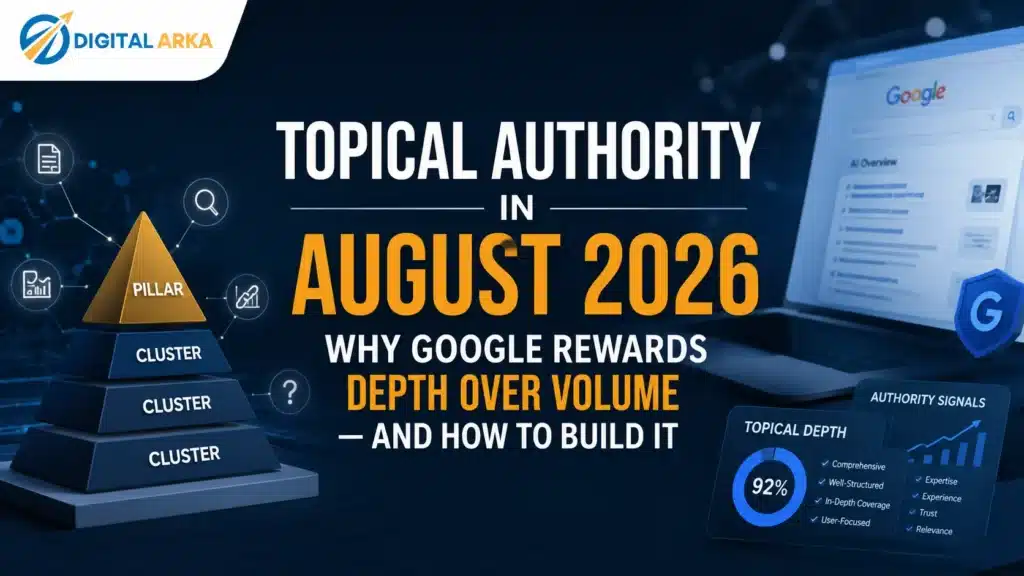

The Era of the Single Keyword Page Is Over
In August 2026, Digital Arka audits more than 50 client websites every quarter, and we see the same pattern repeatedly: businesses that published hundreds of thin, isolated blog posts targeting individual keywords watch their traffic collapse in core updates, while businesses that built 10 deeply interlinked posts around a core topic cluster continue gaining ground. Google now rewards depth over volume, and the data backs it up decisively.
Content clusters — pillar pages paired with satellite cluster articles — increase organic traffic by 40 percent through topical authority signals, according to Digital Applied’s 2026 content cluster research. More significantly, Google’s Search VP confirmed this year that AI Mode and AI Overviews run on the same ranking systems as traditional Search. You do not build a separate strategy for AI visibility — you build genuine topical authority, and that authority earns visibility across every surface simultaneously.
“Content clusters increase organic traffic by 40% through topical authority. AI Mode and AI Overviews run on the same ranking systems as traditional Search — no separate GEO channel exists.” — Digital Applied Content Cluster Guide 2026 / Google Search VP
What Topical Authority Actually Means in 2026
Topical authority means Google recognises your site as the most comprehensive, reliable, and consistently updated source on a specific subject. You achieve it when Google’s systems can look at your domain and confirm: this site covers this topic from every angle — beginner to advanced, strategic to tactical, question to answer. The clearer and more interconnected your topic universe is, the more likely Google classifies you as an authority source — and cites you in AI-generated answers.
In 2026, topical authority rests on three structural pillars. First, breadth: does your content cluster cover every subtopic within a subject area, leaving no obvious gaps a competitor can exploit? Second, depth: does each individual piece go beyond surface-level information to offer genuine insight, original data, or first-hand experience? Third, internal connectivity: does your site architecture signal to Google exactly how your content pieces relate to each other through disciplined, two-directional internal linking?
The Pillar-and-Cluster Architecture That Wins in August 2026
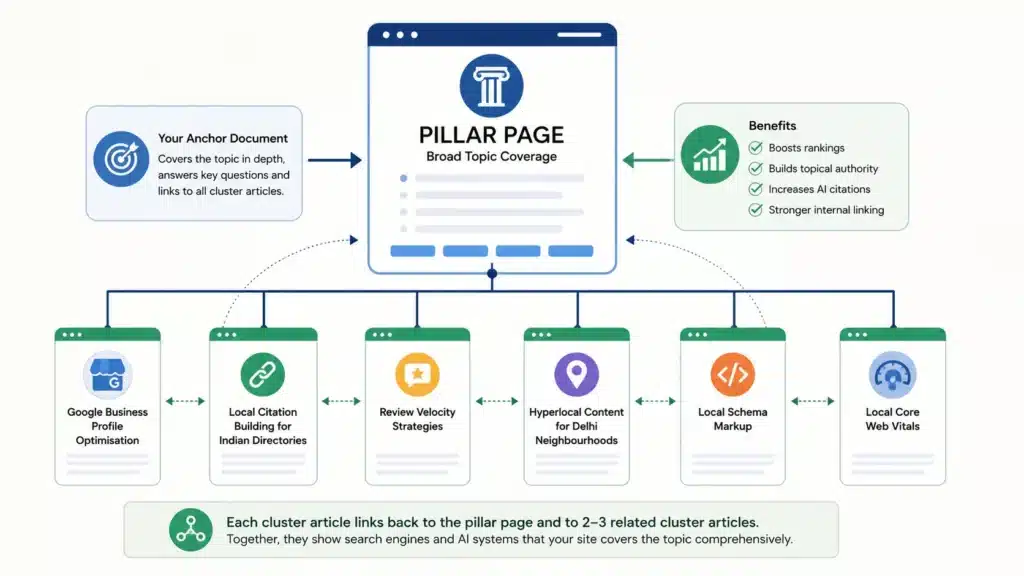
The Pillar Page — Your Anchor Document
Your pillar page covers a broad topic comprehensively. It answers the foundational questions, defines key concepts, and links out to every cluster article that goes deeper on a specific subtopic. Digital Arka builds pillar pages of 3,000 to 5,000 words for clients in the SEO, digital marketing, and local business space. These pages rank for head terms and serve as the authoritative hub that distributes ranking signals to all cluster content.
Write your pillar page to answer the question: “If a complete beginner asked me everything about [topic], what would I tell them?” Structure it with question-based H2 headings, direct-answer openers in each section, and explicit links to deeper cluster articles using anchor text that describes what the linked page covers.
Cluster Articles — Your Depth Signals
Each cluster article targets a specific subtopic with a level of depth the pillar page cannot provide without becoming unwieldy. A pillar page on “local SEO for Delhi businesses” spawns cluster articles on: Google Business Profile optimisation, local citation building for Indian directories, review velocity strategies, hyperlocal content for Delhi neighbourhoods, local schema markup, and local Core Web Vitals. Each cluster article links back to the pillar page and to two to three sibling cluster articles.
HubSpot’s 2026 research confirms the pillar-and-cluster approach “improves rankings and increases the likelihood of being cited in AI-generated responses” because your content demonstrates comprehensive coverage of a topic rather than a single, isolated answer. AI systems cite sources that clearly demonstrate subject expertise — and a well-built cluster makes that expertise visible at the site architecture level, not just the page level.
“The pillar-and-cluster approach improves rankings and increases the likelihood of being cited in AI-generated responses — your content demonstrates comprehensive coverage rather than a single, isolated answer.” — HubSpot State of Marketing 2026
5 Steps Digital Arka Uses to Build Topical Authority for Clients
01 Choose One Topic Territory and Own It Completely
We do not let clients try to build topical authority on five topics simultaneously. We choose one core topic per quarter — the subject where the client has the deepest genuine expertise and the highest business value — and we systematically build the full cluster around it before moving to the next. A digital marketing agency in South Delhi that builds complete topical authority on “local SEO for Delhi SMBs” earns more citations than an agency that publishes one post each on 20 different marketing topics.
02 Map Every Subtopic Before Writing a Single Word
We build a topic map — a spreadsheet listing every question, subtopic, and angle someone might search within the chosen territory. We categorise each one: pillar, cluster, or FAQ item. We check which subtopics already have pages on the site (to avoid cannibalisation), which competitors cover (to find gaps), and which generate the most AI Overview triggers (to prioritise for AEO structure). This map guides the next six months of content production.
03 Write Cluster Articles That Satisfy the Full Search Intent
Each cluster article at Digital Arka must satisfy the full search intent for its target query — not just mention the topic. We check what the top three results for a query actually contain, identify what they miss, and ensure our client’s article covers the gap. We add original data where possible (case study results, client benchmarks, first-hand observations) because 66 percent of marketers say original content creation has the most positive impact on SEO in 2026, according to The Edigital’s SEO Trends research.
04 Build Two-Directional Internal Links on Every Publish
When we publish a new cluster article, we immediately add internal links to it from the pillar page and from two to three sibling cluster articles. We then check that the new article links back to the pillar. This two-directional linking creates the semantic network that signals topic relevance and topical authority to Google’s systems. Orphan pages — published content with no internal links pointing to it — receive no authority signal from the cluster.
05 Refresh Cluster Articles Every 90 Days With New Data
A 2019 article updated with 2026 data can outperform a new article, according to The Edigital’s 2026 SEO trends research. We set every client’s cluster articles on a 90-day refresh cycle: update the statistics, add a new section addressing a recent development, update the dateModified schema timestamp, and republish. This freshness signal directly improves citation eligibility in Perplexity (which cites content under 30 days old in 82 percent of its responses) and signals content health to Google’s quality systems.
Topical Authority and AI Search: The Connection That Makes It Essential
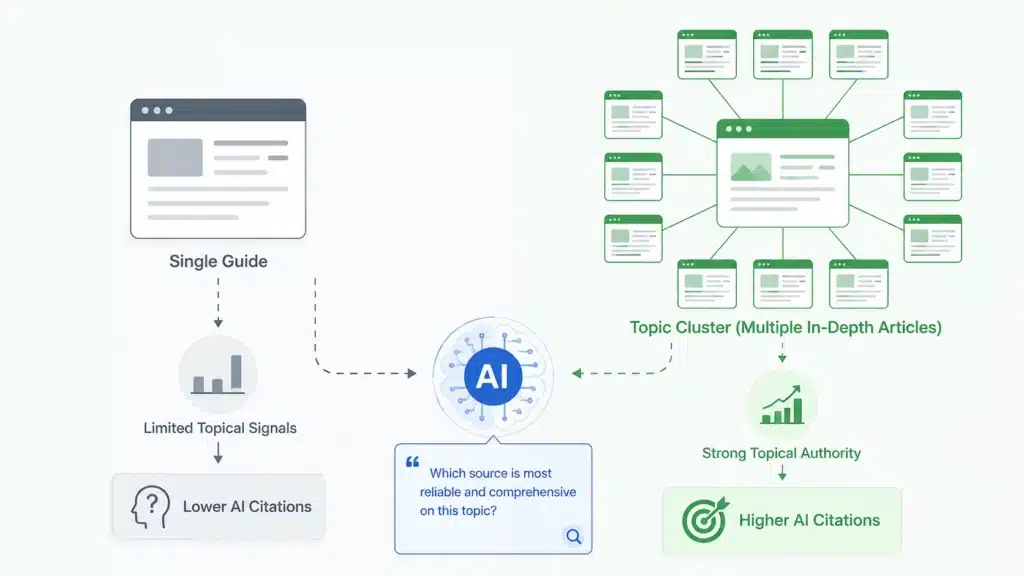
Google’s AI Mode and AI Overviews do not build their answers from isolated pages. They synthesise information from sites that demonstrate comprehensive, consistent coverage of a topic. When an AI system searches for the most reliable source to cite on “local SEO for Delhi businesses,” it does not evaluate a single page in isolation. It evaluates the entire domain’s track record on that topic — how many relevant pages exist, how recently they were updated, how comprehensively they cover the subtopic landscape, and how consistently the author entity demonstrates expertise.
A business with a 15-article topic cluster on local Delhi SEO earns more AI citations on that subject than a business with one comprehensive guide — even if the single guide is technically better on the page level. The cluster signals topical depth at the domain level. The single guide signals a one-time effort. AI systems distinguish between the two and weight domain-level topical signals heavily in citation decisions.
Topical Authority for Delhi NCR Businesses: Where to Start
At Digital Arka, we recommend that every Delhi NCR business identify one hyper-local topic where they have irreplaceable first-hand knowledge. A restaurant in Connaught Place has first-hand knowledge of dining trends in Central Delhi that no national publication can replicate. A law firm in Saket has expertise in Delhi High Court filing procedures that a generic legal blog cannot match. That first-hand, location-specific knowledge is the foundation of an unbeatable topical authority cluster.
Start with a pillar page on your core local specialty. Build five cluster articles around it in the first quarter. Add internal links bidirectionally. Refresh everything at 90 days. Contact Digital Arka at digitalarka.com or call +91 70110 34858 — we build full topical authority clusters for Delhi NCR businesses as part of our SEO engagement programmes.
Frequently Asked Questions (AI-Query Based)
We sourced these questions from real queries people ask Google AI Mode, ChatGPT, Perplexity, and Bing Copilot about this topic. Every answer uses a direct, passage-first structure for maximum AI citation eligibility.
Q1. What is topical authority in SEO and why does it matter in 2026?
A: Topical authority is the recognition Google gives to websites that demonstrate comprehensive, consistent expertise on a specific subject through multiple interlinked content pieces. It matters in August 2026 because Google’s AI Mode and AI Overviews preferentially cite sources that show domain-level topical depth, not just strong individual pages. Content clusters increase organic traffic by 40 percent and significantly raise AI citation eligibility, according to Digital Applied’s 2026 research.
Q2. What is a content cluster and how does it help SEO?
A: A content cluster is a group of interlinked web pages covering a topic from multiple angles — a pillar page covering the broad topic and satellite cluster articles covering specific subtopics in depth. It helps SEO by building topical authority signals that Google uses to classify your site as a reliable expert on a subject. HubSpot confirms the pillar-and-cluster approach “improves rankings and increases likelihood of being cited in AI-generated responses” in 2026.
Q3. How many articles do I need for a content cluster to build topical authority?
A: A minimum viable content cluster requires one pillar page and five to seven cluster articles targeting specific subtopics, all bidirectionally interlinked. Digital Arka recommends building to 10 to 15 cluster articles per topic territory over six months. The quality and connectivity of each article matters more than the total count. Five deeply researched, well-structured cluster articles outperform 20 thin posts covering the same subtopic range.
Q4. How does topical authority affect AI Overview citations?
A: Topical authority directly increases AI Overview citation rates because AI systems evaluate domain-level topic coverage, not just individual page quality. A domain with 15 interlinked posts on a subject earns more AI citations than a domain with one strong post, even if the single post is technically superior. AI systems interpret consistent, comprehensive coverage as a domain-level trust signal that makes them more confident citing that source in generated answers.
Q5. What is a pillar page and how do I write one?
A: A pillar page is a comprehensive, long-form page (3,000 to 5,000 words) that covers a broad topic from multiple angles and links to all related cluster articles. Write one by: answering the most common questions about the topic in dedicated sections, using question-based H2 headings, opening each section with a direct answer, and explicitly linking to deeper cluster articles with descriptive anchor text. The pillar page ranks for head terms and serves as the authority hub for the entire cluster.
Q6. How often should I update content cluster articles for best SEO results?
A: Refresh every cluster article every 90 days minimum. Update statistics to current data, add a new section addressing recent developments, update the dateModified schema timestamp, and republish. Perplexity cites content under 30 days old in 82 percent of its responses. Google’s quality systems also reward content freshness as a signal of active editorial maintenance. A well-maintained 2-year-old article consistently outranks a newer article on the same topic in a well-built cluster.
Q7. Does topical authority replace the need for backlinks in 2026?
A: No. Topical authority and backlinks work together in 2026. Topical authority signals expertise and comprehensiveness through your own content architecture. Backlinks signal external validation and authority from third-party sources. According to TryAnalyze.ai’s analysis of 83,670 AI citations, 92.36 percent of AI citations come from top-10 ranking domains — and those domains typically have both strong topical authority and strong backlink profiles. Build both simultaneously.
Q8. How does internal linking build topical authority?
A: Internal linking builds topical authority by creating a semantic network that signals to Google how your content pieces relate to each other. When you link from a cluster article to the pillar page and from the pillar page back to the cluster article, you communicate topic relevance and content hierarchy. Google’s crawl systems follow internal links to discover and assess the full scope of your coverage. Two-directional linking — pillar to cluster and cluster to pillar — is the most important internal linking practice for topical authority.
Q9. Can a small business build topical authority against large competitors?
A: Yes. Small businesses build topical authority most effectively by choosing a hyper-specific niche where they have irreplaceable first-hand expertise. A Delhi-based accountancy firm that builds a complete content cluster on “GST filing for Delhi restaurants” earns more topical authority on that specific subject than a national financial services brand publishing generic tax content. Hyper-local, hyper-specific expertise is the small business’s biggest topical authority advantage.
Q10. How do I measure topical authority progress in Google Search Console?
A: Measure topical authority progress in GSC by tracking: total impressions across all pages in your cluster (should grow month over month), average position for your cluster’s head terms (should move toward top 5), click-through rate on cluster pages (improves as rich result eligibility grows with schema and structure), and AI citation frequency using the GSC AI performance report. Rising cluster-wide impressions alongside stable or improving average positions indicate growing topical authority recognition.