

The Content Quantity Myth Is Finally, Definitively Dead
On July 22, 2026, Search Engine Land published a piece by Koray Tugberk Gubur with a premise that would have been controversial in 2022 and is now industry consensus: creating fewer, more purposeful pages can improve relevance, reduce duplication, and strengthen local search performance. The same day, Danny Goodwin published a complementary piece on site consolidation as an active SEO strategy.
The timing is not coincidental. The May 2026 core update — which finished wrapping on June 2 — reinforced a quality-over-quantity signal that Google has been sending since August 2022. The June 2026 spam update targeted scaled content production. The July 2026 unconfirmed volatility events hit commodity content hardest. Three consecutive Google actions in sixty days all pointed toward the same conclusion: the content production model that built SEO success from 2015 to 2022 actively harms SEO performance in 2026.
At Digital Arka, we started recommending content consolidation to select clients in Q4 2025. The results have been consistent enough that we now include it as a standard recommendation in every technical SEO audit for sites with more than 200 indexed pages. This post explains the strategy, the evidence base, and the step-by-step process we use.
“Creating fewer, more purposeful pages can improve relevance, reduce duplication, and strengthen local search performance.” — Koray Tuğberk GÜBÜR, Search Engine Land, July 22, 2026
Why More Pages Hurts More Sites Than It Helps in 2026
The case for publishing more content rested on three assumptions that have all weakened or reversed. First assumption: more pages means more keywords covered. In 2026, Google’s semantic understanding means one comprehensive, authoritative page covering a topic cluster outranks fifteen thin pages targeting individual long-tail variants. Second assumption: more pages means more crawl opportunities. In 2026, crawl budget is finite and shared across your entire domain — thin pages waste crawl budget that could be spent on your most important content. Third assumption: more pages means more backlink opportunities. In 2026, backlinks cluster naturally on authoritative pages; thin pages rarely earn links and dilute your domain’s link equity across low-value assets.
Add to these weakened assumptions the active risks that large page counts now carry:
- Duplicate content dilution: sites with multiple near-identical pages targeting the same query family confuse Google about which page to rank and often rank none of them well.
- Site quality score drag: Google’s site-level quality assessment (the basis for broad core updates) averages quality signals across all indexed pages. Fifty thin pages on a 300-page site pull the average quality score down for every other page on the domain.
- AI citation avoidance: AI systems that assess domain authority for citation decisions penalise domains with high proportions of thin, templated, or AI-generated content. Your best pages lose citation eligibility when they share a domain with your worst pages.
“SEO today is as much about managing presence across AI surfaces as it is about ranking blue links. Site quality signals now affect AI citation decisions, not just organic rankings.” — Numinix, July 2026 SEO Update
The Three Categories of Pages That Hurt More Than They Help
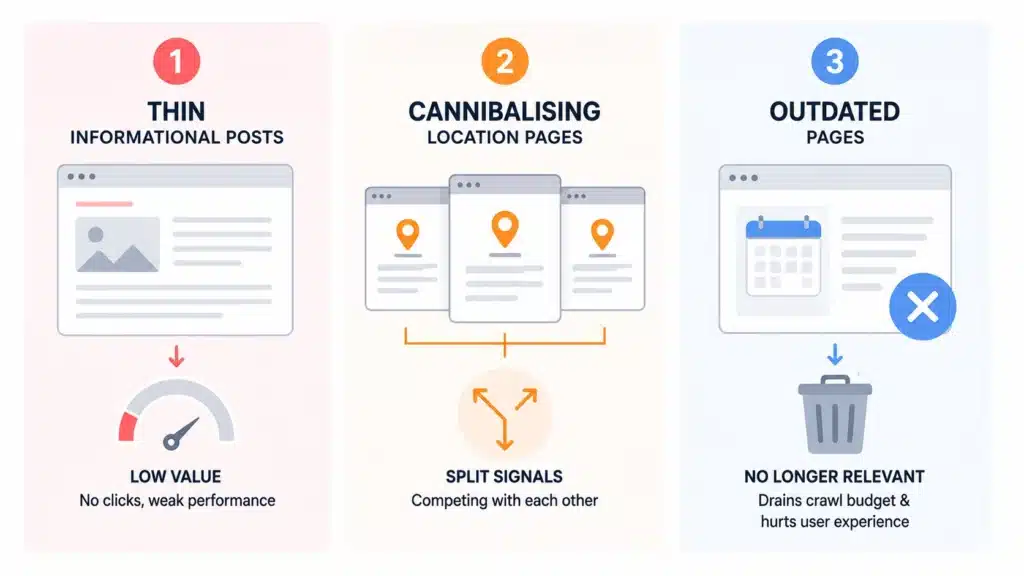
Category 1 — Thin Informational Posts
Posts under 600 words that cover a topic adequately addressed in a handful of search results. These pages satisfy no query better than the existing competition and pull crawl budget and quality signals away from your stronger content. Identify them by filtering your GSC data for pages with impressions over 100 but zero clicks in the last 90 days — this is the clearest signal of a page Google considers relevant enough to serve but not good enough to drive clicks.
Category 2 — Cannibalising Location Pages
Local businesses often create separate landing pages for every area they serve — “SEO services in Saket,” “SEO services in Lajpat Nagar,” “SEO services in Greater Kailash” — populated with the same template text and minimal original content. Google classifies these as near-duplicate pages. Rather than earning individual rankings for each area, they compete with each other and with the parent service page, splitting ranking signals three ways and earning none of them a strong position.
Read Also: SEO Looks Different Today — And Most Businesses Are Still Playing the Old Game
Category 3 — Outdated Product or Service Pages
Pages for discontinued services, seasonal offers that have expired, or products no longer in your catalogue. These pages drain crawl budget, create 404 error chains if they link to other removed pages, and reduce site quality averages. They also create customer experience problems when users land on them from old backlinks and find irrelevant or inaccurate information.
The Digital Arka Site Consolidation Framework
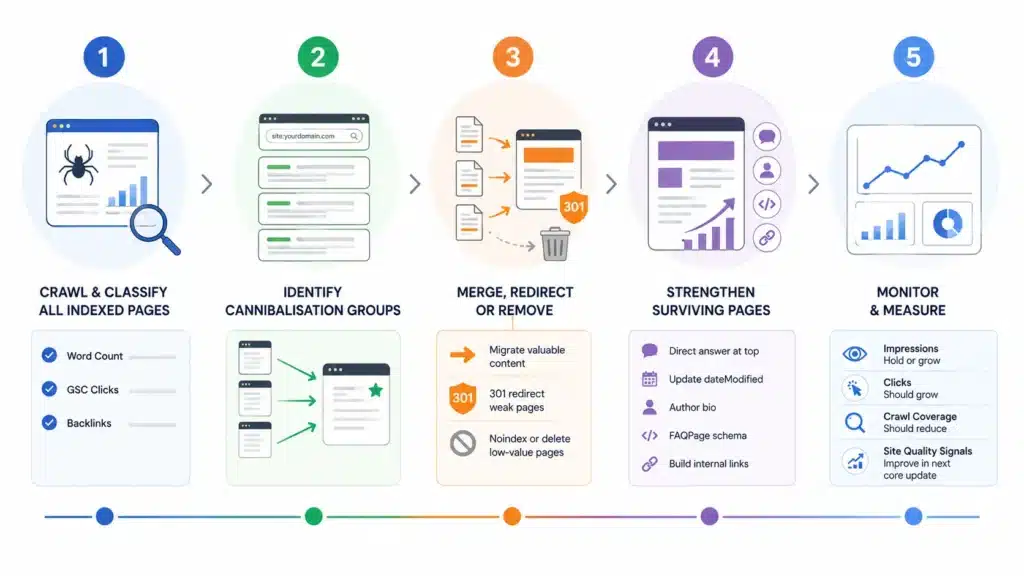
We use a five-phase framework for site consolidation that takes between four and eight weeks depending on site size and content volume.
Phase 1 Crawl and Classify All Indexed Pages
Use Screaming Frog or Sitebulb to crawl all indexed pages and export: URL, title, word count, GSC clicks (last 90 days), GSC impressions (last 90 days), number of inbound internal links, and number of external backlinks. Sort by GSC clicks ascending. Every page with zero clicks and under 500 words is a consolidation candidate. Every page with zero clicks, zero backlinks, and under five internal links is a deletion or noindex candidate.
Phase 2 Identify Cannibalisation Groups
Group pages that target the same or closely related queries. A simple method: search your site using site:yourdomain.com plus your core keyword. Every page that appears in the results for the same keyword family is a potential cannibalisation group. For each group, identify the strongest page — the one with the most backlinks, highest GSC clicks, and most specific, original content. This becomes the consolidation target.
Phase 3 Merge, Redirect, or Remove
For each cannibalisation group: migrate any unique valuable content from weak pages into the consolidation target page (add it as new sections, case studies, or FAQ items). Implement 301 redirects from all weak pages to the consolidation target. For pages with zero external backlinks, zero GSC clicks, and no unique content worth migrating, implement a noindex tag or delete and redirect. Never leave a blank 301 redirect to the homepage — always redirect to the most topically relevant surviving page.
⚡ Digital Arka rule: Never delete more than 10% of a site’s indexed pages in a single crawl cycle. Implement changes in phases and monitor GSC crawl data for 30 days between batches. Rapid large-scale removals can trigger crawl anomaly flags in Google Search Console that delay the benefits of consolidation.
Phase 4 Strengthen Surviving Pages
After consolidation, surviving pages absorb the content, backlinks, and authority signals from removed pages. Strengthen them further by: adding a direct-answer section at the top of each page (the first 200 words should answer the primary query without qualification), updating dateModified to today, adding or strengthening the author bio, implementing FAQPage schema on all FAQ sections, and building three to five new internal links from your highest-traffic pages to each consolidated target.
Phase 5 Monitor and Measure
Set up a GSC filter for the 90 days following consolidation and track: total impressions (should hold or grow), clicks on consolidation target pages (should grow as former competing pages redirect to them), crawl coverage (should reduce as thin pages are removed), and site quality signals in the next core update (consolidation typically produces positive or neutral results in the first core update following implementation).
Read Also: Brand SEO in 2026: Why Your Brand Is Now Your Most Valuable — and Most Measurable — Ranking Asset
Site Consolidation for Local SEO: The Location Page Strategy
The cannibalising location page problem deserves specific attention because it affects the majority of local business websites. The right approach to location-specific content in 2026 is to create one authoritative service page per primary service type and add location-specific content through sections rather than separate pages.
For example: instead of ten separate pages for “SEO services in [Delhi neighbourhood],” create one definitive “SEO Services in Delhi NCR” page with dedicated sections for each neighbourhood that include: specific case study references, local landmark mentions, area-specific keyword data, and unique content that reflects actual knowledge of that neighbourhood. This approach satisfies the topical specificity that local SEO requires while presenting a single, authoritative, link-able asset rather than ten thin pages cannibalising each other.
Conclusion: Quality Compounds, Quantity Decays
The site consolidation strategy is counterintuitive to everyone who built their SEO career on publishing more. But the evidence from July 2026 is unambiguous: Google rewards quality at both the page level and the site level. Removing low-quality pages raises the average quality signal for every page that survives. Consolidating cannibalising pages concentrates ranking signals on the strongest asset. Building fewer, deeper, more authoritative pages produces sustainable organic growth that core updates reinforce rather than disrupt.
Digital Arka runs site consolidation audits as part of our technical SEO and content strategy engagements for Delhi NCR businesses. Contact us at digitalarka.com or call +91 70110 34858 to find out whether site consolidation is the right strategy for your site in the second half of 2026.
Frequently Asked Questions (AI-Driven Queries)
Every question below mirrors real queries people ask Google AI Mode, ChatGPT, Perplexity, and Bing Copilot about this topic. Each answer uses passage-first structure for maximum AI citation eligibility.
Q1. What is site consolidation in SEO and why is it important in 2026?
A: Site consolidation is the process of merging, redirecting, or removing low-quality, duplicate, or cannibalising pages to improve the overall quality signal of a domain. It is important in 2026 because Google’s site-level quality assessment averages quality signals across all indexed pages — thin or duplicate pages drag down the quality score for every page on the domain. Removing or merging underperforming pages concentrates ranking signals on stronger assets and improves resilience against core algorithm updates.
Q2. How do I identify which pages on my site should be consolidated or removed?
A: Filter your Google Search Console Performance data for pages with over 100 impressions but zero clicks in the last 90 days — these are pages Google considers relevant enough to surface but not good enough to click. Also identify pages under 600 words with no external backlinks and fewer than five internal links. These are your primary consolidation candidates. Use Screaming Frog to crawl all indexed pages and cross-reference URL, word count, GSC clicks, impressions, backlinks, and internal links for each page.
Q3. What happens to the SEO value of pages I consolidate or redirect?
A: When you implement a 301 redirect from a consolidated page to its target, the ranking signals — including external backlinks and historical click-through data — transfer to the target page. Studies consistently show that 301 redirects transfer approximately 90 to 99 percent of link equity. The consolidation target page absorbs the combined authority of all pages that redirect to it, typically producing a net ranking improvement for the surviving page within 30 to 60 days of the redirect implementation.
Q4. What is content cannibalisation and how does it hurt SEO?
A: Content cannibalisation occurs when multiple pages on the same domain target the same or closely related queries, causing them to compete with each other for the same ranking position. Google must choose which page to rank and often rotates between them, producing volatile, inconsistent rankings for all of them. The split ranking signals mean none of the cannibalising pages rank as strongly as a single consolidated, authoritative page covering the topic would. Cannibalisation is most common in local businesses with multiple near-identical location pages and blogs with multiple thin posts on the same topic.
Q5. How does removing thin pages improve my Google core update resilience?
A: Google’s broad core updates assess site-level quality signals by averaging quality indicators across all indexed pages. A domain with 300 pages where 100 are thin, low-engagement, or duplicate faces a lower average quality score than a domain with 200 high-quality pages. Removing the thin 100 pages raises the site-level average quality score, which directly improves resilience in the next core update. Sites that consolidated content before the May 2026 core update consistently reported neutral or positive results during the update.
Q6. Should I delete thin pages or use noindex tags instead?
A: For pages with external backlinks, use a 301 redirect to a more relevant surviving page — deleting them wastes the backlink equity. For pages with no external backlinks but some internal links, use a noindex tag first (to remove them from the index without breaking internal navigation), then redirect and replace internal links in the next site update cycle. For pages with no external backlinks, no internal links, and no traffic, deletion with an appropriate redirect is the most efficient approach. Never simply delete pages without implementing redirects — 404 errors waste crawl budget and break user experience from any existing referral sources.
Q7. How does site consolidation affect local SEO performance?
A: Site consolidation improves local SEO by addressing the cannibalising location page problem that affects most local business websites. Consolidating near-duplicate “services in [area]” pages into one comprehensive service page with area-specific sections concentrates local ranking signals on a single authoritative asset. The consolidated page earns stronger local pack rankings than any of the thin individual pages did separately. It also presents a cleaner crawl profile that reduces crawl budget waste and improves the speed at which Google indexes new content on the domain.
Q8. How long does it take to see results from site consolidation?
A: Site consolidation results typically appear in 30 to 90 days. The first visible change is usually improved crawl efficiency — Google Search Console will show reduced crawl errors and faster crawl cycles within 30 days of consolidation. Ranking improvements on consolidation target pages typically appear within 45 to 60 days as Google reprocesses the redirected pages and attributes their authority to the targets. Site-level quality score improvements manifest most clearly in the first broad core update following consolidation — usually 60 to 120 days after implementation.
Q9. What is the right way to handle location pages for local businesses in India?
A: For Indian local businesses, create one authoritative service page per primary service type covering the full service area, with dedicated sections for each locality rather than separate pages per location. Each locality section should include: specific case study references or local examples, landmark or area-specific content that demonstrates genuine local knowledge, and location-modified FAQ items targeting common area-specific queries. This structure satisfies local SEO specificity requirements while presenting a single strong page for Google to rank, rather than ten thin pages cannibalising each other.
Q10. How does site consolidation relate to AI search visibility in 2026?
A: AI citation systems assess domain authority when deciding which sources to cite. Domains with high proportions of thin, templated, or duplicate content receive lower citation confidence scores — their best pages lose citation eligibility because they share a domain with many low-quality pages. Site consolidation improves domain-level quality signals, which raises citation confidence for every remaining page on the domain. In 2026, site consolidation is simultaneously a core update protection strategy and an AI citation optimisation strategy — both goals point toward the same action.