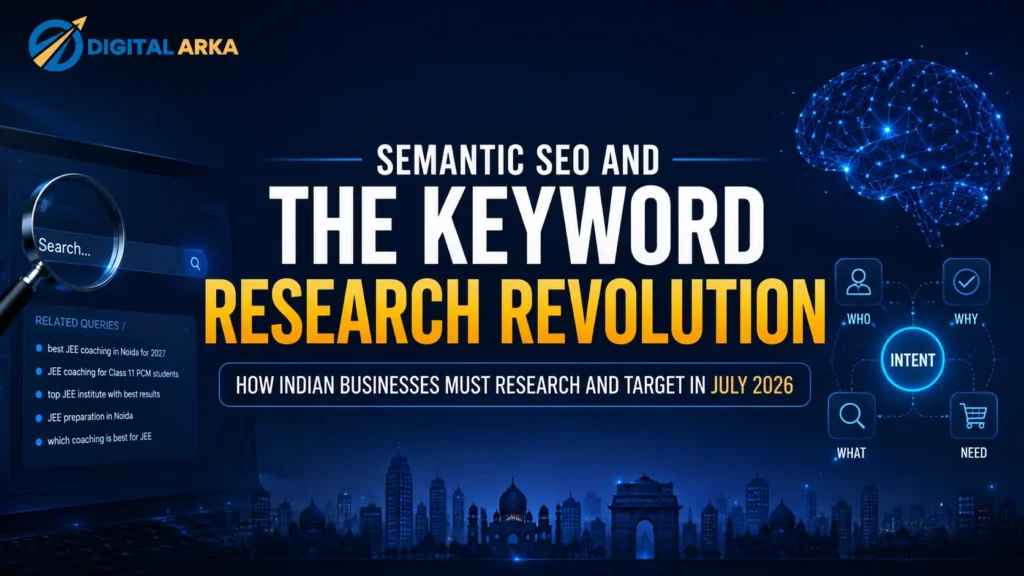

In July 2026, the atomic unit of SEO is no longer the keyword — it is the intent. One piece of genuinely comprehensive content that satisfies an intent cluster of 15 related queries will consistently outperform 15 separately keyword-optimised articles that each address only their single target query.
The keyword research process most Indian businesses use in July 2026 was designed for 2018. Pick a keyword. Check search volume. Check keyword difficulty. Write an article targeting that keyword. Hope it ranks.
This process still produces results — for some queries, in some categories. But the queries for which it works are shrinking, and the queries for which it is completely ineffective are growing rapidly. As Google’s AI systems evolve from retrieval engines to reasoning engines, the definition of what a “keyword” is has fundamentally changed.
In July 2026, users are not searching “best JEE coaching Noida.” They are asking “which JEE coaching institute in Noida has the best results for PCM students who are currently in Class 11 and want to give the 2027 exam?” These are not keywords — they are conversational, intent-rich, context-laden queries that require a fundamentally different research and content strategy to capture.
This blog covers the complete reimagining of keyword research for Indian businesses in July 2026: what semantic SEO means in practice, how to research and target the new category of queries that matter, and what changes Indian businesses must make to their content strategy to remain visible as search behaviour evolves.
The Death of the Single Keyword — and What Replaced It
Traditional keyword research is built on a fiction: that Google users express their intent through a short phrase that maps cleanly to a single page. This was approximately true in 2010. It has become progressively less true with every development in search — voice search, mobile search, AI search — and in July 2026 it is simply wrong for a large and growing category of queries.
Query lengths have tripled inside AI Mode. Users are submitting fuller context, not shorter keywords. “Running shoes” has become “best running shoes for a 40-year-old beginner runner with flat feet who wants to train for a half marathon in Chennai’s weather.” The new query is not longer for no reason — it is longer because AI Mode can process and answer it accurately, and users have learned that longer queries get better responses.
Semantic SEO is the discipline of optimising for what a query means, who is asking it, why they are asking it, and what they actually need — rather than optimising for the literal words in the query.
Google’s systems now evaluate content through semantic understanding. Two pages with completely different words can rank for the same query if they satisfy the same intent. Two pages with identical keywords can rank differently if they serve different intents. The keyword is no longer the atomic unit of SEO — the intent is.
For Indian businesses, this shift requires a research process that starts with customer intent rather than keyword tools. The question is not “what keywords do people search?” but “what problems are my potential customers trying to solve, and what do they want to know, do, or buy at each stage of that solution journey?”
Entity SEO: The Technical Layer Beneath Semantic Search
Semantic SEO has a technical infrastructure that most Indian businesses have not yet implemented: entity optimisation. Understanding entities is essential for understanding why some businesses rank for queries that never appear in their page content — and why some businesses with perfectly keyword-optimised pages fail to rank.
An entity is a clearly identifiable thing — a person, organisation, product, place, concept, or event — that has distinct identity and existence in Google’s Knowledge Graph. Google’s systems map entities and their relationships. “DigitalArka” as an entity is connected to “Delhi NCR” as a location entity, “SEO services” as a service category entity, and “digital marketing agency” as a business type entity. When all of these entity relationships are clear and consistent, Google can surface DigitalArka for queries that never contain the word “DigitalArka” but are clearly asking for what DigitalArka provides.
Entity clarity now beats keyword stuffing. From the July 2026 SEO Trends analysis: “Your site, profiles, service names, founder bio, and local listings need to say the same thing so machines can classify your business correctly.” This is entity clarity — the practice of ensuring that every signal your brand produces across the web consistently and precisely describes what your business is, what it does, who it serves, and where it operates.
Read Also- Predictive SEO: How to Win the Rankings Game
The most common entity clarity failure in Indian businesses: the homepage describes one thing, the About page says another, the GBP says something slightly different, and the IndiaMart listing has yet another description. This semantic blur makes it impossible for Google’s systems to classify your business confidently — which suppresses your rankings for entity-based queries even when your keyword optimisation is strong.
Implementing entity clarity requires: consistent business name across all platforms, Organisation schema on your homepage, founder and team Person schema on author pages, service category signals that match across your website, GBP, and directory listings, and geographic entity signals that are consistent with your actual operating area.
The New Keyword Research Process: Intent Clustering Over Volume Chasing
The practical implication of semantic SEO for keyword research is that the process must change fundamentally. Here is the process that works for Indian businesses in July 2026:
Step 1: Define your customer intent landscape — not your keyword list.
Start by mapping the questions, problems, and decisions your target customers have at each stage of their journey. For a Delhi legal firm: clients at the awareness stage are asking “do I need a lawyer to register my company?” At the consideration stage: “what is the difference between LLP and private limited company in India?” At the decision stage: “how much does company registration cost in Delhi?” These are not keyword research outputs — they are customer intent outputs. The keyword research comes after.
Step 2: Group queries by intent, not by volume.
Traditional keyword tools sort by search volume. Semantic keyword research sorts by intent clusters. Fifteen queries that all express the intent “I want to understand JEE eligibility criteria” form one intent cluster — even if each query uses different words. One piece of genuinely comprehensive content that satisfies that intent cluster can rank for all fifteen queries.
This is the concept Google calls “intent match” — and the May 2026 Core Update put more importance on it than any previous update. The update gave a boost to websites that actually provided answers to users’ queries rather than just keyword-based content.
Step 3: Use Google’s own surfaces for semantic keyword research.
The most valuable keyword research tool for July 2026 is not Ahrefs or Semrush — it is Google’s own People Also Ask boxes, AI Overview responses, and autocomplete suggestions. These surfaces reveal the actual natural language queries that real users are submitting — including the long-tail, conversational queries that traditional keyword tools underreport because their search volumes are individually small but collectively significant.
Step 4: Map breakout trends for first-mover advantage.
Google Trends’ “Trending Now” dashboard now updates every 10 minutes. Breakout topics — queries showing 5,000%+ growth — represent high-intent demand with often lower competition than established keywords. By the time a Breakout term appears in standard keyword research tools (which aggregate data over 30–90 days), the trend may have already flattened. Indian businesses that monitor Trends in their category and publish substantive content during the breakout growth phase can capture significant visibility with lower competition than they would face for established keywords.
Conversational Query Optimisation: Writing for How Indians Actually Search in 2026
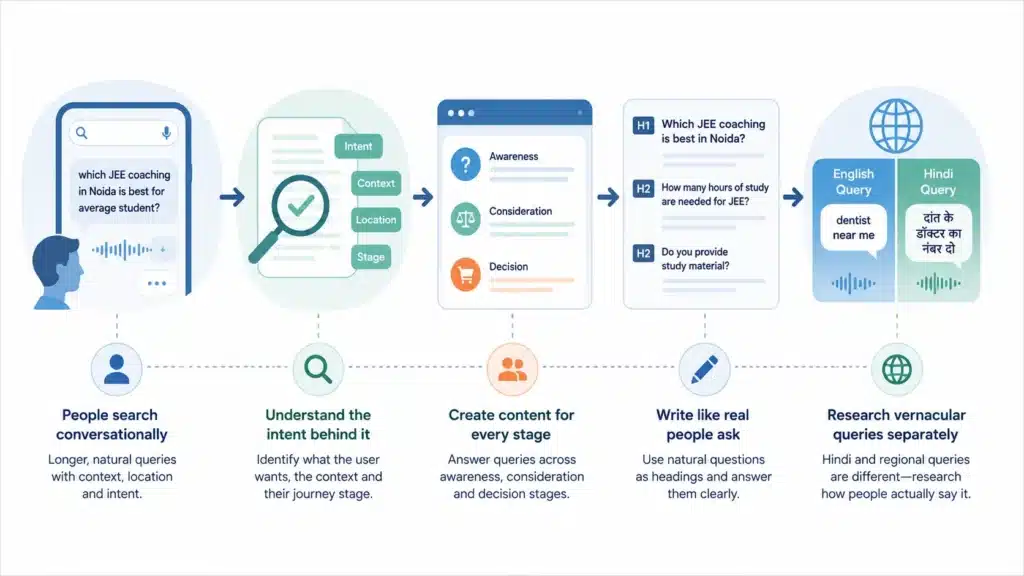
The practical content implications of India’s evolving search query patterns are significant and specific. Here is what Indian businesses must change about how they write content to capture the semantic and conversational query landscape of July 2026:
Write in the language your customers actually use. This sounds obvious — it is consistently ignored. A Noida coaching institute’s website that uses formal academic language about “pedagogical approaches to JEE preparation” is optimising for a query pattern that does not exist in reality. The actual queries are: “which JEE coaching is best for average student in Noida?” “how many hours of study needed for JEE from Noida coaching?” “do Noida JEE coaching centres provide study material?” Write for those queries.
Use natural language headings that mirror real questions. The heading “Our Approach to JEE Preparation” answers no query. The heading “How Our JEE Coaching in Sector 50 Noida Helped 47 Students Crack Advanced in 2026” answers the real query “which coaching has good JEE results in Noida?” The heading “What Makes Our Teaching Method Different from Other Noida Coaching Centres?” answers the real query “best JEE coaching method Noida.”
Address intent at every stage — not just transaction intent. Most Indian business websites only optimise for bottom-of-funnel transactional intent (“buy our service”). The buyers who become customers went through an awareness stage and a consideration stage first. Writing content for those earlier stages — genuinely helpful, non-promotional content that addresses real questions at each stage — builds the topical authority and trust that makes the eventual transactional conversion far more likely.
For Hindi and vernacular queries: research separately, not by translation. Hindi voice queries do not translate directly from English keyword research. The phrase “dentist near me” in Hindi is often “dant doctor kahan hai” or “dant ke doctor ka number do” — colloquial formulations that differ significantly from a literal Hindi translation of “dentist near me.” Conduct Hindi keyword research using Google’s Hindi autocomplete, People Also Ask in Hindi, and by asking native Hindi-speaking customers what they would actually say.
Internal Linking as Semantic Architecture: The Most Underused SEO Lever in India
No discussion of semantic SEO is complete without addressing internal linking — and no aspect of technical SEO is more consistently neglected by Indian business websites.
Internal links serve two purposes simultaneously: they help users navigate to related content, and they signal to Google’s systems the topical relationships between your pages. A robust internal linking architecture is the structural implementation of your topical authority — it is how your website communicates “here are all the pieces of my expertise on this topic, and here is how they relate to each other.”
For semantic SEO, internal links carry semantic signals through their anchor text. When your pillar page on “JEE Coaching in Noida” links to a supporting article with the anchor text “how our JEE faculty approach Physics teaching,” that anchor text signals to Google that the linked page is about a specific, relevant subtopic of JEE coaching. When 15 supporting articles all link back to the pillar page with topically relevant anchor text, the pillar page accumulates strong semantic signals that it is the comprehensive authority on that topic.
The internal linking failures most common in Indian business websites:
First, not linking at all — a blog with 50 posts where each post is an island, with no links to related posts or service pages. Every page is a missed opportunity to distribute semantic signals and direct users to converting pages.
Second, linking with generic anchor text — “click here,” “read more,” “learn more” communicate nothing to Google’s systems about the content being linked to. Replace all generic anchors with descriptive, topically relevant text.
Third, linking only from new content to old content — a full internal linking architecture requires going back to existing pages and adding links to new content where topically relevant. Many Indian businesses publish new content that receives no internal links from existing pages, effectively limiting its indexation speed and authority accumulation.
Fourth, missing the conversion link — every blog post should have at least one contextually appropriate link to a relevant service page. Not a promotional banner — a natural mention within the content that connects the topic being discussed to the service that solves the problem.
The audit that reveals your internal linking gap: use your website’s sitemap to identify all pages with fewer than 3 inbound internal links. These pages are semantically isolated — they are not benefiting from the topical authority your other pages are building. Fixing this is one of the fastest, highest-ROI improvements available to most Indian business websites.
The Velocity Dimension: Real-Time SEO for Indian Businesses in July 2026
Beyond the structural changes to keyword research and semantic optimisation, July 2026 introduces a velocity dimension to SEO that represents a genuinely new strategic capability for Indian businesses.
Read Also: Brand SEO in 2026: Why Your Brand Is Now Your Most Valuable — and Most Measurable — Ranking Asset
Google Trends’ forecasting engine now updates every 10 minutes. Breakout topics — queries with 5,000%+ search volume growth — appear in this dashboard before they appear in any other keyword research tool. Traditional tools aggregate clickstream data over 30–90 days; by the time a trend appears in Ahrefs or Semrush, the growth phase may have already peaked.
The velocity strategy: monitoring your industry’s Trending Now section daily, identifying Breakout terms during their growth phase, and publishing substantive, authoritative content during the growth phase of the trend rather than after it has plateaued.
For Indian businesses, this is particularly valuable in categories with regular trend events: budget-related queries spiking around the Union Budget, GST compliance queries spiking around filing deadlines, admission queries spiking around JEE/NEET result and counselling periods, real estate queries spiking around project launch announcements. Indian businesses that monitor and respond to these category-specific trend spikes with pre-prepared expert content can capture significant first-mover search traffic.
The velocity strategy requires a content production system that can move in 24–48 hours — not the typical 2–4 week article production cycle. This means: having editorial frameworks for your most likely trend categories pre-built, having expert sources identified and briefed on rapid response, and having a publication workflow that can go from trend identification to published content inside 24 hours.
AI writing tools have made the velocity strategy achievable for small Indian businesses that previously could not produce content at this speed. The critical quality control: AI produces the draft; a genuine subject-matter expert reviews, corrects, and adds first-hand perspective before publication. Content produced this way — fast but expert-reviewed — earns both velocity ranking advantages and E-E-A-T credibility.
Entity clarity now beats keyword stuffing. Your website, GBP, LinkedIn, and directory listings must say the same thing about your business so that Google’s AI systems can confidently classify you as the authoritative answer for your domain — without ambiguity or contradiction between platforms.
Action Plan: Rebuilding Your Keyword Strategy for July 2026
Here is the practical implementation plan for rebuilding keyword research and semantic SEO for Indian businesses:
This week: Audit your current content for intent match. Take your top 10 traffic pages. For each, ask: “What is the user who lands on this page actually trying to do, decide, or learn?” Then ask: “Does this page completely satisfy that intent?” Pages where the answer to the second question is “no” are your priority optimisation targets.
This month: Build your intent landscape map. List every question, problem, and decision your potential customers have at each stage of their journey. Group these into intent clusters. Identify which clusters have no content on your website — these are your content gaps. Identify which clusters have content that does not fully satisfy the intent — these are your optimisation targets.
This month: Fix your entity clarity. Ensure your business name, description, operating area, and services are described consistently across your website, GBP, LinkedIn, and your top 5 directory listings. Implement Organisation schema if not already done.
This quarter: Rebuild your internal linking architecture. Use your sitemap to identify pages with fewer than 3 internal links. Prioritise linking from your highest-traffic pages to your most important service pages. Replace all generic anchor text with descriptive, topically relevant anchors.
This quarter: Implement a velocity monitoring routine. Set a 15-minute weekly appointment to review Google Trends Trending Now for your category. Identify Breakout topics. Build a content brief and publish within 48 hours of identifying a relevant breakout trend.
The Bottom Line
Semantic SEO in July 2026 is not a technical complication of the keyword research process you already use. It is a fundamentally different approach to understanding what your customers are searching for, structuring your content to satisfy their complete intent, and building the entity clarity that makes Google’s AI systems confident that your business is the right answer to their query.
The businesses winning in Indian search in the second half of 2026 are those that have moved from “which keywords should I rank for?” to “what problems am I solving, and how do I become the entity that Google, Gemini, and ChatGPT most confidently associate with the solution?” That transition requires real work, real expertise, and real commitment to content that genuinely serves the user. It is also, for exactly those reasons, a competitive advantage that is durable and compounding.
DigitalArka builds semantic SEO strategies and entity-optimised content architectures for Indian businesses. Free semantic SEO audit at digitalarka.com