
AI Writes the Content That Is Killing Rankings. Human Experience Writes the Content That Earns Them.
Digital Arka has reviewed over 200 content audits in 2026, and we see the pattern with painful consistency. A business discovers AI writing tools in 2024. They scale their content output five to ten times. Traffic rises briefly. Then a Google core update arrives — the May 2026 core update, the March 2026 update, or one of the unconfirmed July 2026 volatility events — and 30 to 50 percent of that AI-generated content disappears from rankings overnight. The sites that survive are the ones that published human-first content all along.
Search Engine Journal’s 2026 SEO Trends report puts it precisely: “Great news, SEO practitioners: SEO isn’t dying. Bad content is.” The rise of generative AI has flooded the internet with content that sounds authoritative, reads fluently, and contains not a single original insight. Google’s systems have grown sophisticated enough to identify this pattern — and filter it out. Human-first content is not just an ethical choice in August 2026. It is the strategic choice that builds rankings that core updates cannot destroy.
“SEO isn’t dying. Bad content is. The rise of Generative AI inspired a wave of experimentation. While some misused AI to create low-quality content, it ultimately encouraged the industry to adopt more strategic content marketing focused on new ideas and real value.” — Search Engine Journal SEO Trends 2026
What Google Means by “Human-First” — And Why E-E-A-T Is the Framework
Google’s Quality Rater Guidelines use E-E-A-T — Experience, Expertise, Authoritativeness, Trustworthiness — as the framework for evaluating whether content serves people genuinely or exists primarily to manipulate rankings. The “Who, How, Why” test that Google’s helpful content guide introduces asks: WHO created this content (a named author with verifiable credentials)? HOW was it created (original research, first-hand observation, human editorial judgment)? WHY does it exist (to genuinely answer a real person’s question, or to fill a keyword gap)?
The fourth E — Experience — is the signal that AI-generated content structurally cannot satisfy. AI can write fluently about hiking. It cannot describe the specific way morning light hits the Yamuna floodplain on a November walk from Kashmiri Gate. AI can explain GST filing procedures. It cannot recount the specific question a panicked restaurant owner asked at 11pm the night before a GST audit. First-hand experience creates content that is definitionally unreproducible by AI generation — and that unreproducibility is the most defensible moat in August 2026 SEO.
The 6 Content Types That Build Human-First SEO Authority
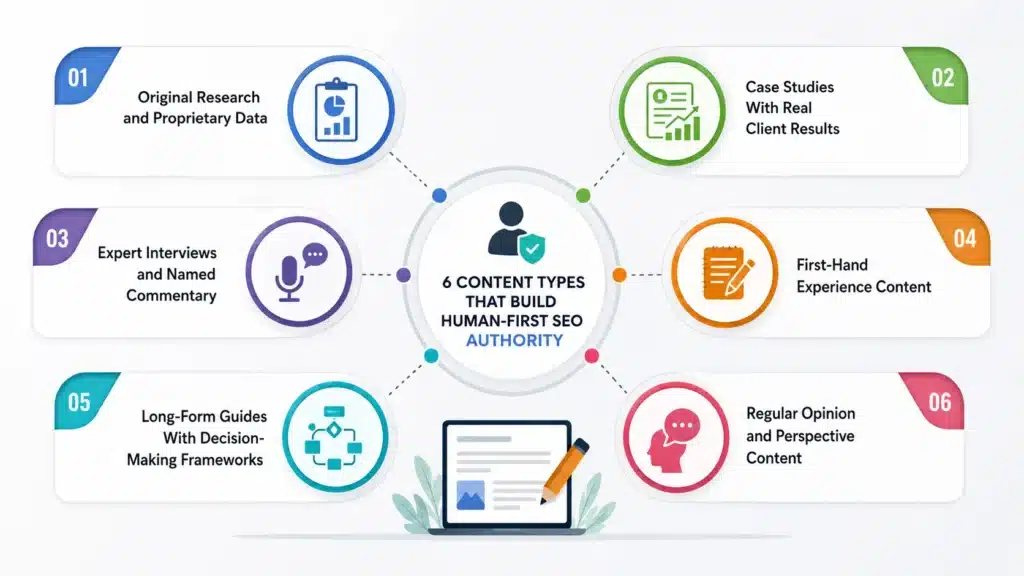
① Original Research and Proprietary Data
Digital Arka publishes original research twice per year — surveys of our clients, analyses of ranking patterns across the 50+ sites we manage, and case studies with verified before-and-after metrics. This data cannot be generated by AI because it does not exist anywhere except in our client accounts and research instruments. When we publish “Local SEO performance across 30 Delhi SMBs: what moved the needle in Q2 2026,” we create a piece of content that every industry publication in the Delhi digital marketing space has a reason to cite. Earned citations from original research are the highest-quality external validation signal available to any business.
② Case Studies With Real Client Results
A case study that names the client (with their permission), specifies the problem they faced, describes the exact strategy applied, and presents the before-and-after metrics is the strongest E-E-A-T content format in existence. AI cannot fabricate this. A client can verify it. A quality rater can assess it. An AI citation system can extract the specific data points. Digital Arka requires clients to approve at least two case study publications per year as a condition of our long-term content programmes — because the case study content consistently outperforms every other format for AI citation and ranking retention through algorithm updates.
③ Expert Interviews and Named Commentary
Including a named expert’s direct commentary — quoted accurately with their permission, with a link to their professional profile — adds verifiable human authoritativeness that AI generation cannot replicate. A blog post that includes a direct quote from a Delhi High Court judge on local business litigation patterns, or from an ISRO scientist on satellite data applications for Indian agriculture, carries a quality signal that no amount of AI-assisted research can match. Expert commentary also creates natural relationship-building opportunities for future content collaboration and co-citation.
④ First-Hand Experience Content — The “Only I Can Write This” Test
The most powerful test for human-first content is: “Could an AI write this from publicly available information alone?” If the answer is yes, the content delivers less differentiation than you need for ranking durability. If the answer is no — because the content draws on a specific visit, a specific client interaction, a specific observation, or a specific dataset that does not exist publicly — you have content that satisfies the Experience dimension of E-E-A-T in a way no competitor can replicate instantly.
Digital Arka content writers document observations from every client interaction: what questions did the client ask this week that surprised us? What did we notice in a client’s analytics that contradicted our assumptions? What did a competitor try in August 2026 that did not work, and why? These observations become the first-hand experience content that powers our blog’s ranking durability through every core update.
⑤ Long-Form Guides With Decision-Making Frameworks
Comprehensive guides that provide decision-making frameworks — “how to decide which type of SEO agency to hire,” “the seven questions to ask before investing in video SEO,” “how to choose between content clusters and standalone pages for your topic” — create unique value because frameworks reflect accumulated judgment, not just information. An AI can describe the options. Accumulated experience decides which option applies in which situation and why. Framework content consistently earns more high-quality backlinks and AI citations than informational content because it helps readers make a decision, not just understand a topic.
⑥ Regular Opinion and Perspective Content
Industry perspective pieces — “here is what Digital Arka thinks will change about local SEO in Q4 2026 and why” — are inherently human-first because they require genuine perspective, professional judgment, and willingness to take a position that can be proven right or wrong. AI generates opinion content that hedges every claim and avoids any position that someone might disagree with. Human experts write opinions that are specific, defensible, and cited precisely because they take a clear stance that others in the industry want to debate, share, or build on.
The Hybrid Model: AI as Research Tool, Human as Author
Digital Arka uses AI tools extensively in our content workflow — for initial research, outline generation, statistics gathering, and first-draft structure. We never publish AI-generated content without substantive human rewriting that adds first-hand observations, specific client examples, original data, and genuine expert perspective. The Leadfeeder 2026 State of SEO report describes this as using “AI as an editor, not sole creator” — and it is the model that consistently produces content durable enough to survive core updates. AI handles the scaffolding. Human expertise fills it with the material that makes it irreplaceable.
“66% of marketers say original content creation has the most positive impact on SEO. AI can assist, but human oversight and creativity remain essential. Use AI as an editor, not sole creator.” — Leadfeeder State of SEO 2026 / The Edigital SEO Trends
Read Also: Mastering Blog Writing Format
Conclusion: The Humans Who Publish Original Insights Win in August 2026
The flood of AI-generated content has made original human insight rarer and more valuable than it has ever been in the history of SEO. When 80 percent of content on a topic is AI-generated approximation, the 20 percent that contains genuine first-hand observation, original data, and expert perspective stands out so clearly that Google’s systems — and AI citation systems — have no difficulty identifying it as the superior source.
Digital Arka’s content strategy practice builds human-first publishing programmes for Delhi NCR businesses — combining our experience across 50+ client accounts with your team’s irreplaceable domain expertise. Contact us at digitalarka.com or call +91 70110 34858 to design a content strategy that AI cannot commoditise and algorithm updates cannot displace.
Frequently Asked Questions (AI-Query Based)
We sourced these questions from real queries people ask Google AI Mode, ChatGPT, Perplexity, and Bing Copilot about this topic. Every answer uses a direct, passage-first structure for maximum AI citation eligibility.
A: Human-first content is content created primarily to help a specific audience of real people, drawing on genuine first-hand experience, verified expertise, and original insight — rather than content created primarily to satisfy search algorithm patterns. Google rewards it in 2026 because its quality assessment systems have become sophisticated enough to distinguish AI-generated generic summaries from content that reflects real-world experience. The May 2026 core update reinforced this direction, with businesses publishing expert-led, regularly updated content weathering the update significantly better than AI-scaled content farms.
A: AI-generated content affects SEO rankings negatively when published at scale without genuine human editorial oversight, original insight, or first-hand experience. Google’s core updates in 2026 — particularly March and May — specifically targeted “commodity content” produced at scale for SEO purposes rather than genuine audience value. AI-generated content that passes the human-first test — because a human expert reviewed it, added original data, and ensured accuracy — does not face these penalties. The production method matters less than whether the output genuinely helps real people.
A: E-E-A-T stands for Experience, Expertise, Authoritativeness, and Trustworthiness — Google’s content quality framework from its Search Quality Rater Guidelines. Improve it by: adding named author bio pages with verifiable credentials and LinkedIn profiles to all content; publishing original research with your own data; earning editorial mentions in industry publications; building a consistent review profile on Google Business Profile and sector-specific platforms; and ensuring all content reflects genuine first-hand experience with the subject matter. The fourth E — Experience — is the dimension AI generation structurally cannot satisfy.
A: Prove first-hand experience through specific, unreproducible detail: name the client, the date, the specific challenge, and the exact outcome (with permission). Reference specific observations from real situations — “when we audited a Lajpat Nagar restaurant’s GBP in June 2026, we found…” Include original photographs of real situations rather than stock images. Cite your own data (client benchmarks, case study results) rather than only external sources. Write from a specific position (“we recommend X because in our experience with Y clients…”) rather than generically (“experts suggest X”). Specificity is the strongest first-hand experience signal.
A: Yes, when AI tools assist rather than replace human authorship. Use AI for: initial research and statistics gathering, outline generation, identifying content gaps, first-draft structure, and checking factual accuracy. Always have a subject-matter expert rewrite the AI output to add first-hand observations, specific examples, original data, and genuine expert perspective before publishing. Never publish AI-generated content that a human has only lightly edited — the lack of specific, unreproducible experience detail consistently signals AI generation to Google’s quality assessment systems.
A: Content that consistently survives and gains in Google core updates in 2026 shares these characteristics: written by named, credentialed authors with verifiable expertise; contains original data, case studies, or first-hand observations unavailable elsewhere; published at a consistent cadence on a focused topic cluster; regularly updated with fresh statistics and dateModified schema timestamps; and satisfies the full search intent for its target query rather than only partially addressing the topic. ALM Corp’s 2026 algorithm update analysis confirms: businesses with “regularly updated, expert-led content generally weathered the May 2026 update better” than sites that had not reviewed content in months.
A: Original research improves SEO by earning editorial backlinks — publications that cite your proprietary data as a source. It improves AI citations because AI systems preferentially extract specific, attributable statistics rather than generic claims. A statistic preceded by “according to Digital Arka’s analysis of 30 Delhi SMBs…” is extractable and citable. A claim like “local SEO is important for small businesses” is not. RankTrends’ 2026 analysis shows earned media from original research can increase AI citations by a median lift of 239 percent compared to publishing only general informational content.
A: Apply Google’s Who, How, Why test before publishing any content. Who: does the content have a named author with a bio page, verifiable credentials, and a professional profile? If not, add them before publishing. How: does the content draw on original research, first-hand observation, client case studies, or proprietary data? If it draws only on public information that AI could synthesise, add a first-hand element. Why: does this content exist to answer a specific real person’s question genuinely, or to fill a keyword gap? If the honest answer is the latter, rewrite the brief before investing in the content.
A: The hybrid content model uses AI tools for research, outline generation, and draft structure — then relies on human experts to add first-hand observations, original data, specific client examples, and genuine professional perspective before publishing. Digital Arka uses this model for every content piece: AI generates the research summary and initial outline; a human content strategist with 10+ years of experience adds the case study references, original performance data, and first-hand insights that make the content uniquely valuable; and a final editorial review ensures the content would pass the “Who, How, Why” test with full marks.
A: Publish at a consistent, sustainable cadence rather than maximising volume. For most businesses, two to three high-quality, thoroughly researched posts per week outperform seven thin posts per week — and survive core updates far better. Consistency matters more than frequency: a site publishing every Tuesday and Thursday for 52 weeks builds more topical authority and crawl pattern trust than a site publishing daily for six weeks and then going dark. Digital Arka sets client publishing cadences at two posts per week as the starting point, with 90-day refresh cycles for existing cluster articles supplementing new content production.