

 info@digitalarka.com
 +91 86534 16999
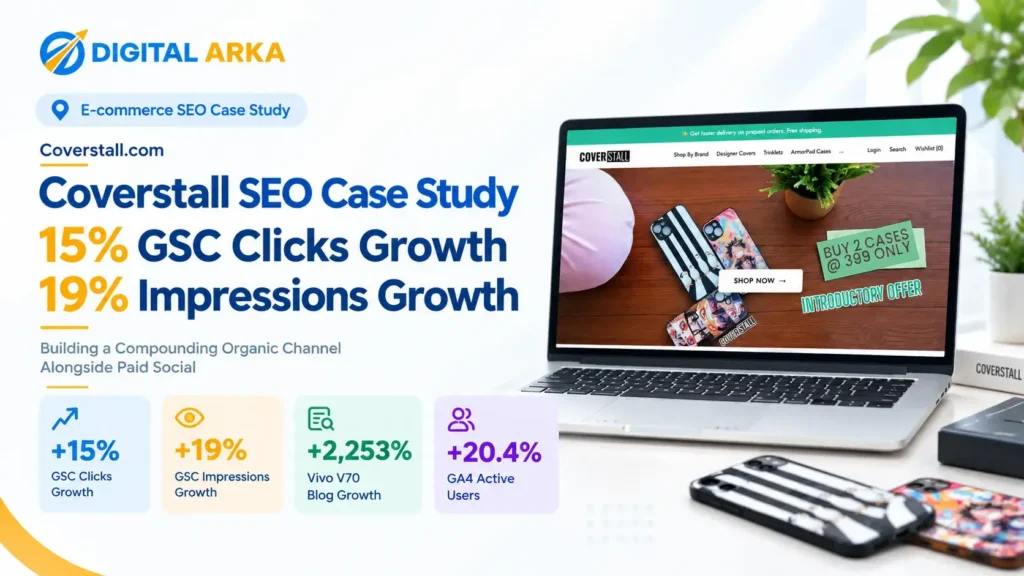

How We Built a Genuine Organic Growth Engine Alongside Coverstall’s Paid-First D2C Model
Coverstall is a D2C mobile phone case and cover brand selling designer, custom-printed, and glass phone cases across India, including licensed and pop-culture designs, customisable glass covers, and model-specific fits for the latest phone launches. Like many fast-moving D2C brands, Coverstall’s growth engine was built primarily on Facebook and Instagram paid acquisition, a genuinely effective channel, but one that scales cost with every additional sale rather than compounding for free the way organic search can. This case study covers the organic SEO work built specifically to complement that paid engine, not replace it, and what it delivered.
| +15% | +19% | +2,253% | +20.4% |
| GSC clicks growth (period over period) | GSC impressions growth (period over period) | Growth on a single breakout blog post | GA4 active users growth |
Client Snapshot
- Business: Coverstall.com, a D2C designer and custom mobile phone case and cover brand
- Product range: Custom glass phone covers, designer and licensed prints, and model-specific fits for current-generation phones
- Primary acquisition channel: Facebook and Instagram paid social, the brand’s largest and most established traffic source
- Engagement scope: Technical SEO, on-page optimisation, and blog/content strategy built to grow organic search as a genuine complementary channel
The Challenge
Coverstall’s traffic data tells an honest, common D2C story: Facebook paid delivers by far the largest volume of active users and sessions, with Instagram paid and direct traffic following behind it. Google organic search was a real but comparatively small channel, present, but with clear room to grow relative to the brand’s actual product range and content potential.
This is not a weakness unique to Coverstall, it reflects how most fast-scaling D2C brands actually grow: paid social first, because it is fast and controllable, with organic search often under-invested simply because it takes longer to compound. The risk in leaving that gap unaddressed is straightforward: every sale through paid social carries an ongoing acquisition cost, while organic search, once built, keeps delivering without a matching per-click bill.
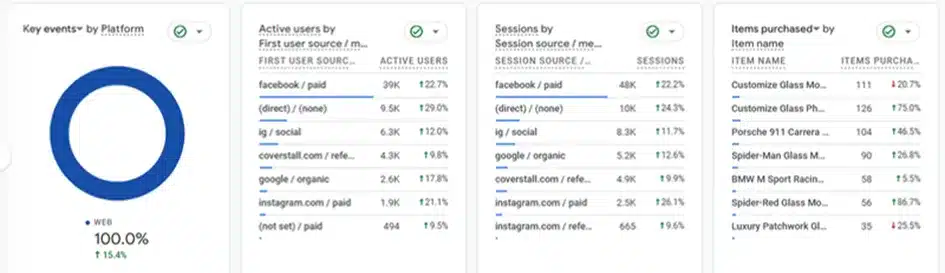
Traffic sources: Facebook paid (39K active users) is Coverstall’s dominant channel, with Google organic (2.6K, +17.8%) a smaller but genuinely growing complement.
12,000 +

- Keyword optimize rank on Google

The Goal
Build organic search into a genuine, compounding acquisition channel alongside Coverstall’s paid engine, specifically targeting the high-intent, model-specific searches (“Vivo V70 back cover,” “Oppo Reno 15 case”) that paid social does not efficiently capture, while strengthening the core collection and product pages already carrying the brand’s main organic weight.
Our Approach
Model-Specific Content Targeting
Rather than competing only on broad, expensive terms like “mobile cover online,” we built content around specific, high-intent phone model launches and comparisons, capturing search demand at the exact moment a new phone releases and buyers start searching for compatible cases.
Collection & Product Page Optimisation
The core collection pages, already Coverstall’s strongest organic assets, received continued on-page optimisation to defend and grow their existing ranking position rather than letting new content development come at their expense.
Blog Content as a Genuine Discovery Engine
Blog content was built specifically to rank independently for research-stage searches, phone feature comparisons, “best back cover” style guides, and similar content, functioning as a top-of-funnel channel feeding the core commercial pages.
The Results
Comparing the most recent 28-day period to the prior 28 days, Google Search Console clicks grew 15% (4.24K to 4.95K) and impressions grew 19% (33.3K to 40.6K), consistent, genuine period-over-period growth in an organic channel that had previously taken a back seat to paid acquisition.
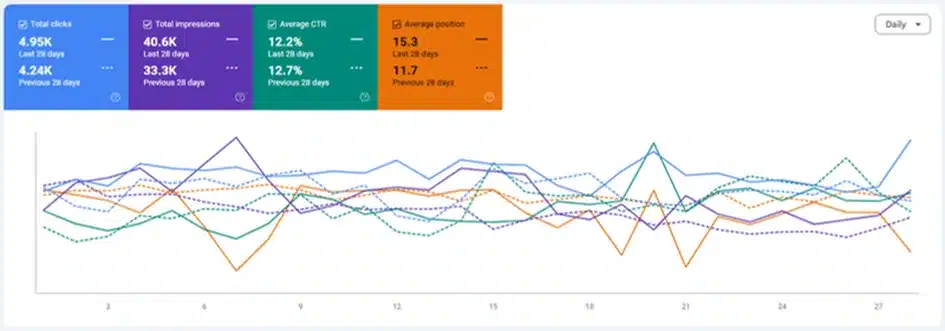
Google Search Console, period-over-period: clicks up 15% (4.24K to 4.95K) and impressions up 19% (33.3K to 40.6K).
The Standout: A Single Blog Post Growing 2,253%
The single most striking result in this engagement came from targeted, model-specific content: a blog post covering the Vivo V70 and Vivo V70 Elite’s features, specifications, and compatible back covers grew clicks by 2,253% in one reporting period, from a low base to 353 clicks, becoming the second-highest-traffic page on the entire site behind the homepage collection page itself.
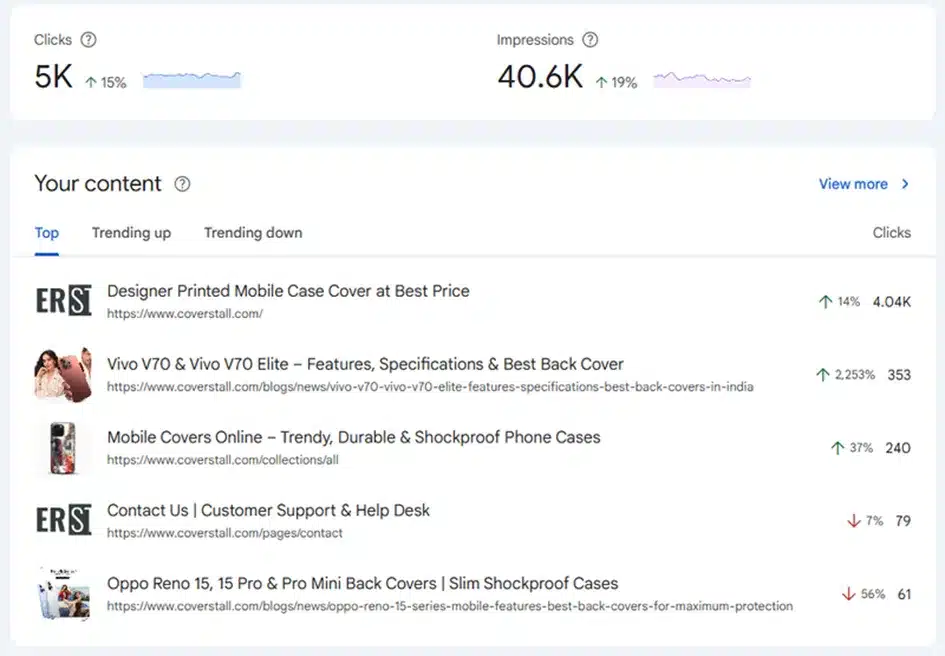
Top content by clicks: the Vivo V70 blog post up 2,253% (353 clicks), the standout performer of the engagement, alongside the core collection page (37% growth, 240 clicks).
This result is a genuinely useful proof point for the model-specific content strategy: a single, well-timed piece of content built around a real phone launch can rival or exceed the traffic of established commercial collection pages within one reporting cycle, at zero ongoing cost per click.
Broader Search Visibility Over Time
Looking at Coverstall’s total Google Search visibility across broader trailing windows, tracked snapshots taken roughly six weeks apart show total impressions nearly doubling, from 240K to 443K, as the site’s indexed footprint and search presence expanded. Click-through efficiency on this now-larger impression base is an area we are actively addressing next, since broadening reach is only the first half of converting that visibility into proportional traffic.
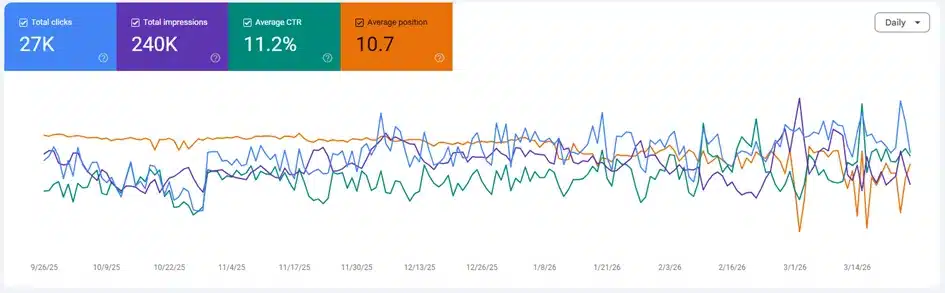
Total Search visibility snapshot, late March 2026 (trailing ~6-month window): 27K clicks, 240K impressions.
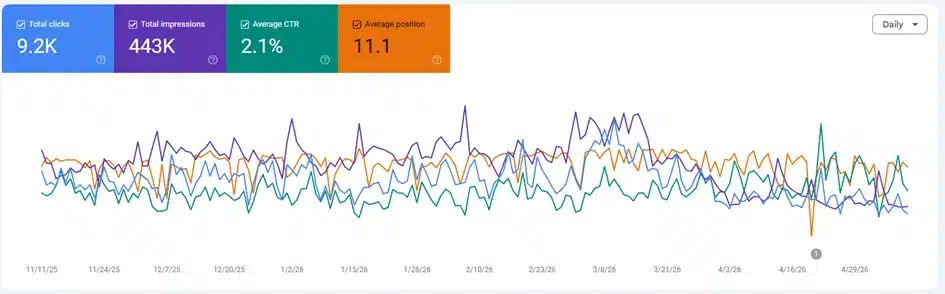
Total Search visibility snapshot, mid-May 2026 (trailing ~6-month window): impressions grew to 443K as indexed footprint expanded; improving click-through on this broader base is a current focus area.
Key Takeaways
- Organic SEO does not need to be the #1 channel to be genuinely valuable – for a paid-social-first D2C brand like Coverstall, organic growth reduces blended acquisition cost even while remaining a secondary channel by volume.
- Model-specific, launch-timed content punches far above its weight – the Vivo V70 blog’s 2,253% growth shows targeted, timely content can rival established commercial pages quickly, at zero ongoing paid cost.
- Growing visibility and growing clicks are two different jobs – expanding impressions is necessary but not sufficient; converting that broader visibility into proportional clicks is the deliberate next phase of this work.
Why This Matters Beyond Coverstall
Coverstall’s situation, a paid-social-first D2C brand with real organic upside still on the table, describes a large share of India’s fast-growing e-commerce brands. The lesson here is not that organic should replace paid social, it clearly should not for a brand where paid is working, but that treating organic as a genuine, deliberately built complementary channel, especially through launch-timed, model-specific content, captures real incremental demand paid social alone does not efficiently reach. This mirrors the approach behind DigitalArka’s Ecommerce Website Development Service.
What We Would Tell Another Paid-First D2C Brand
The clearest lesson from this engagement is that “organic is smaller than paid” and “organic is not worth investing in” are two very different statements, and D2C brands scaling quickly on paid social often conflate them. Coverstall’s Facebook and Instagram channels will likely remain larger than organic search for the foreseeable future, and that is genuinely fine. The relevant question was never whether organic could overtake paid, it was whether organic could be built into a real, compounding channel that lowers blended acquisition cost over time. The Vivo V70 result answers that question concretely: a single piece of well-timed content produced traffic rivalling an established commercial page, at no ongoing per-click cost, a result paid social structurally cannot replicate no matter how well optimised the campaign is.
The second lesson is about honesty in reporting growth. It would have been easy to present only the clean, favourable numbers, the 15% and 19% period-over-period growth, the 2,253% blog spike, and leave out the broader visibility snapshots showing click-through rate under pressure as impressions scaled. We include that pattern here deliberately, because a genuinely useful case study, and a genuinely useful monthly report, shows what still needs work alongside what is already working. That is also, not coincidentally, the same standard we hold every DigitalArka client report to.
What Our Clients Say
“We were running Meta Ads but weren’t getting enough quality leads from our campaigns. DigitalArka improved our audience targeting, ad creatives, and campaign structure, helping us generate more relevant enquiries while making better use of our ad budget.”
– Amit S., Business Owner
“Our Facebook and Instagram campaigns were getting clicks, but conversions were low. DigitalArka optimized our Meta Ads campaigns with better targeting, compelling creatives, and conversion-focused strategies. We now receive more qualified leads from our campaigns.”
– Priya R., Marketing Manager
Growth Strategy

We believe that real growth begins with a solid foundation. Our Growth Strategy is built around understanding your business goals, analyzing your market, and creating a custom SEO roadmap that drives measurable results.

Frequently asked question
Yes. Paid social remains the largest single channel by volume. This engagement was specifically about building organic search into a genuine, growing complementary channel alongside it, not replacing paid acquisition.
Comparing the most recent 28-day period to the prior 28 days, Google Search Console clicks grew 15% (4.24K to 4.95K) and impressions grew 19% (33.3K to 40.6K).
It was published to align with a real phone launch, capturing high-intent searches from buyers actively researching the new phone and looking for compatible cases at the exact moment that search demand existed, growing 2,253% in clicks in one reporting period.
This is a known pattern when a site's indexed footprint expands quickly, more pages become newly visible for a wider range of queries before all of them individually earn strong click-through rates. Improving click-through on this broader base is an active, ongoing focus.
Yes, GA4 tracks purchases alongside views and active users. The reporting period covered here showed 1.8K purchases site-wide, up 15.4%, alongside 65K active users (+20.4%) and 394K views (+11%).
Content built around a specific phone model, such as a new launch's features and compatible case options, rather than generic category terms. It works well because it captures buyers at their exact moment of purchase intent, right after a new phone releases.
Organic traffic carries no per-click cost once content is built and ranking, unlike paid social's ongoing cost-per-click. This makes organic a genuinely valuable complement for reducing blended acquisition cost over time, even while remaining a smaller channel by volume.
This case study highlights the standout result specifically; the broader content strategy includes ongoing model-specific and collection-supporting content published on a regular cadence.
The core "Mobile Covers Online" collection page and the homepage-adjacent designer case page are the strongest established organic performers, with the Vivo V70 blog emerging as a new, fast-growing addition alongside them.
Converting the recently expanded impression base into proportional clicks through improved titles, meta descriptions, and continued model-specific content targeting upcoming phone launches.