

 info@digitalarka.com
 +91 86534 16999
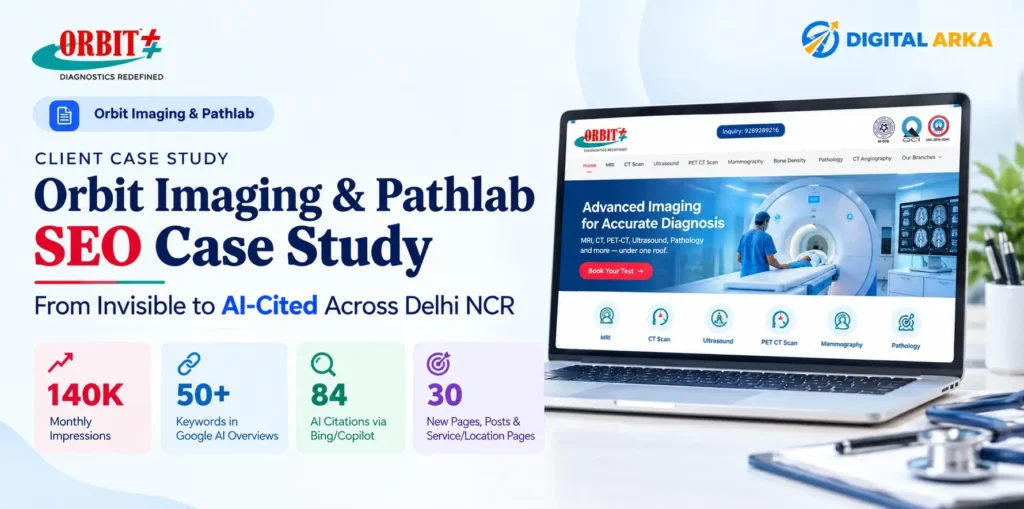

How We Took Orbit Imaging & Pathlab From Invisible to AI-Cited Across Delhi NCR
Orbit Imaging & Pathlab is a diagnostic centre network offering MRI, CT, PET-CT, ultrasound, and pathology services across multiple locations in Delhi NCR and Gurugram. When Orbit Imaging came to DigitalArka, the brand had real clinical credibility on the ground but almost no organic search presence to match it, most of its target keywords were not ranking at all, its website carried missing meta data and thin content across dozens of pages, and it had zero visibility in the AI-generated answers increasingly shaping how patients research a diagnostic centre before calling one. This case study walks through exactly what we found, what we changed, and what happened to traffic, rankings, and AI citation over the following months.
| 140K | 50+ | 84 | 30 |
| Monthly impressions (from a low base) | Keywords reaching Google AI Overviews | AI citations via Bing/Copilot in 30 days | New pages, posts & service/location pages |
Client Snapshot
- Business: Orbit Imaging & Pathlab, a multi-location diagnostic imaging and pathology centre
- Locations served: Karol Bagh, Rohini, Dwarka, Green Park, Dilshad Garden, Paschim Vihar, Meerut, and Gurugram
- Services: MRI (including 3T and Contrast MRI), CT and CECT scans, CT Coronary Angiography, PET-CT, Ultrasound/Doppler, and pathology testing
- Engagement scope: Technical SEO, local SEO across 8 Google Business Profile locations, AEO/GEO (AI search) optimisation, content creation, and off-page authority building
The Challenge
Before this engagement, an audit of orbitimaging.in surfaced the kind of technical and content gaps that quietly cap organic performance, regardless of how strong the underlying business is. Across roughly 30 audited pages, we found a consistent pattern: missing or generic meta titles and meta descriptions, pages with thin or entirely missing body content, and missing header, footer, and menu elements on several key service pages. None of this was visible to a casual visitor scanning the homepage, but it meant search engines had a genuinely incomplete, poorly signalled picture of what Orbit Imaging actually offered and where.
The keyword data told the same story from a different angle. Reviewing the starting position for Orbit Imaging’s priority local search terms, the majority showed “NA,” not ranking anywhere in a trackable position, and several of the keywords that did rank sat well outside page one: “MRI scan price in Dwarka” started at position 33, “Book MRI scan in Rohini” started at position 21, “Book MRI scan in Gurugram” was not ranking at all. The site also had no infrastructure in place for AI-driven search at all, no llms.txt file, and no explicit crawler access configured for the AI bots (ChatGPT, Claude, Perplexity, and others) increasingly responsible for how patients research a diagnostic centre before ever visiting a traditional search engine.
12,000 +

- Keyword optimize rank on Google

The Goal
Orbit Imaging needed three things working together: genuine visibility across its eight physical locations in the way patients actually search (“MRI scan price in Rohini,” “Best CT scan centre in Dwarka”), a technically sound website that search engines could fully understand and index, and, increasingly, actual presence inside the AI-generated answers now appearing above traditional search results for many diagnostic queries. Ranking alone was not the target. Ranking in a way that reliably turned into a phone call or a booking was.
Our Approach
Technical Foundation & GEO Infrastructure
We began by fixing the fundamentals the audit surfaced, correcting meta titles and descriptions, rebuilding missing content, and restoring header, footer, and menu elements across affected pages. Alongside this, we reconfigured robots.txt to explicitly allow more than 20 AI bots and crawlers, including GPTBot, ClaudeBot, PerplexityBot, and Google-Extended, and created a dedicated llms.txt file describing Orbit Imaging’s services and site structure specifically for AI systems. This is the infrastructure layer that determines whether an AI system can even find and understand a site before it can ever cite it.
Location & Service Page Build-Out
We built 25 new service and location-specific pages targeting Orbit Imaging’s highest-intent local search terms, covering each of its eight served locations across MRI, CT, PET-CT, ultrasound, and cardiac imaging services, plus 16 blog posts (5 in the initial phase, 11 more the following month) covering genuine patient questions, from “When Do You Need a CT Scan” to procedure-specific PET-CT content.
Local SEO & Citation Mapping
We mapped and optimised Google Business Profiles across all eight locations, building a citation map covering more than 170 location-specific keywords across seven core service categories, strengthening the consistent NAP (name, address, phone) signal search engines use to confirm genuine local relevance.
Off-Page Authority Building
Each reporting month included more than 30 business directory and classified listing submissions, 30-plus guest post and blog placements on platforms including Dev.to, Notion, and LiveJournal, and 30-plus forum link placements, building the external authority signal that supports both traditional ranking and AI citation credibility.
Timeline
- Phase 1 (Technical foundation) – Site audit, meta data and content fixes, robots.txt/llms.txt configuration for GEO readiness.
- Phase 2 (Content & local buildout) – 25 new service/location pages, initial blog content, 8-location citation map and GBP optimisation.
- Phase 3 (Scaling & AI visibility) – Continued monthly content (11 additional blogs), sustained off-page link building, and active monitoring of AI Overview and Bing/Copilot citation growth.
The Results
Reporting across the engagement shows consistent, compounding growth in organic visibility, not a single spike. Comparing the two most recent full reporting months available, Google Search Console impressions grew from 113K to 140K, an increase of roughly 21%, while clicks grew from 2,460 to 2,650, up 8% month over month, continuing a trend that had already shown 17% clicks growth and 46% impressions growth the month before that.
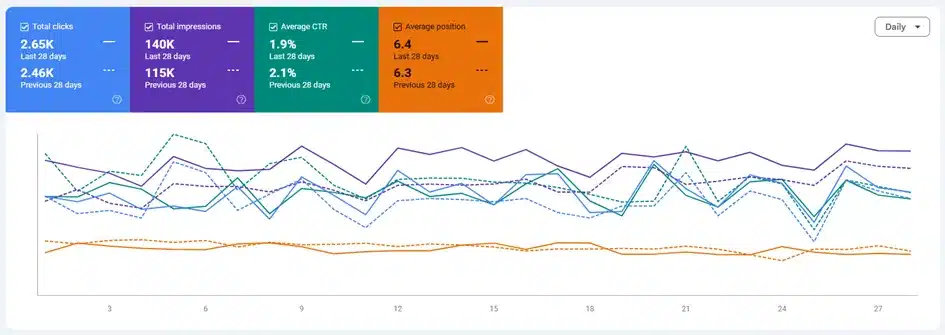
Google Search Console, 28-day view: 2.65K clicks and 140K impressions, up from 2.46K clicks and 115K impressions the prior period.
The clearest single-page story is the CT Angiography page, which grew clicks by 197% in one month, the fastest-growing page across the entire site, alongside steady growth on the Gurugram location page (+27%) and the flagship discount-rates page (+7%).
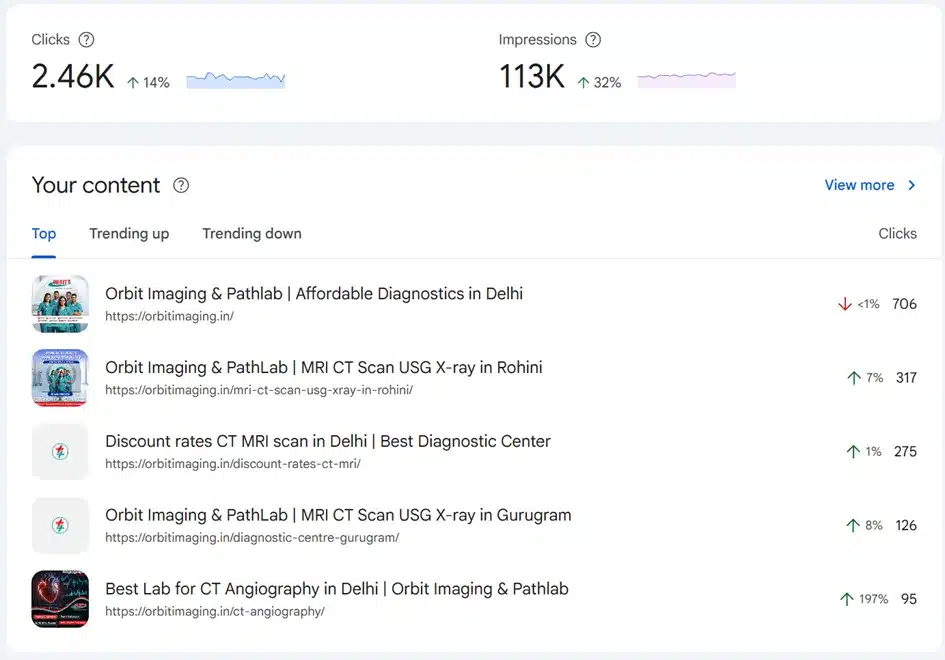
Top pages by clicks: CT Angiography shows +197% growth, the standout performer, alongside steady gains on the Rohini and Gurugram location pages.
Keyword Rankings: From Not Ranking to Page One, and Into AI Overviews
The keyword-level movement is where the technical and content work shows up most concretely. Several priority terms moved from not ranking at all to first-page, or first-position, results:
- “Book MRI scan in Rohini” – from position 21 to position 3.
- “Best CT scan centre in Dwarka” – from not ranking to position 1.
- “Best CT Scan Centre in Rohini” – from not ranking to position 2.
- “MRI scan price in Dwarka” – from position 33 to position 9.
- “Book MRI scan in Dilshad Garden” – from position 7 to position 2.
- “Doppler ultrasound in Gurugram” – from not ranking to position 1.
By the most recent reporting period, more than 50 tracked keywords were appearing inside Google’s AI Overviews, the AI-generated answer box now shown above traditional results for many health and diagnostic queries, up from 35 the month before. On Google Business Profile rankings specifically, Orbit Imaging held 10 or more keywords at position 1 across its eight locations, with Gurugram-area rankings showing consistent upward movement, “Book MRI scan in Gurugram” climbing from position 23 to 17 on Maps and from unranked to AI Overview status organically.
AI Visibility: The Newest Channel
Beyond Google, Orbit Imaging also began accumulating measurable AI citation activity through Bing and Microsoft Copilot, 84 citations in a single 30-day period, with a peak of 30 citations in one day, alongside a 3.04% Bing CTR, above the industry-typical 2 to 2.5% range. Google Analytics also began showing early but genuine referral traffic directly from ChatGPT, a channel that did not exist for this site before this engagement.
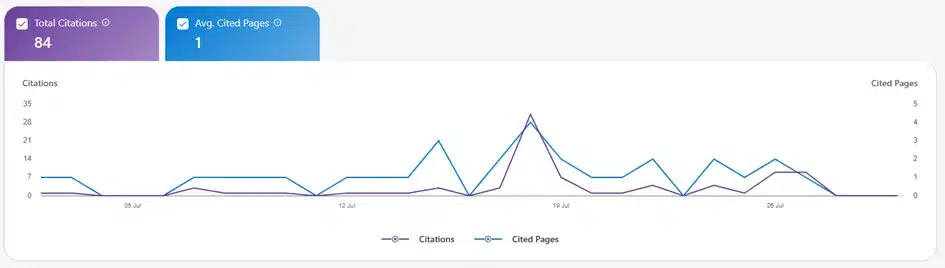
Bing/Copilot AI citations: 84 total citations in a 30-day period, a new visibility channel that did not exist for Orbit Imaging before this engagement.
Traffic Quality and Sources
Organic Google search became, and remained, Orbit Imaging’s largest single traffic source, contributing 55.6% of sessions in the most recent reporting month, ahead of paid search. Direct traffic, typically a signal of growing brand recognition, grew alongside it, and the first genuine AI-assistant referral sessions appeared during this period as a measurable, if still early, new channel.
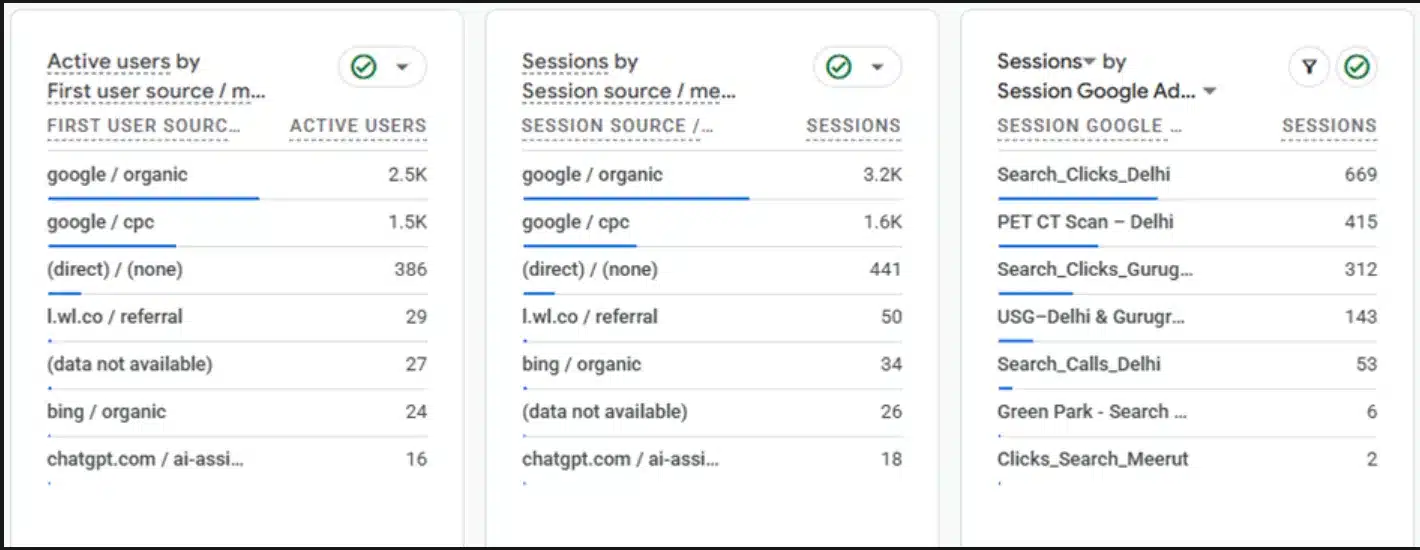
Traffic acquisition breakdown: Google organic leads at 3.2K sessions, with early ChatGPT/AI-assistant referral traffic (18 sessions) appearing as a new channel.
Key Takeaways
- Technical fixes compound – correcting missing meta data, thin content, and crawler access was not a one-time cleanup, it was the precondition that let every subsequent content and local SEO investment actually register with search engines and AI systems alike.
- Local SEO and GEO are no longer separate strategies – the same location and service page depth that improved traditional Maps rankings also fed directly into AI Overview and Bing Copilot citation growth.
- Growth was gradual and genuine, not a single spike – consistent month-over-month gains across clicks, impressions, and citation volume reflect compounding organic authority, not a short-lived tactic.
Why This Matters Beyond Orbit Imaging
Orbit Imaging’s starting point, a clinically credible business with a technically underdeveloped website and zero AI-search presence, is genuinely common across India’s healthcare and diagnostics sector. The approach that worked here, fixing technical foundations first, then building location-specific depth, then extending deliberately into AEO/GEO infrastructure, reflects exactly how DigitalArka approaches every healthcare and local business SEO engagement, documented in more detail in our SEO Services for Doctors and Local Business Listing service pages.
What Our Clients Say
“We were running Meta Ads but weren’t getting enough quality leads from our campaigns. DigitalArka improved our audience targeting, ad creatives, and campaign structure, helping us generate more relevant enquiries while making better use of our ad budget.”
– Amit S., Business Owner
“Our Facebook and Instagram campaigns were getting clicks, but conversions were low. DigitalArka optimized our Meta Ads campaigns with better targeting, compelling creatives, and conversion-focused strategies. We now receive more qualified leads from our campaigns.”
– Priya R., Marketing Manager
Growth Strategy

We believe that real growth begins with a solid foundation. Our Growth Strategy is built around understanding your business goals, analyzing your market, and creating a custom SEO roadmap that drives measurable results.

Frequently asked question
The audit found missing or generic meta titles and descriptions, thin or missing page content, and missing header, footer, or menu elements across roughly 30 audited pages, technical gaps that limit how fully search engines and AI systems can understand a site regardless of the quality of the underlying business.
Meaningful keyword movement, several terms moving from unranked to page one, was visible within the first few months of the engagement, with continued compounding growth in impressions, clicks, and AI citation volume in each subsequent reporting period.
GEO (Generative Engine Optimization) is the practice of structuring a website so AI systems like ChatGPT, Claude, and Perplexity can access, understand, and cite its content. For a diagnostic centre, this matters directly, patients increasingly ask AI tools health and provider questions before ever running a traditional search.
Eight Google Business Profile locations were mapped and optimised: Karol Bagh, Rohini, Dwarka, Green Park, Dilshad Garden, Paschim Vihar, Meerut, and Gurugram, covering more than 170 location-specific keywords across seven core service categories.
It means Google's AI-generated answer box, shown above traditional organic results for many queries, is directly citing Orbit Imaging as a source. More than 50 tracked keywords reached this status by the most recent reporting period, up from 35 the month before.
AI Overview appearances generate an impression, the page is shown as a cited source, without always producing a traditional click, since some users get their answer directly from the AI summary. This is a known, expected pattern industry-wide as AI Overviews expand, and brand exposure still occurs even without a click.
Each active month included more than 30 business directory and classified listing submissions, 30-plus guest post and blog placements, and 30-plus forum link placements, building genuine external authority signals alongside the on-site and local SEO work.
Yes, Orbit Imaging ran Google Ads campaigns concurrently, and organic and paid traffic are reported separately throughout this case study. Organic Google search became the largest single traffic source, ahead of paid, by the most recent reporting period.
Through Bing Webmaster Tools, which reports how often a site is cited as a source when users interact with Microsoft Copilot or Bing Chat. Orbit Imaging recorded 84 such citations in a single 30-day period.
Results vary by starting point, local competition, and category. Orbit Imaging's outcome reflects a genuinely underdeveloped starting technical foundation combined with consistent, sustained monthly execution, not a guaranteed outcome for every engagement.